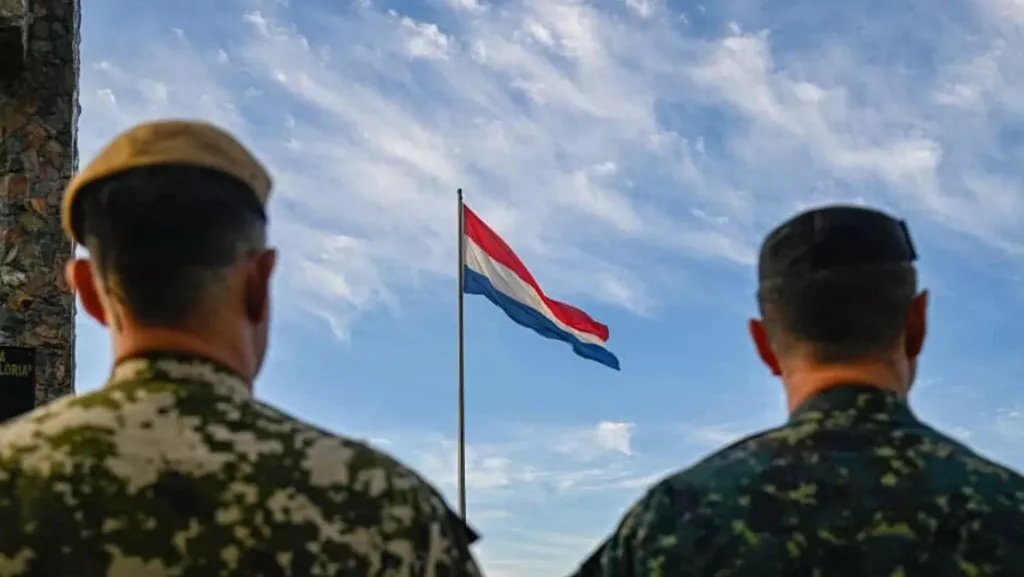
Two soldiers with the Paraguayan flag flying in the background. Photo: X/@Ejercito_Pyo.
Two soldiers with the Paraguayan flag flying in the background. Photo: X/@Ejercito_Pyo.
The Paraguayan government sent 4,000 troops and its Super Tucano aircraft to reinforce border security and “neutralize” possible interventions by organized crime. Sputnik-consulted experts highlighted possible US influence on the decision and the downside of militarizing borders without tackling corruption.
With the aim of “combating organized and transnational crime,” the Paraguayan government deployed a contingent of up to 4,000 military and police personnel to its borders. The operations also mark the first deployment of Super Tucano aircraft, acquired in mid-2025.
“The government of Paraguay is determined to combat organized crime with every available resource, and this operation is yet another demonstration of that commitment,” Paraguayan Defense Minister Óscar González Cañete said at a press conference on November 11 as he introduced one of the military deployments that, as part of the operation, would be sent to the border areas with Brazil and Bolivia.
More explicitly, the commander of the Armed Forces of Paraguay, César Moreno Landaida, said that the objective of the operations will be “to prevent, deter, and, if necessary, neutralize any type of threat, whether it comes from transnational organized crime, international terrorist organizations, or any other related offense.”
The deployment reportedly yielded swift results: hours after troops mobilized, the Air Force intercepted a Bolivian-registered light aircraft conducting an unauthorized flight over Paraguayan airspace. A Super Tucano forced the plane to land, though its occupants fled, presumably intending to load drugs on Paraguayan soil.
As part of Operation Guaraní Shield, law enforcement forces also seized one ton of marijuana on the country’s southern border, which was presumably ready to be shipped to Argentina.
An alliance with the US?
In an interview with Sputnik, Paraguayan lawyer and international analyst Héctor Sosa Gennaro attributed the massive security deployment by the Paraguayan government to the Santiago Peña administration’s desire to become a US ally in South America.
“I believe that this is part of an alliance with the US government for a frontal fight against organized crime and drug trafficking along Paraguay’s borders with Bolivia and Brazil, where there is a great deal of activity,” the analyst said.
Sosa Gennaro suggested these efforts align with “a commitment potentially imposed on the country,” mirroring “US operations across the Caribbean.”
He also cited Paraguay’s recent designation of Brazilian gangs Primeiro Comando da Capital (PCC) and Comando Vermelho as “terrorist organizations,” alongside the use of Super Tucano aircraft and a new shoot-down law, as signs of alignment with Washington.
Venezuela’s Defense Minister: US Military Used as Mercenaries, New Military Drill
“Staged performance”
Paraguayan expert on human rights and citizen security, Jorge Rolón, said in a conversation with Sputnik that the involvement of the military in internal security matters in Paraguay dates back to 2013, when then-President Horacio Cartes (2013–2018) promoted a law to authorize the Armed Forces’ participation in combating organized crime.
While at the time the objective was to combat the Paraguayan People’s Army (EPP), Rolón said that the military deployment “has only grown” since then, now with drug trafficking in its sights, even operating under a state of emergency in some departments of the country.
“The comparative experience of what has happened in other countries where the fight against drugs has been militarized shows that this has not worked and generates a great deal of violence,” Rolón opined.
In this regard, the expert considered the large-scale operations as more of a “staged performance,” since the Santiago Peña government “needs to demonstrate that it is doing its work in the fight against organized crime. This does not work anywhere, and if it were about firepower or technology, the US would not allow a single kilo of cocaine on its soil.”
The expert warned that, while criminal groups may try to avoid direct confrontations with the Armed Forces at the border, Paraguayan security forces themselves may provoke clashes when “the State wants to demonstrate some results from this deployment.”
Rolón emphasized that large drug seizures, which are often heavily promoted in the media, are “anecdotal,” since criminal groups are able to “naturally regroup” when their leaders are removed or they are weakened.
“Even if small planes are intercepted or 1,000 kilos of drugs are seized, the problem will persist because it is a huge business that moves a lot of money,” he added.
According to the expert, Paraguay will not achieve substantial results in combating organized crime until it “cleans up its home” and cuts off the flows of corruption that link the political system, security forces, and criminal groups. As an example, he said that the death of ruling-party Congressman Eulalio Gómez hinted at the relationship between politics and drug trafficking, but its ramifications were barely investigated after the legislator’s death.
“No matter how many troops we deploy, how much we patrol the river, or how many soldiers we station at the border, the problem is not there,” Rolón summarized.
(Sputnik) by Sergio Pintado
Translation: Orinoco Tribune
OT/SC/DZ