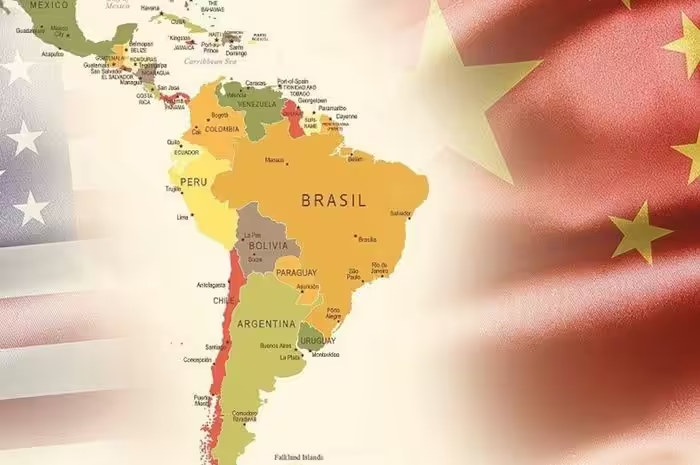
Overall, what’s happening undermines the notion that Latin America is the United States’ “backyard.” Admiral Craig Faller, the head of US Southern Command, recently told NBC News : “Chinese influence is global, and it is everywhere in this hemisphere, and moving forward in alarming ways.”
Cuba joins Belt and Road On December 25, 2021, Cuba and China signed a “cooperation plan” for the joint promotion of the Belt and Road Initiative.
Call it a Christmas present for US President Joe Biden, Senator Marco Rubio and others in Washington, DC, who don’t like either country. Or a reminder that Taiwan is not the only offshore island of strategic interest.
Cuba joined Belt & Road in 2018 through a memorandum of understanding. The cooperation plan, in the words of China’s Global Times, clarifies the “key… projects for China and Cuba … including infrastructure, technology, culture, education, tourism, energy, communications and biotechnology, which are in line with Cuba’s development plans for the short and long term.”
RELATED CONTENT: China Moves Onto USA’s Doorstep by Signing Up Cuba to Belt & Road. Will it Cause a Standoff Like the 1962 Missile Crisis?
Last October, Cuba became a member of Belt & Road’s Energy Partnership. Established in 2019 to promote cooperation in renewable energy, it now has 32 members in Asia-Pacific, Central and South Asia, the Middle East, Africa, Eastern Europe and Latin America.
But now China may give Cuba a chance for economic development without American participation.
Image: globaltimes.cn China – Latin America-Caribbean Forum On December 3, 2021, the third ministers’ meeting of the China-CELAC Forum was held in the form of a video conference.
Founded in 2011, CELAC (Comunidad de Estados Latinoamericanos y del Caribe or, in English, Community of Latin American and Caribbean States) is an association for dialogue among its 33 members and with other countries and regional groupings including the European Union, China, the Russian Federation, the Cooperation Council for the Arab States of the Gulf, Turkey, the Republic of Korea and Japan.
The ministers adopted the “China-CELAC Joint Action Plan for Cooperation in Key Areas (2022-2024)” , a long and detailed document covering:
• Political and Security Cooperation
Did they forget anything?
Hot-button issues for strategic thinkers in Washington, DC, and Western European capitals include:
• Continue holding the China-Latin America Superior Defense Forum. [The Fourth and most recent China-Latin America High-level Defense Forum was held in October 2018 at the International College of Defense Studies of the National Defense University of the Chinese People’s Liberation Army. Participants included the Bolivian defense minister, Costa Rican security minister, chief of Uruguay’s Defense General Staff and other defense and security officials from Latin America.]
• Deepen cooperation among financial institutions, providing financial cooperation mechanisms for the development of trade and investment projects.
• Strengthen exchanges between scientific and technological authorities, to increase synergies between the innovation, academic, and scientific sectors of the parties.
• Strengthen exchanges and cooperation in the peaceful civilian use of nuclear energy and nuclear technology.
• Strengthen mutually beneficial cooperation between governments, enterprises, and research institutions in digital infrastructure, telecommunications equipment, 5G, big data, cloud computing, artificial intelligence, internet of things, smart cities, internet+, universal telecommunication services, radio spectrum management and other areas of common interest, and explore the construction of joint laboratories.
• Strengthen exchanges and cooperation in the field of aerospace, in matters of peaceful exploration of space, space science, satellite data sharing, satellite applications, construction of ground infrastructure, personnel training and education.
• Work toward deeper cooperation in the fields of electricity, oil, gas, renewable energies, new energies, nuclear energy for civilian use, energy technology, electromobility and equipment, geological and energy mining resources.
• With Chinese support conduct Chinese language education, to incorporate Chinese language into member states’ national education curricula and to open Confucius Institutes and Confucius Classrooms.
Economic and strategic challenges China’s relations with Latin America and the Caribbean have evolved far beyond the point of being a mere incipient challenge to the existing order. In fact, China has already become a major investment partner for Latin America and the Caribbean, ranking with Europe and the United States.
Archive Caribbean China and the Community of Latin American and Caribbean States ForumChina-Latin AmericaCuba-China
According to the IMF Working Paper “Chinese Investment in Latin America: Sectoral Complementarity and the Impact of China’s Rebalancing”:
• “Over the last decade China’s investment in Latin America and the Caribbean (LAC) has increased substantially in volume and become more diversified.”
• “Once heavily concentrated in fossil fuels, metals, agriculture and other natural resources, Chinese investment in LAC has increasingly tilted towards manufacturing and services industries such as transport, electricity, financial services and information and communication technology.”
• “Asia – and particularly China – accounts for almost a third of LAC’s inward foreign direct investment stock, followed by Europe and the US, with shares of 30 and 20 percent, respectively.”
Brazil has received the most Chinese attention in the region, but investments and infrastructure project loans directed at Argentina, Peru, Ecuador, Venezuela, Colombia and Mexico have also been significant.