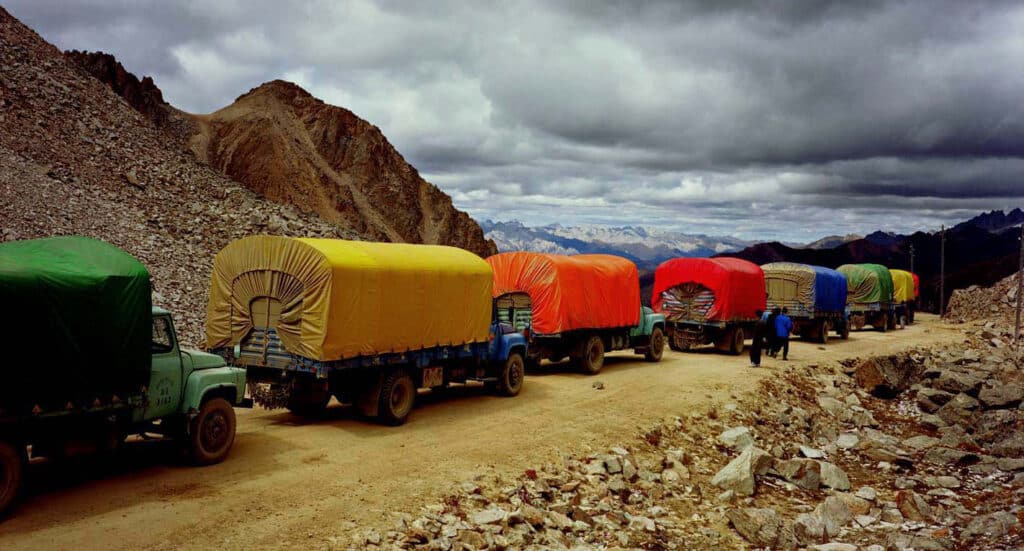
Moving Rainbow (1998-2001), artwork by Chinese artist Xiong Wenyun.
Moving Rainbow (1998-2001), artwork by Chinese artist Xiong Wenyun.
By Vijay Prashad – Mar 30, 2023
On 20 March 2023, China’s President Xi Jinping and Russia’s President Vladimir Putin spent over four hours in private conversation. According to official statements after the meeting, the two leaders talked about the increasing economic and strategic partnership between China and Russia–including building the Power of Siberia 2 pipeline–and the Chinese peace initiative for the war in Ukraine. Putin said that “many of the provisions of the peace plan put forward by China are consonant with Russian approaches and can be taken as the basis for a peaceful settlement when the West and Kiev are ready for it.”
These steps towards peace have not received a warm welcome in Washington. Ahead of Xi’s visit to Moscow, John Kirby, the spokesperson for the US National Security Council, declared that any “call for a ceasefire” in Ukraine by China and Russia would be “unacceptable.” As details of the meeting emerged, US officials reportedly expressed fear that the world might embrace China and Russia’s efforts to secure a peaceful resolution and end the war. The Atlantic powers are, in fact, redoubling their efforts to prolong the conflict.
On the day of the meeting between Xi and Putin, the United Kingdom’s minister of state at the Ministry of Defence, Baroness Annabel Goldie, told the House of Lords that “[a]longside our granting of a squadron of Challenger 2 main battle tanks to Ukraine, we will be providing ammunition including armour-piercing rounds which contain depleted uranium.” Goldie’s statement came on the twentieth anniversary of the US-UK invasion of Iraq, in which the West used depleted uranium on the Iraqi population to deleterious effect. In reference to the UK’s provision of depleted uranium to Ukrainian forces, Putin said that “it seems that the West really has decided to fight Russia to the last Ukrainian—no longer in words, but in deeds.” In response, Putin said that Russia would deploy tactical nuclear weapons to Belarus.
Within China, Xi’s visit to Russia was widely discussed with a general sense of pride that China’s government is taking leadership both to block the ambitions of the West and to seek peace in the conflict. These discussions, reflected in journals and on social media platforms such as WeChat, Douyin, Weibo, LittleRedBook, Bilibili, and Zhihu, emphasised how China, a developing country, has nonetheless been able to overcome its limitations and take on a leadership position in the world.
These discussions within China are largely unavailable to people outside the country for at least three reasons: first, they take place in Chinese and are not often translated into other languages; second, they take place on social media platforms that, in addition to being in Chinese, are not used by people from outside the Chinese-speaking community; and third, growing Sinophobia, stemming from a longstanding colonial history of thought and exacerbated by the New Cold War, has deepened a disregard for discussions in China that do not adopt the Western worldview. For these reasons, and more, there is a genuine lack of understanding about the range of opinions in China concerning the shifts in the world order and the country’s role in these shifts.
Within China, there is a rich tradition of intellectual debate that takes place in journals inspired in one way or another by Chen Duxiu’s Xīn Qīngnián, or New Youth, first published in 1915. In the first issue of that journal, Chen (1879–1942), who was a founding member of the Communist Party of China, published a letter to the youth which included a list of admonitions that seems to have set the terms for the intellectual agenda of the next hundred years:
The experience of New Youth set in motion journal after journal, each with an agenda to build more adequate theories about developments in China that seek to establish the country’s sovereignty and lift them out of the so-called “century of humiliation” (百年屈辱), a period that was characterised by Western and Japanese imperialist intervention. In 2008, several leading intellectuals in the country founded a new journal, Wenhua Zongheng (文化纵横), which has increasingly become a platform to debate what Xi called the “great rejuvenation of the Chinese nation” (中华民族伟大复兴). The bi-monthly journal features the country’s leading voices, who offer various perspectives on important issues of the day such as the state of the post-COVID-19 world and the importance of rural revitalisation.
Last year, Tricontinental: Institute for Social Research and Dongsheng began a conversation with the editors of Wenhua Zongheng which led to the production of a quarterly international edition of the journal. Through this partnership, select essays from the Chinese editions of the journal are translated into English, Portuguese, and Spanish, and an additional column is featured in the Chinese edition that brings voices from Africa, Asia, and Latin America into dialogue with China. We are proud to say that the first issue of this international edition (vol. 1, no. 1) launched this week, with the theme “On the Threshold of a New International Order.”
This issue features three essays by leading scholars in China–Yang Ping (editor of Wenhua Zongheng), Yao Zhongqiu (professor at the School of International Studies and dean of the Centre for Historical Political Studies, Renmin University of China), and Cheng Yawen (dean of the Department of Political Science at the School of International Relations and Public Affairs, Shanghai International Studies University), as well as my brief editorial. Both Professors Yao and Cheng discuss the changes in the current international order, mainly the decline of US unipolarity and the emergence of regionalism. Professor Yao’s contribution, which goes back to the Ming dynasty (1388–1644), makes the case that the changes taking place today are not necessarily the creation of a new order, but the return of a more balanced world system as China “revives” its place in the world and as the ambitions of the US find their limits in the emergence of key countries in developing countries, including China, India, and Brazil.
All three essays focus on the importance of China’s role in the developing world, both in economic terms (such as through the ten-year-old Belt and Road Initiative, or BRI) and in political terms (such as through China’s attempt to restart a peace process in Ukraine). Editor Yang Ping is firm in his view that “China’s historical destiny is to stand with the Third World,” both because–despite its major advances–China remains a developing country and because China’s insistence upon multilateralism, as Professor Cheng argues, means that it does not seek to displace the US and become a new global hegemon. Yang ends his account with three considerations: first, that China must not be led merely by commercial interests but must “prioritise what is necessary to ensure strategic survival and national development;” second, that China must intervene in debates about the new international system by introducing the BRI’s principles of “consultation, contribution, and shared benefits,” which include seeking to expand the zone of peace against the habits of war; and third, that China must encourage the creation of an institutional mechanism beyond economic cooperation–such as a “Development International”–to promote the genuine sovereignty of nations, the dignity of peoples faced with the International Monetary Fund’s debt-austerity trap, and a new internationalism.
Yang, Yao, and Chen’s perspectives are essential reading as part of an important initiative for global dialogue. We look forward to your feedback about the first international edition of Wenhua Zongheng and are currently working on the second edition, which will focus on China’s path to modernisation.
As the United States pushes for a major power conflict in the Asia-Pacific, it is essential to develop lines of communication and build bridges towards mutual understanding between China, the West, and the developing world. As I wrote in the closing words of my editorial, “[i]nstead of the global division pursued by the New Cold War, our mission is to learn from each other towards a world of collaboration rather than confrontation.”

Vijay Prashad is an Indian historian, editor, and journalist. He is a writing fellow and chief correspondent at Globetrotter, a project of the Independent Media Institute. He is the chief editor of LeftWord Books and the director of Tricontinental: Institute for Social Research. He has written more than 20 books, including The Darker Nations: A People’s History of the Third World (The New Press, 2007), The Poorer Nations: A Possible History of the Global South (Verso, 2013), The Death of the Nation and the Future of the Arab Revolution(University of California Press, 2016), and Red Star Over the Third World (LeftWord, 2017). He writes regularly for Frontline, the Hindu, Newsclick, AlterNet and BirGün.