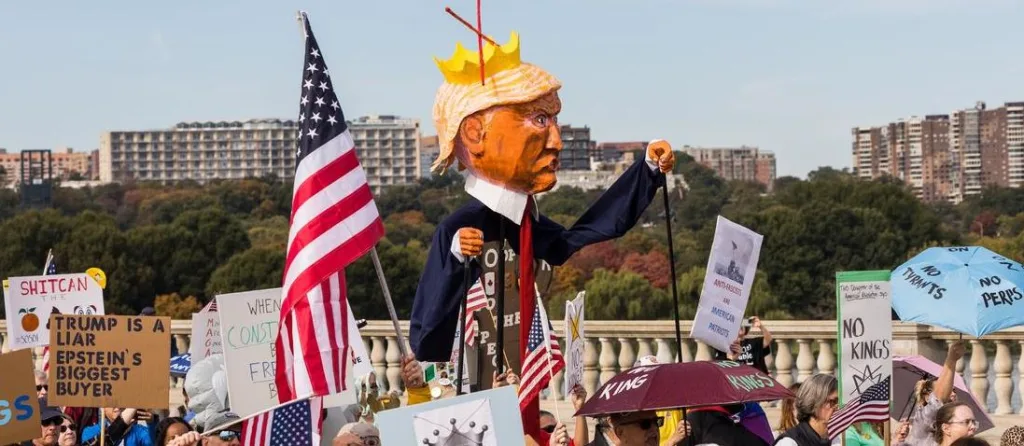
A "No Kings" protest in Washington D.C. on October 18, 2025, that was part of a larger series of nationwide protests against the US regime. The demonstration features an effigy of Donald Trump wearing a crown and a cape, carried by a protester. Photo: Tom Hudson/Zuma Press Wire/Shutterstock.
By Francisco Delgado Rodríguez – Oct 22, 2025
The well-known thinker of the Prussian era, Carl von Clausewitz, left posterity with an iconic concept about war, stating that it was nothing more than a continuation of politics by other means. In other words, fractured domestic politics hinders and seriously jeopardizes even the most elaborate war plans.
More or less, with some nuances, this is what is happening right now in Washington. And that is precisely what creates the perception that Mr. Rubio’s plans to welcome Christmas with Venezuela at his feet seem to be fading with each passing hour, or rather, minute.
Of course, it is too early to claim victory. No one in their right mind could deny the tremendous dangers that the Venezuelan nation continues to face. It is well known that when things get hot at home, US governments tend to create smokescreens with some “feat” abroad.
In that sense, the high financial costs, some $60 million per day, also put pressure on them to do something on Venezuelan soil to justify themselves; it could be at least a tactical blow, bombing something, assassinating someone, which, while not achieving the maximum of “regime change,” would clean up the image of the Pentagon and Chief Trump; they would say under their breath that they did what they could, without acknowledging the monumental fiasco.
But, unlike weeks ago, today it is easy to see that the internal situation has rapidly become more complicated, in line with the reflection of the aforementioned Carl von Clausewitz.
First, there is the extraordinary and growing rejection of “King” Trump, according to the sentiments of some 7 million protesters mobilized in 2,700 cities in all 50 states, covering virtually the entire United States. It is said to be the largest civic mobilization in the country’s history.
To top it off, prior to this convincing episode, a poll by the renowned AP/NORC polling agency, made up of the press agency of the same name and NORC at the University of Chicago, shows that Trump currently has only 37% support, compared to 61% rejection.
But let’s see what the atmosphere is like in the palace of power. In Congress, there is growing unease among legislators, both Democrats and Republicans, who openly reject an adventure against Venezuela or demand prior approval from Congress.
Some senators, rightly angry, are demanding evidence linking the crew of the sunken boats to drug trafficking, or at least the names of those killed, and insist on the tremendous violations the administration is committing, which it responds to with deafening silence.
However, the main argument for questioning the attack against the Venezuelans comes from a look at the military high command, those who do the dirty work and provide the dead.
The best proof of this is the departure of Admiral Alvin Holsey, head of the Southern Command, one year after taking office, long before completing the mandatory four years. This means that the main head of the operation in the Caribbean, with whom the matter was discussed and who was asked for “technical” criteria on how to attack Caracas, is leaving.
This event, presented as a resignation, has special connotations, even though Holsey is just another of the high-ranking officers who are retiring, or rather being retired, under the current administration. In this regard, recall the disastrous meeting with the generals on September 30, where, in his own words, Secretary of War Pete Hegseth hinted that he wants neither women nor blacks in the high command.
And why is Holsey resigning? The answer is even more conclusive. The admiral disagrees with this type of operation, which consists of killing fishermen and crew members of alleged drug boats.
To make matters worse, they riddled humble fishermen from Trinidad and Tobago with missiles, curiously citizens of a country whose government has shown its willingness to help the invaders.
Speculation is rife surrounding the admiral’s departure, which is also contributing to internal confusion. Some “experts” even claim that Holsey was not in command of the operations against the drug boats, but that they are carried out by “special operations forces” detached from the Southern Command; incredible. Be that as it may, what they cannot deny is that the expeditionary group is facing a storm in its chain of command, and not exactly a climatic one.
In this context, there is also a gap in the media. All journalists accredited to the Pentagon, in protest against arbitrary rules imposed by Hegseth, decided to leave the press room of this war secretary, an unprecedented and unexpected event. And without journalists, the reality show of war also runs the risk of falling apart.
Added to this is the confession of Chief Trump, who has ordered the CIA to implement covert operations in Venezuelan territory, no less. This type of action is certainly nothing new; it is well known that the Bolivarian revolution has always had to face it. What is implausible now is that no head of state had ever thought of making such plans public. No leader, neither in the US nor in the rest of the world.
This latest display of verbal incontinence by Trump is a colossal mistake because it puts his covert agents, now exposed, at risk. He intends to instill fear and make threats, but with something that is already known, and which the Chavistas have proven they know how to deal with successfully.
And the paralysis of the federal government continues to spread, approaching the historic record of 35 days during Trump’s first term. It is estimated that in just one week, the cost amounts to some $7 billion, with obvious socio-economic and political consequences, affecting millions of people. Meanwhile, Democrats and Republicans are trading blame in the midst of the election campaign, which ends in November 2026.
As things stand, Trump faces a perfect storm. Unforeseen disruptions in the military high command, made worse by the departure of the person in charge of leading the aggression against Venezuela, financial problems due to the government shutdown, lack of consensus in the upper echelons of politics and especially in the lower echelons, among the masses who reject the installation of a new reign 2.0, that is, against a government that practices unrestrained presidential arbitrariness, accompanied by the absolute mediocrity of its secretaries or ministers.
For its part, the international anti-Venezuelan front is suffering its own debacle. Isolating the Bolivarian revolution has been an obsession of US administrations, and with Mr. Rubio, they established the narrative that Bolivarians not only violate human rights, but are also drug traffickers and even narco-terrorists. And the central argument: they are therefore a threat to US security.
But the combination of sinking ships in extrajudicial killings in international waters and the inability to show a single piece of evidence for the accusations made has thrown Mr. Rubio’s entire narrative into crisis. Speaking into the microphones, he despises the UN and reminds us that they seek peace through force.
The absurdity ends up mobilizing those around the world who have some level of dignity and, above all, courage, to oppose the US government.
Thus, statements rejecting any military action against Venezuela are accumulating from ALBA-TCP, the Non-Aligned Movement, CELAC, and the BRIC countries, with Russia and China playing a prominent role.
The arguments and courage of leaders such as those of Brazil and Mexico also resonate, with special emphasis on the clear stance of Petro, who has already earned the verbal contempt of the US president, who has resorted to his arsenal of threats, slander, and sanctions to silence him.
At the same time, those governments in Our America that are more inclined to support the arguments of the State Department are facing their own paralyzing political crises, with uncertain outcomes.
Of particular importance is the meeting of Heads of Government of the Caribbean Community (CARICOM), where they approve the reaffirmation of the principle of maintaining the Caribbean Region as a zone of peace. Also, very subjective, is the silence of the European Union, with a well-known history of questioning the Bolivarians, all of which suggests that in this matter, it is Mr. Rubio and his government who are moving towards isolation.
The invading ships and planes, which left their bases in the hot month of August, may return, while the expeditionaries clamor for back pay and their senior officers are probably ashamed of ordering the annihilation of defenseless people.
On this last issue, we must insist again and again, tirelessly, appealing to the decency that remains in humanity.