After an attempt on his life, former President Evo Morales, who leads the polls for the upcoming presidential elections, accuses the Bolivian State and the US Drug Enforcement Agency (DEA) of orchestrating the paramilitary operation.
Due to popular intervention and surveillance footage, enough evidence has been produced to sustain such accusations.
Morales blames the business and geopolitical interest around Lithium, for what he calls a grab for power by former partner and now rival, Bolivian President Luis Arce.
A full transcript of Oscar Leon’s interview with Evo Morales follows the video below.
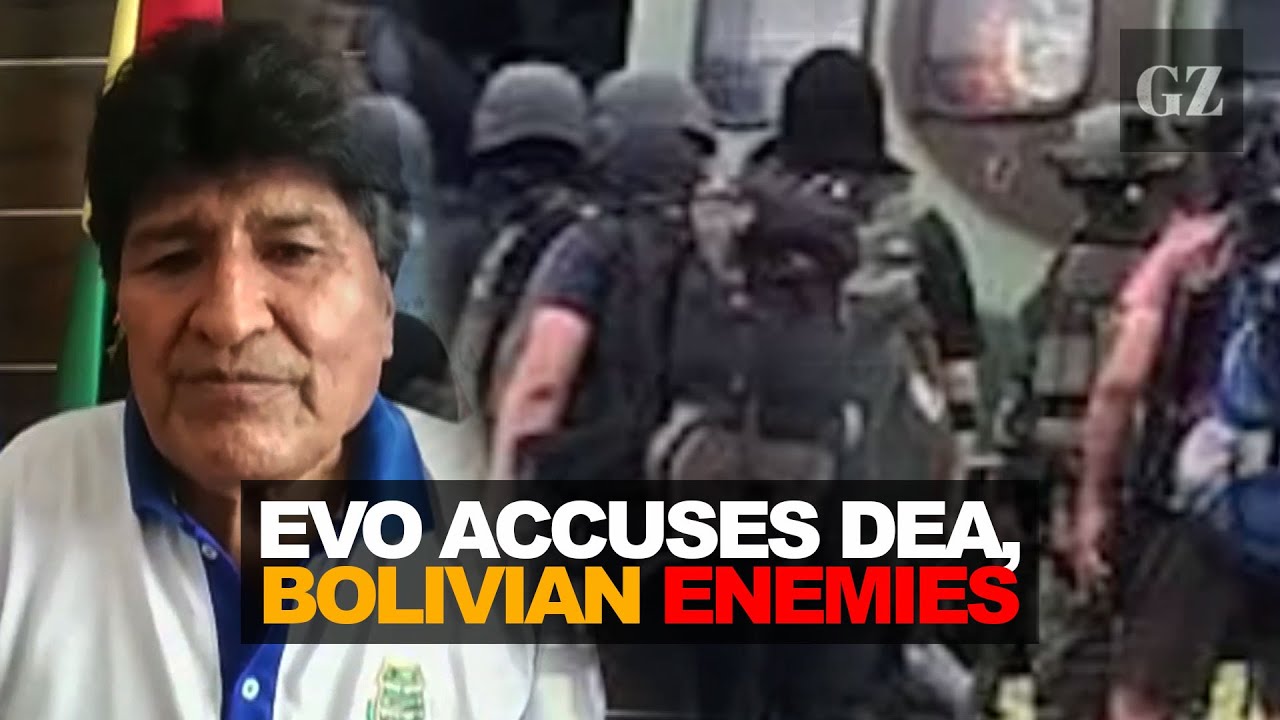
Óscar León: We were at the press conference yesterday and you said there that it was the DEA and the Armed Forces and the police who had tried to attempt on your life. Can you give us a little more indications or details?
Evo Morales: Let’s see, one. After the coup d’état in 2019, the DEA and USAID have returned to Bolivia.
Before [Arce’s election], with Minister Murillo [under Jeanine Añez, after the 2019 Coup]. And when [the U.S. agencies] returned, about a year after the coup, those United States agencies never left and stayed here. Well, [the DEA] is operating publicly inBolivia. It is no longer a secret.
I have papers at hand, which show how some members of the National Bolivian Police were arrested in Colombia, and the [Bolivian] Minister of Government said that they were going to consult with the DEA, for a report [on how to resolve the case]. That is governing with the DEA.
When a minister says he is going to consult with a foreign agency, that is clear proof of their involvement. Secondly, there is official information indicating coordination with the DEA. In the operation shown in the video, we see a helicopter, and it’s clear that paramilitaries boarded it.
That same helicopter was intended to take me away. When their plan failed, they fled due to the reaction of the peasant movement against those who opened fire.
In the video, those who carried out the attack appear to be foreigners—judging by their attire: shorts, tennis shoes, and backpacks—as they boarded the helicopter. When the Armed Forces were questioned, they refused to provide any clear information. Their response was, “I don’t know”—neither confirming nor denying involvement.
If they were certain of their innocence, they would simply say, “No, it didn’t happen.” Sooner or later, the truth will come out. Their silence is the best evidence of a tacit admission. I repeat: if there was nothing, they could have denied it outright. But instead, they refuse to release footage from surveillance cameras.
The commander stated that the videos would only be released upon orders from higher authorities. Naturally, as soldiers, they won’t act without orders. If the presidency gave the command, the situation would be different. Those surveillance tapes must come to light.
One thing, here it is, Coronel Rojas, He has been arrested. Let me show you. You can see it here. Because he will ask the DEA for a report on the Bolivian Pablo Escobar. I have several newspaper cuts like this. Look, here it says Minister Montaño. Could it be that Santa Cruz is worse than Venezuela and Cuba? He is a leftist president. How can he say that Santa Cruz is worse than Cuba and Venezuela? Page 7 of this newspaper.
So, it is clear proof that the government is with the right. Well, it is all there. There are so many newspaper clippings
Voiceover: Lithium is vital to U.S. national security due to its critical role in military and industrial applications. It powers advanced technologies like drones, weapon systems, and energy storage, supporting both defense operations and renewable energy goals. With limited domestic production, securing reliable lithium supplies is essential for maintaining technological superiority and safeguarding infrastructure from geopolitical risks.
Óscar León: At the press conference on Monday, I took the second question and asked which interests he believed were behind the coup and the current political crisis. I mentioned Elon’s Musk infamous tweet, in which he replied to a comment about the Bolivian Coup by saying:
“We’ll coup whoever we want, deal with it”.
Morales’ immediate response began with one word: “Lithium”.
I asked him to expand on that.
Evo Morales: “Yes, the coup was fundamentally about lithium, as I mentioned yesterday in the press conference.
We had a plan through the Ministry of Energy to prioritize lithium investment, with 41 plants, mostly in Potosí, Oruro, and other departments. Over half of these were dedicated to lithium production, including lithium hydroxide, lithium carbonate, and lithium batteries, along with by-products and inputs.
It was set up as a Public-Private Partnership (PPP) alliance. Imagine—this industry wouldn’t just rely on imports of inputs and by-products. Instead, we would produce things like potassium chloride for fertilizers and medicines domestically. In fact, we’re already exporting some. During my previous term, we established a small processing plant with a capacity of 350,000 tons per year, operating at only 30% capacity. The government is not taking advantage of that facility for Brazil’s market.
[Ever since my administration nationalized hydrocarbons in 2006], transnationals were excluded from the extractive processes. They could only participate in the industrial phases. Natural resources like lithium and hydrocarbons belong to the Bolivian people and are managed by the state. When we began adding value to lithium, the coup d’état occurred—driven by those wanting control over our lithium.
And you know what Elon Musk said? “We’ll carry out a coup wherever we want.” That’s his mindset, even as people resist. It’s been claimed that he financed the coup, with support from Donald Trump.
It’s unbelievable to hear President Lucho [Luis Arce] now congratulating Trump. Even if it’s for protocol, how can he align with those behind the coup? During the self-coup of 2024, there were even tweets from the U.S. chargé d’affaires defending Lucho. When has the U.S. ever supported a left-wing leader? Never. Lucho is not left-wing.
Even the coup-plotting OAS (Organization of American States), which supported the 2019 coup, defended Luis Arce in the 2024 Coup. This is a class struggle, an ideological and principled fight.
Unfortunately, Luis Arce has had a hand in this. He halted the lithium project under the pretense of focusing on direct lithium extraction. In four years, he achieved nothing and now blames me? When? How? He was part of my government. Everything is paralyzed under his administration.
The real goal is to destroy the MAS (Movement for Socialism) and disable Evo Morales, while allowing the U.S. to regain control over Bolivia’s lithium. Their actions align with the U.S. national security doctrine, which seeks to dominate our natural resources under the guise of national security.
When I nationalized hydrocarbons, which are a key energy resource, I directly challenged the U.S. national security doctrine.
These are the programmatic and ideological differences between the United States, Luis Arce, and me.”
Voiceover: In a controversial move, Bolivia’s Supreme Electoral Tribunal recognized Glover Garcias—Arce’s candidate—as the party’s leader, ignoring a popular assembly that had nominated Morales not only to lead the party, but to run for a fourth presidential term.
Morales has accused Arce of orchestrating the constitutional ruling that bars re-election for more than two terms, effectively disqualifying Morales.
Óscar León: This reminds me, we have been doing several reports in Latin America, for example in Argentina, in Ecuador, quite a lot, also in Brazil, lawfare or war, using the law. And yesterday you mentioned this and showed these documents that illustrated some instances of how Lawfare is carried out in Bolivia.
Can you tell us a little about lawfare in Bolivia?
Evo Morales: So in 2021 the government made the Black Plan. In January 2002, the communications team of the Ministry of Government gave me a copy.
The plan is to destroy Evo politically, Armando Rodriguez, Loza, the deputy, an enlightened one, a young deputy called Alberto Arizpe. Initially, I didn’t believe it, but time went by, and in 2022, in July 2022, I said “now”, and in a meeting with Lucho Arce. I said to him: “Lucho, what is this? A Black Plan to destroy Evo?” The Minister of the Presidency was there, the Vice President, there were leaders of the Peace Party of Unity, there was also the President of the Chambers and the head of the caucus who was also at that meeting, where I showed his plan “25 – 30 Lucho President”.
At a previous national meeting. We had agreed that the candidates would be defined on the year right before the elections. And in any case, Arce is within his rights to run for re-election even by himself, if he wants to.
But on a sheet of that plan, “Lucho 25 – 30” it said: Evo on the left, Camacho, and Mesa on the right and in the middle is him, Luis Arce. This is the document. I have it in my hand. It is the rightward shift, I told everyone at the meeting. He got scared, he said I will investigate and up to now he has not told me anything.
It has already begun. That fight, the war of the media. But when they started saying, on social networks: “Evo, king of cocaine”, I started defending myself.
Time is passing, there are also plans to finish off the MAS and Lucho Arce, in 2021 – 2022, He did not accept that the MAS-IPSP colors would be shown at official events. President Luis Arce was with the Socialist Party, he no longer believed in the MAS, but at the end of 2022 in a survey it became evident.
Without the MAS, how much % would [President Luis Arce] get? Barely 6%
Three Women, Three Perspectives on the Division in Bolivia’s MAS
In 2020 Arce won saying “we are from the MAS”, “we are from the MAS”. And now in the survey that I showed yesterday. How much % does Arce have? 2.2% his positive image is worse [than that of former president Yanine Añez]. A week ago [President Arce] had 4%.
So, the issue. The issue is, I repeat, ideological, with the government of Lucho Arce.
So yes, this is persecution, and the U.S. government is involved. At this moment, the indigenous movement and its worldview, rooted in history and heritage, are inherently anti-colonial—you know this well.
During colonial times, we were threatened with extermination. In the Republican era, we were the most hated. Today, [us indigenous], we represent the only true left-wing party. Our movement came to power, fundamentally transforming the Republic.
The MNR (Nationalist Revolutionary Movement) led the so-called Bolivian Revolution of 1952, overthrowing the military junta and establishing a new government. But for me, that wasn’t a revolution; it was an insurrection of the people. The UDP (Democratic and Popular Union) temporarily joined forces with the MNR in this insurrection to restore democracy. But their time in power was short-lived and unfinished.
At this political moment, being at the forefront of the indigenous movement for 14 years is a historic record. Since 1825, no president has governed for 14 years. Winning over the people is no small feat—it requires tangible results in economic, social, political, and cultural spheres.
That’s where the support and votes come from. It was as a collective movement that we achieved such enduring power.
What did the United States say during the coup? “MAS is not returning to government, and Evo Morales is not returning to Bolivia.”
Lucho Arce ran for president—I suggested his candidacy, but I did not impose it. There were four candidates: Lucho, David, Diego Pari, and Rodríguez. In exile in Argentina, we voted, and Lucho Arce won. When MAS returned to power and I, Evo Morales, returned alive to Bolivia, it was thanks to the Bolivian people’s vote.
What did the empire say to the coup plotters after the coup? That MAS had to be banned. From Argentina, I spoke with some members of the Supreme Electoral Tribunal, and they told me there were “internal and external pressures” to eliminate MAS-IPSP. Now, President Lucho Arce is doing exactly that—finishing off MAS-IPSP.
The United States doesn’t want Evo Morales to return, yet here I am. And now, Lucho wants to do more—here’s some critical information for you. It’s not just about trying to kill Evo. If they catch me, they want to extradite me to the United States. Minister César Siles and Minister of Government Eduardo Castillo are involved in this plan.
A month and a half ago, during a meeting with the Plurinational Constitutional Court, what did Lucho Arce say? “We have a common enemy—his name is Evo Morales.” Arce went on to say: “Evo Morales, detained in Bolivia? No, he’s dangerous. It’s better to send him abroad.” The magistrates informed me of this.
You should know that history repeats itself. Back in 1994-95, during Gonzalo Sánchez de Lozada’s government, I was detained. I spent about a month and a half in a cell. I was then called to the Ministry of Government, where Sánchez de Lozada and his minister were present. What did they say to me?
“Evo, eradicate coca. If you don’t, you have three paths: the cemetery, [the prison at] Chonchocoro, or the United States.” I replied, “Minister, I am in your hands. I am in your hands.” And now, history is repeating itself.
Óscar León: This reminds me of a case, for example, in Ecuador, and something I witnessed when Rafael Correa was in office. I had the opportunity to be a cameraman that day, and I remember observing what was happening. It made me feel that the presidents of that era in Latin America—those emerging as part of a new left—were challenging the empire, so to speak.
There was a movement among several presidents, who stood together with bold initiatives. They proposed creating a South-South Bank and establishing development entities within the Global South. There was an entire plan in the works, as I understand it.
If we reflect on what happened to those involved in that historic moment, it’s remarkable. Many faced coups or persecution. Cristina Kirchner, Rafael Correa, Lula, yourself—all have endured some form of targeting.
It seems to me that this is a response to the challenge they posed back then. What do you think about this so-called “new Condor Plan” that people are discussing in Latin America these days?”
Evo Morales: Mmm, that era was something else—with Lula, Chávez, Néstor Kirchner, Correa. The first blow, for me, started with Fernando Lugo, then Dilma Rousseff, and Cristina. What happened to Correa was devastating.
In 2021, I read an article predicting that Lucho Arce would become the new Lenín Moreno. I didn’t believe it at the time and even defended Lucho. But as time has passed, it seems worse than Lenín Moreno. Fascism has returned here under Lucho Arce. For me, fascism involves using violent civilian groups to intimidate, attack, and oppress humble people—all with the backing of the police. Neoliberal governments never did that.
Now, it’s no longer the military targeting public and political life—it’s judges and prosecutors. That’s where we are now. For me, this is the new Plan Condor disguised under the banner of justice. Here in Bolivia, we have what I call “legal thugs,” operating through the judicial system.
Lucho Arce and David Choquehuanca no longer rely on the Assembly. Instead, they use two self-extended magistrates. All their rulings, sentences, and resolutions are null and void because no article of the Constitution allows for extensions or self-extensions of judicial terms.
The Constitution is clear—no authority or state body can issue a resolution that benefits itself. Yet these magistrates extended their terms to remain in power.
If constitutional rules were followed, I would still qualify as president of MAS-IPSP, constitutionally, legally, and legitimately. Now, the government uses these self-extended judges to strip the Assembly of its powers, governing through court rulings and injunctions.
For me, this is the second Plan Condor. Leftists, humanists, progressives, and anti-imperialists are now at the mercy of judges and prosecutors.”
Óscar León: Another issue we have discussed extensively here is the mining conflict in Ecuador. At this particular moment, it is a very serious matter. The peasants are quite defenseless, facing enormous corporate power. Imagine—President Noboa is the very embodiment of corporate interests, and the president’s aunt is the one managing the mining companies.
I wanted to ask for your opinion on nature, Pachamama. Right now, we’re witnessing an unprecedented global shift. There’s snow in Arabia, but none at the North Pole. What do you think about the moment we’re living in, on a global scale?”
Evo Morales: Today, as the G20 meets in Brazil, it would be worthwhile for the G20 to conduct a deep evaluation—a profound reflection on life and social justice. The only way to guarantee social peace is through a degree of equality, identity, and wealth redistribution.
Programs must emerge to defend democratic life but also, and fundamentally, to care for Mother Earth. I am convinced that Mother Earth can exist without humankind—perhaps even better without us—but humanity cannot exist without Mother Earth. That’s why I proposed to the United Nations the need to debate the rights of Mother Earth.
For me, the rights of Mother Earth are more important than the rights of humanity. If we do not respect her right to regenerate, if we fail to care for her, humanity’s survival is not guaranteed—not just for men or women, but for all life.
This is a tremendous responsibility, and collectively, we have not assumed it.
Additionally, this ties to the issue of exploitation. We cannot accept an extractivist policy. If extraction must occur, it must respect Mother Earth.
We have a policy for Mother Earth that, I repeat, is fundamentally based on respecting her rights. The indigenous worldview is one of complementarity with nature, deeply rooted in history. In native communities, there is no private property—the land is communal. We rotate, care for it, and rehabilitate it.
Mechanization is acceptable, but it must align with our way of life: complementarity with Mother Earth, collectivity, and harmony with humanity.”
Óscar León: In many places where I’ve been, and perhaps across much of the world, there is growing fear and concern about the possibility of a Third World War, which is already being fought in Europe and the Middle East. Such a conflict could undoubtedly threaten all life on the planet.
Do you think that Latin American politicians are capable of uniting once again, of raising a single voice as a bloc to confront the third world war, global warming, and all these immense challenges we’re facing?
Evo Morales: Let’s see. As human beings, we need to identify and confront the projects and plans of the North American empire. We must challenge the Monroe Doctrine of 1823 and the Manifest Destiny ideology of 1845.
The Monroe Doctrine claims that America is for the Americans, meaning that Latin American countries are considered U.S. colonies. But they are losing ground. To me, the United States is no longer an economic power, though it remains a military one. NATO, however, has essentially become the U.S. Department of Defense. I don’t understand what the Europeans are doing, aligning themselves with this.
Manifest Destiny—the belief that the U.S. is blessed by God and destined to rule the world and its natural resources—is equally incomprehensible. It has fueled militarization across the globe.
More recently, the U.S. National Security Doctrine has faced serious challenges. I place a lot of confidence in BRICS and the emergence of a New World Order—a multipolar world.
This gives me hope. I sense a rebellion is underway, but it needs to accelerate. Change isn’t possible without the support of the people. Only when leaders stand alongside their people can policies for the people be guaranteed—not policies for the empire.
Unipolarity does not ensure life—not for today, not for future generations, and certainly not for Mother Earth.”
Óscar León: Thank you very much for your time, Mr. Former President. We express our solidarity regarding the attack you experienced and wish you the best of luck moving forward. Thank you.
Evo Morales: Thank you very much. To conclude, let me say that the government of Lucho Arce has stolen the people’s money. Corruption is rampant. I have the moral authority to speak about this. I came to the presidency without academic credentials, thanks to truth and honesty—you know me.
The Bolivian judges may have taken away our MAS acronym, but they will never strip us of our revolutionary principles. A revolutionary never retires or abandons the battlefield. I will not leave Bolivia. I will stand with the people, even if persecuted. They tried to kill me, and I survived.
Now, we are more united than ever, committed to recovering our democratic and cultural revolution, and saving Bolivia again, just as we did during our 14 years in government.