Under these circumstances, there are several issues that need to be addressed to counter the disinformation campaign, as well as the legitimate confusion that might exist in the minds of those not very familiar with the Venezuelan reality and the imperialist plots against Venezuela:
• Delcy Rodríguez and the Chavista leadership betrayed President Nicolás Maduro: This disinformation trend came to light just minutes after the January 3 US military attack on Venezuela. Despite the fact that this narrative comes from the empire, it was a legitimate feeling in some cases, especially for people who do not know what Chavismo really is. However, a person knowledgeable about the empire’s misinformation regime could smell the hands of US imperialism behind it. The speed at which this narrative spread, and the “sources” that spread it, immediately reveals the purpose.
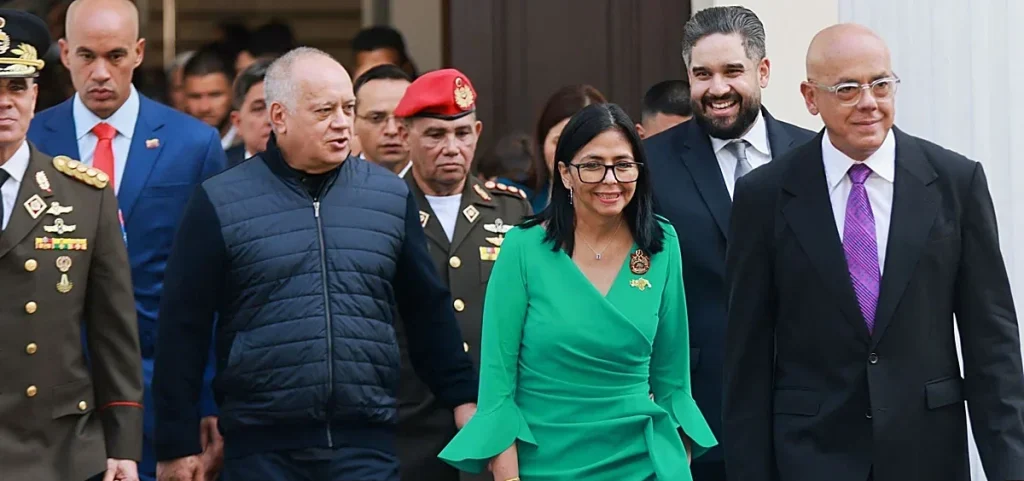
• Delcy Rodríguez’s meeting with CIA director and SOUTHCOM chief is evidence of Venezuela being a new US colony: Information missteps coming from Venezuela after the strike might have helped the White House-made misinformation campaign. CIA Director John Ratcliffe’s flash visit and meeting with Delcy Rodríguez on January 16 contributed to this, as the Venezuelan government did not report properly on the meeting. However, an analytical mind capable of understanding the complexities of an unprecedented event, such as the kidnapping of President Maduro and the bombing of Venezuela, could have hinted at the nature of the meeting and the lack of options for Chavismo to deal with US warmongering and imperialist dominance. The Venezuelan government had better messaging regarding the visit by the head of SOUTHCOM, General Francis L. Donovan; nonetheless, the smear campaign did not retreat in that instance either.
• The new reform of the Organic Law of Hydrocarbons is unconstitutional and another piece of evidence of vassalage: There is clear evidence showing that the draft of this reform was prepared before President Maduro’s kidnapping, and that it contains many of the business formulas included in the 2020 Anti-Blockade Law. Recognizing the shortcomings of this reform, one has to acknowledge that it contains some setbacks regarding the gains of the Bolivarian Revolution, but it is extremely counterproductive to call it unconstitutional.
• The Amnesty Law is a sign of capitulation: A similar trend continues with the Amnesty Law, as many news corporations portray it as a sign of weakness or the result of a US order. In reality, the liberation of jailed far-right politicians and activists began in November 2025, and this law was a demand from several Venezuelan organizations, including some close to Chavismo. Moreover, the law explicitly states that it does not grant amnesty to those who have participated in war crimes and military actions against the state.
• The visit of US Energy Secretary Chris Wright equals capitulation: By the time of US Energy Secretary Wright’s visit to Venezuela, it was evident that the US was already easing (not lifting) some of the worst illegal sanctions. It is important to highlight that this move is being done by the US while negotiating with a government controlled by Chavismo, which is evidence of the strength of Chavismo, as the US was not capable of materializing its regime change goal. However, it is evident that the US is forcing Venezuelan authorities to play its tune because Venezuela has a gun pointed at its head. It is also essential to note that Venezuela selling oil to US corporations is neither new nor anti-Chavista, given that the United States was the second largest destination for Venezuelan oil throughout the Chávez presidency and until 2019 when the US blockade itself made it impossible. Finally, even after an atrocious US bombing operation, an oil blockade, and a decade-long battery of illegal sanctions, Venezuelan authorities still daily express their resolve to keep pushing for a multipolar world and deepening the communal state and its sovereignty, in accordance with Chavista principles.
• Delcy Rodríguez’s possible visit to the US, Trump’s possible visit to Venezuela, and the resumption of diplomatic relations: This possibility has already been acknowledged by Acting President Rodríguez, as well as by US President Donald Trump. Many Chavistas see the possibility of such events as unavoidable in the attempt by the Chavista leadership to gain some oxygen through a sort of strategic retreat, in order to move forward when the time comes. However, many hope that it is Trump who visits Venezuela, as no one trusts the US. Washington has broken all international and moral rules, and could potentially kidnap the current Venezuelan leader if she sets foot in that country. On the other hand, it is extremely important for Chavistas and their supporters inside and outside Venezuela to understand that US imperialism is just waiting for the right time to complete its regime-change dreams in Venezuela, and we all need to be prepared for that in all possible ways. As for the resumption of diplomatic relations, it is a plan that has been in the making for several years already according to sources close to the Venezuelan Ministry for Foreign Affairs. It is a necessity for Venezuelans in the US, as well as in the interest of bringing back President Maduro and his wife Cilia Flores. Moreover, it was the US that destroyed its relations with Venezuela by recognizing the fake presidency of Juan Guaidó in 2019.
In connection with the previous line of thought, it is also important to highlight the facts that contradict the US-made smear campaign:
• Why, if Venezuela is a US colony, do we see Venezuelan and international far-right operators continuing with destabilization operations? They also smear Delcy Rodríguez by falsely claiming that she is dismantling the Missions and Great Missions, that she took down the portraits of Simón Bolívar and Hugo Chávez from public buildings, and that she is now the enemy of Interior Minister Diosdado Cabello and Defense Minister Vladimir Padrino.
• Why, if Venezuela is a US colony, are oil corporations complaining about the Hydrocarbons Law reform? US corporations are complaining about what they consider a heavy tax burden in Venezuela despite the concessions given in the reform, as well as the lack of precision regarding “international arbitrations,” since the new law establishes “independent arbitration” instead, as explained by the Venezuelan right-aligned lawyer Allan Brewer-Carías.
• Why, if Venezuela is a colony, are US representatives coming to Venezuela instead of Venezuelan puppet authorities going to Washington? In the imperialist power structure, the image of foreign presidents arriving at the White House to meet the imperial ruler is extremely important and a sign of power. So far, Venezuela has not submitted to the US for a visit; however, no one can guarantee that it will not happen in the future.
• Why, if Venezuela is a colony, is the country going to have a popular consultation on March 8? One of the crown jewels of Chavismo and the Bolivarian Revolution is its communal nature—the communal state. Within it, the communal popular consultations initiated in 2024 by President Maduro have represented a leap forward. Just a few weeks after taking office, Delcy Rodríguez scheduled a new communal consultation for March 8, showing the resolve of Chavismo to continue deepening this key feature. Alongside that, by analyzing Rodríguez’s public events and government activities over the last 50 days, anyone can clearly see her efforts toward strengthening the communal economy initiative. This is vital for the project’s consolidation, meaning not only giving the means of production to the communes but also encouraging them to be efficient and oriented towards the most needed capacities and demands of each commune.
Chavista Pragmatism Amid Siege and Multifactorial War
Simultaneously, there are several trends being pushed internally in Venezuela by the far-right and in some cases by self-declared Chavista influencers, analysts, and politicians. Friends of Chavismo abroad need to be aware of these trends to truly understand what is at stake in Venezuela and what the collapse of Chavismo would really mean—something that has not happened yet, despite what many claim:
• Reform of the labor law: If one listens to radio shows or TV interviews in Venezuela in recent weeks, one would immediately notice that almost everyone interviewed on economic issues raises the need to reform the Labor Law approved by President Chávez, which granted important gains to workers. We are not blind and know that many of those gains have been thwarted by the weight of the economic crisis created mostly by US sanctions. However, we also cannot believe that reverting those gains will benefit the workers, as many of us already know that anytime corporations are given a benefit, they only use it to make more profit and make the capitalist class richer.
• Dollarization: One may hear ordinary Venezuelans talking about an upcoming full dollarization of the Venezuelan economy. This is not happening in a vacuum; it is the result of a campaign launched by local media and influencers who have implanted an idea that goes against most principles defended by Chavismo and its own economic stability. Since 2019 the dollar is commonly used in Venezuela, however there is a big difference from that to become an economy with the US dollar as the official currency. It is important to note that for the last 20 quarters—meaning since early 2021—Venezuela has been recording quarterly GDP growth.
• Privatization of state industries (including PDVSA): The idea of privatization via accessing the New York Stock Exchange, replicating the alleged ARAMCO success, has been hinted at by far-right economists. Even newcomer Chavista oil experts like Alejandro Terán have claimed that this is an idea that they have been campaigning for over years and will keep campaigning harder.
• Full amnesty for everyone, including those who committed crimes against humanity: The recently approved Amnesty Law is part of a legitimate attempt by Chavismo and democratic opposition factors within the National Assembly to stimulate debates that bring back the idea of a possible reconciliation among many in Venezuela. Despite its wide scope, far-right politicians and operators inside and outside Venezuela are demanding the freedom of terrible criminals, testing the limits of the state’s resolve to keep the country at peace. The case of Juan Pablo Guanipa and the attempts to resuscitate an extremely weak far-right student movement to relaunch street protests and chaos are facts, not just possible scenarios. Chavismo will be able to handle them, but one cannot underestimate their will to sow chaos now that their US masters are back in the US embassy in Caracas.
• Early elections: This is another trend that will eventually be campaigned for by far-right operators in Venezuela when the US gives them the signal to do so. So far, it is evident that Trump needs more time to secure access to Venezuelan oil, which is so desperately needed by the US economy, especially with its own self-made upcoming West Asia crisis in the event of a military aggression against Iran.