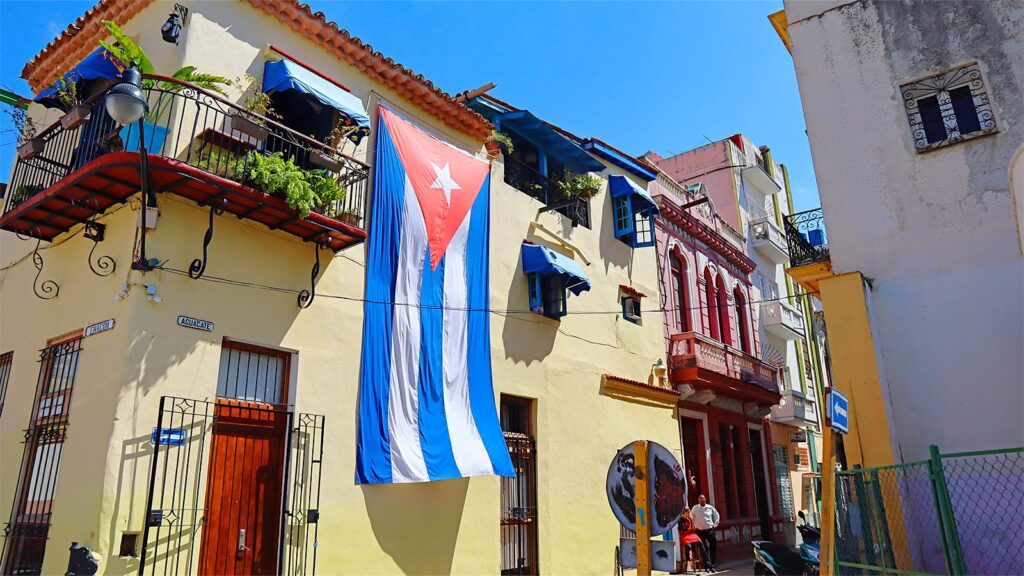
A typical street scene in Old Havana, Cuba, featuring distinctive colonial architecture and a large Cuban flag displayed on a building. Photo: Cigar Aficionado/file photo.
A typical street scene in Old Havana, Cuba, featuring distinctive colonial architecture and a large Cuban flag displayed on a building. Photo: Cigar Aficionado/file photo.
By Isaac Saney – Mar 17, 2026
Amid an intensifying economic war waged by Donald Trump and Marco Rubio—marked by an unprecedented tightening of sanctions and a de facto fuel blockade—Havana has moved to expand opportunities for foreign investment. This shift, under discussion for months, is neither abrupt nor ideologically capricious. It is both a necessary response to acute material constraints and a strategically calibrated decision within the realities of a capitalist world economy.
Confronted by relentless and maniacal US aggression, Cuba is compelled to adapt in order to endure. Trump’s own rhetoric—that he “can do anything I want with” and would have “the honour of taking Cuba”—lays bare a colonial and white supremacist worldview that continues to shape Washington’s posture toward the Global South. Reports that the United States has demanded the removal of Cuba's President Miguel Díaz-Canel further underscore the broader objective articulated in recent US strategic doctrine: to subordinate the Western Hemisphere to US dominance. In this context, Cuba’s economic adjustments must be understood not as capitulation, but as resistance under siege.
The pursuit of foreign investment is not new. In the aftermath of the Soviet bloc’s collapse and the devastating “Special Period” of the 1990s, Cuba turned to international capital as a matter of survival. At the time, Cuban officials described this opening as a “necessary and unavoidable evil,” reflecting a preference for nationally controlled development. As Fidel Castro explained in 1996, the country required capital, technology, and access to markets—without which stagnation would have been inevitable. The conditions of the time did not permit ideological rigidity; they demanded pragmatic flexibility.
Today, similar pressures are at play. Yet critics who predict that foreign investment will inevitably lead to wholesale privatization misunderstand both the intent and structure of Cuba’s reforms. The Cuban leadership has consistently and emphatically rejected privatization as a neoliberal cornerstone. It has resisted the emergence of a domestic capitalist class that could accumulate disproportionate power and undermine the social foundations of the Cuban Revolution.
Cuba’s economic concessions, therefore, are not inherently capitalist in essence, though they may contain elements that, under certain conditions, could facilitate capitalist restoration.
This distinction is not semantic—it is fundamental. Measures such as joint ventures with foreign firms or the distribution of land in usufruct represent adaptive strategies within a socialist framework, not a dismantling of it. There has been no mass privatization of public assets, no wholesale transfer of national wealth into private hands. Rather, what has emerged are hybrid or novel forms of socialist property—configurations designed to preserve national sovereignty while navigating global constraints.
Crucially, the commanding heights of the economy remain socialized, and political power remains anchored in the working population. The Cuban state continues to function not as an instrument of capital accumulation, but as a mechanism for redistributing social wealth and safeguarding collective welfare. Revenues generated through foreign investment are not siphoned off by an oligarchy but reinvested into the social system. While tensions and disagreements exist—as they do in any society—they unfold within a non-antagonistic framework in which citizens retain meaningful avenues to shape policy.
Cuba Opens Its Economy to Emigrants Amid US-Promoted Energy Crisis
This enduring commitment to social solidarity distinguishes Cuba sharply from capitalist states, where economic policy is typically subordinated to corporate profit. Despite the social strains produced by prolonged crisis, Cuba continues to embody an ethic grounded not in accumulation, but in human connection and mutual care—what might be called an ethic of being rather than having.
The resilience of this model ultimately rests on a decisive historical achievement: the conquest of state power by the Cuban working class. As Fidel Castro emphasized during the crises of the 1990s, reforms would proceed without relinquishing the foundational principle of a government “of the workers, by the workers, and for the workers”—in stark contrast to systems governed by bourgeois, transnational, or imperial interests.
When Cubans themselves are asked whether their project of national independence and socialist development can endure, their answers are sober and unsentimental. There are no guarantees, they acknowledge—only struggle. What is certain, however, is their determination to defend the gains of the Revolution against sustained external assault. For over six decades, Washington has pursued the same objective: the overthrow of the revolutionary government, the dismantling of socialism, and the restoration of US dominance.
Against this, Cuba continues to erect what Vladimir Lenin once described as the most durable barriers to counterrevolution: a deep, far-reaching transformation of society. The more profound the revolution the more difficult its reversal.
Perhaps the essence of this project is best captured not in policy documents, but in a simple declaration once displayed on a Havana billboard: “Each day in the world, 200 million children sleep in the streets. Not one is Cuban.” In that stark contrast lies both the achievement and the aspiration of the Cuban Revolution—an enduring commitment to human dignity in the face of extraordinary adversity.