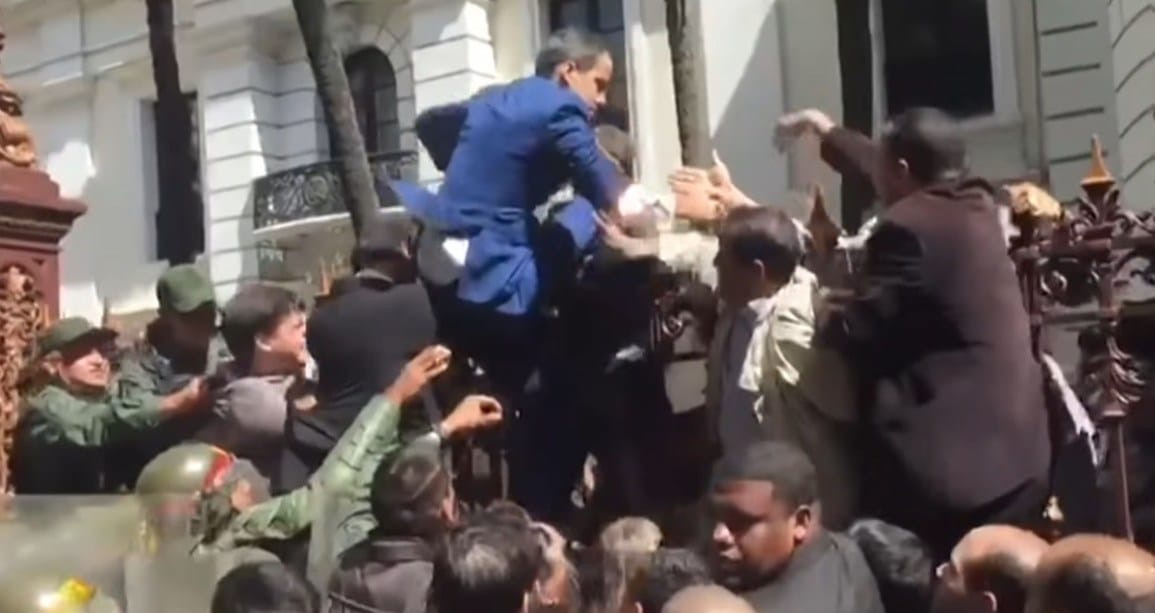
The farcical scene of Juan Guaido attempting to break into Venezuela’s National Assembly as its members voted him out was just the latest chapter in an absurdly bungled coup attempt, and brings Trump’s policy to a dead end.
By Leonardo Flores
Fistfights and screaming matches broke out at Venezuela’s National Assembly on January 5, when the legislative body was scheduled to elect its leader. But the melee was not what the corporate US media has portrayed it as.
The fights weren’t between the Chavistas who support the Bolivarian Revolution and President Nicolás Maduro on one side and opposition members on the other, but rather between competing members of the opposition itself.
https://twitter.com/Garou_Hidalgo/status/1213894570074869766
The opposition imploded because Juan Guaidó, the former president of the National Assembly and self-declared “interim president” of the country, lost his campaign to be reelected as head of the legislature.
The Venezuelan opposition is in a state of disaster — as it has been since former President Hugo Chávez’s first election in 1998. It’s a loose and ever-changing coalition of around a dozen political parties, with differing ideologies, strategies, and constituencies.
The far right, which is comprised mainly of the Voluntad Popular and Primero Justicia parties, is filled with people who have been receiving financial and logistical support from the United States for the past 20 years.
In the 2002 coup against then President Chávez, the far right briefly took over, and excluded the more moderate opposition from positions of power. The moderates learned the wrong lesson: instead of challenging the US-backed right, it caved to them, acceding to their plans of regime change and undemocratic maneuvers.
But an important split occurred between the moderates and the extremists during the presidential elections in May 2018. The moderates ignored the far right’s calls for a boycott and won 3 million votes in the presidential elections, out of a voting electorate of around 15 million people (with approximately 20 million eligible voters).
In September 2019, these moderate opposition figures sat down with the Maduro administration and came to a wide-ranging agreement that included a bipartisan rejection of US sanctions and the appointment of new members of the National Electoral Council.
Between them, the moderates and Chavistas now represent more than 9 million votes, accounting for a full 60 percent of likely voters and 45 percent of eligible voters. This dialogue between two important sectors of Venezuela electoral politics helps explain why September, October, and November were easily the most stable three months for Venezuela in the past year. The dialogue led directly to the events of January 5 in Caracas.
US equivalent: Nancy Pelosi finds out Democrats are replacing her as House Speaker, so she stages a scene outside of Congress to make it look like Trump blocked her from entering. Then she runs down to the Washington Post offices for her swearing-in ceremony. https://t.co/RS7isLyehE
— Anya Parampil (@anyaparampil) January 6, 2020
A badly divided opposition gives Guaido the boot
Juan Guaidó, of the far-right Voluntad Popular party, has served as head of the National Assembly since January 2019. It is this position that he and the United States used to justify proclaiming him supposed “president” of the country. But on January 5, he was facing a tough reelection bid.
As both sides traded unsubstantiated claims of influence peddling, it became clear early in the day that the moderate opposition would join forces with Chavismo to replace Guaidó.
With 150 of 165 members present, the National Assembly elected Luis Parra as its new president. Parra, of the right-wing opposition party Primero Justicia, was elected with 81 votes. Franklin Duarte of the conservative Christian party COPEI (one of Venezuela’s two main political parties prior to the revolution) was elected vice president of the assembly.
José Gregorio Goyo Noriega, of Guaidó’s own Voluntad Popular party, was elected as the National Assembly’s second vice president. And Negal Morales of the neoliberal Acción Democrática (the other pre-revolution major party) was elected secretary of the legislative body.
All four of these parties are firmly in the opposition, belying claims that President Maduro somehow took over the legislature.
At least 30 moderate opposition members joined Chavistas in electing two people from far-right parties to the highest posts in the National Assembly. Venezuela is a complicated country, with its own logic that defies sense, much like its economy. This maneuver by Chavismo and the moderates is the next step toward breaking a political deadlock that has paralyzed the country since 2016.
Primero Justicia best exemplifies the rifts within the opposition, as it is probably the most divided political party in the country. It contains Parra, who has participated in dialogue with the government. In a press conference after being sworn in, he said “we [the opposition] are no longer hooked on confrontation, our first and great challenge is to end confrontation… we’re going to start a path of depolarization of the country and the legislature.”
This party also contains the notoriously intransigent Julio Borges, who referred to Venezuelan migration as a plague (feeding into the region’s rampant, and in some instances, state-sponsored, anti-Venezuelan xenophobia). Borges has also called for a US military option to remove Maduro.
Primero Justicia’s divisions reflect those that have split the opposition as a whole: a wing that wants coexistence versus another that demands total conquest.
The final episode of a surreal reality show?
As it became clear that he was about to lose his reelection, the increasingly farcical Guaidó put on the latest episode of his parallel reality show. He convinced some of the world’s most shameless journalists that he was physically barred from entering the National Assembly by security forces. The video evidence shows otherwise.
El vídeo que Guaidó no quiere que veas.
La mediática mundial dice que la GNB no dejó entrar a Guaidó a la Asamblea Nacional.
FALSO.
La verdad es que NO QUISO INGRESAR y utilizó a Gilberto Sojo (diputado inhabilitado) para armar el predecible show que lo disfrazara de víctima. pic.twitter.com/JK8ZU30vRj
— ✽ Orlenys Ortiz 🍁🍃 (@OrlenysOV) January 5, 2020
Guaidó refused to enter the premises if he wasn’t permitted to bring in 11 former members of the National Assembly. These 11 range from members who were ruled ineligible to serve in the legislature by Venezuela’s Supreme Court due to an alleged vote-buying scheme in their elections, to members who had their parliamentary immunity stripped for having participated in the April 30, 2019 attempted uprising – the one in which the Guaidó faction courageously took over an exit ramp.
The focus on the 11 former legislators who weren’t allowed to enter ignores the nearly 100 opposition legislators who did enter and were present for the vote.
After losing, the Guaidó spectacle continued. He decided to create a parallel congress to go with his parallel presidency — presumably with the upcoming blessing of the parallel Supreme Court. (Keep in mind this “court” operates out of Miami, and is experiencing the same internal meltdown as the rest of the opposition.)
The media battle – the disinformation campaign and its counter-campaign – is now in full swing. According to Parra, there was a quorum and there was a vote, making his ascendance to the head of the National Assembly totally legitimate. The Guaidó faction, however, claims neither happened.
Hours after Parra’s swearing in, Guaidó’s parallel parliament was sworn in at the offices of a pro-opposition newspaper. He claims to have been reelected in the congress with 100 votes.
The confusion surrounding who is and isn’t a member of the National Assembly, as well as technical issues regarding alternate legislators, will suffice to convince most Democrats in Congress, and some of those running for the presidential nomination, to not question Guaidó and the Trump administration’s Venezuela policy.
The levels of bipartisan support for this policy in the US would be absurd if they weren’t so deadly.
Guaido’s scandals erupt as Venezuela slowly recovers
Despite the pain caused by the US policy of hybrid war, Venezuela has, against all odds, started to recover economically.
Oil production is up; oil income is up; a tariff on goods from the United States was lifted (flooding the country with products like Nutella that used to be rare treasures just six months ago); and Venezuela’s digital currency, the Petro, was successfully introduced to the public.
What’s more, the social safety net has been strengthened through the government’s CLAP food distribution program, which now reaches 7 million families every month.
The Great Housing Mission is another success story, as it marked the construction of the 3 millionth home for poor and working-class Venezuelans. Using an estimate of four people per household, which is low for many Venezuelans, that means that at least 12 million people out of a population of 30 million live in quality, low-to-no-cost housing.
Simple math shows that nearly twice as many Venezuelans live in government-built homes than those who vote for Chavismo. This is a huge sector of the population that has directly benefited from government programs, that doesn’t exclusively blame President Maduro for its difficulties, and that is turned off by extremist positions.
Without these votes, the opposition cannot win elections unless they are rigged. These are the voters the moderate opposition is counting on, and it’s not inconceivable that the moderates will become a majority within the opposition when the 2020 legislative elections are held.
Guaidó’s star has faded, and although no one knew it at the time, it was already burning out by February 23, 2019, when he tried to forcibly deliver humanitarian aid from Colombia through the Venezuelan border.
In the past months, the public has also learned how Guaidó entered Colombia with the help of Los Rastrojos, a nefarious paramilitary drug cartel.
Evidencian que Los Rastrojos dieron apoyo logístico a Guaidó
Un video evidencia el apoyo logístico que el grupo narcoparamilitar colombiano Los Rastrojos ofreció al autoproclamado presidente de Venezuela, Juan Guaidó, durante un trayecto de su país a Colombia. pic.twitter.com/cyJf648tYU
— RT en Español (@ActualidadRT) September 23, 2019
During the February 23 coup attempt, Guaidó’s supporters burned their own aid trucks (a fact The New York Times admitted weeks after the fact, long after The Grayzone’s Max Blumenthal exposed it).
Further reporting revealed that the humanitarian aid funding provided to the US-backed opposition was embezzled by Guaidó’s “appointees” in Colombia.
The scandal over the humanitarian aid theft blew up in Venezuela in late 2019, further splintering the opposition. It was the perfect excuse to get rid of Juan Guaidó after an array of miserable failures and his clear commitment to undemocratic methods.
There was the failed uprising of April 30, several plots aimed at destabilization that the government’s security services foiled, and 2019’s last act of desperation: an attack on military bases in southern Venezuela, which was coordinated with far-right Brazilian President Jair Bolsonaro, according to the major newspaper O Globo.
Guaidó started 2019 by establishing a parallel yet powerless presidency. He started 2020 by creating a parallel congress. It’s unlikely this body will be able to do anything other than alienate its own base.
Yet, predictably, the US State Department has been using the same language as Guaidó, and offered his parallel parliament immediate recognition.
When the cocaine is so good you think you’re President: pic.twitter.com/fZi8gJieuZ
— Anya Parampil (@anyaparampil) January 6, 2020
Trump’s Venezuela policy hits a dead end
Trump and the White House have yet to weigh in as of January 6 — apparently too busy escalating the conflict with Iran. Although Vice President Pence did congratulate Guaidó on “his re-election as interim president.” But this wasn’t at all what happened, even in the parallel congress.
It is unclear if the State Department and the president are even on the same page in regards to Venezuela. Trump’s frustration with the policy is building after being assured that removing Maduro would be an easy win. That could help explain why Erik Prince, of Blackwater fame and known associate of Trump, held backchannel discussions in Venezuela with Vice President Delcy Rodríguez.
Prince — who earlier in 2019 pitched a plan to raise a mercenary army to overthrow Maduro — was in Venezuela, according to Bloomberg, to negotiate the release of a group of Venezuelan-Americans who were in jail pending a corruption trial. A more plausible explanation credits Argentina’s new President Alberto Fernández for their partial release.
The Prince meeting likely took place with Trump’s knowledge, and may have been related to holders of Venezuelan bonds and international finance. These bondholders, who prior to the Trump administration’s sanctions were routinely paid on time by the Maduro government, are angry that they can’t collect — and that their best chance to collect, through profits from Venezuela’s state-owned refinery Citgo, might be liquidated by the Guaidó faction.
The State Department downplayed Prince’s visit and reacted poorly, with unnamed officials accusing Prince of violating US sanctions.
This points to strong differences of opinions regarding US policy toward Venezuela and conflicts between various interest groups, one of which appears to want negotiations between the two governments. The prospect of negotiations improved with the firing of John Bolton in September, as well as by the seeming disconnect between the White House and State Department.
But all of this is complicated by the fact that Trump is polling well in Florida, and any change in Venezuela policy would be certain to upset the hardline right-wing Venezuelan and Cuban regime-change lobbies that hold sway in the state.
But with Trump ramping up his maximum-pressure policy on Iran and bringing the region closer to war than at any time since 2003, he has spiked global oil prices, and thereby risked a political price at home.
This leaves the possibility that the White House might pivot to dialogue in Venezuela and relieve sanctions to spur its oil production and soften the shock that will be caused by an escalation of the US-Iran conflict.
The best case scenario for Venezuela involves a lifting of the sanctions. But another outcome seems more probable: business as usual until after the US presidential election, at which point the Juan Guaidó parallel reality show may finally draw to a close.

Leonardo Flores
Leonardo Flores is a Latin American policy expert and campaigner with Code Pink.