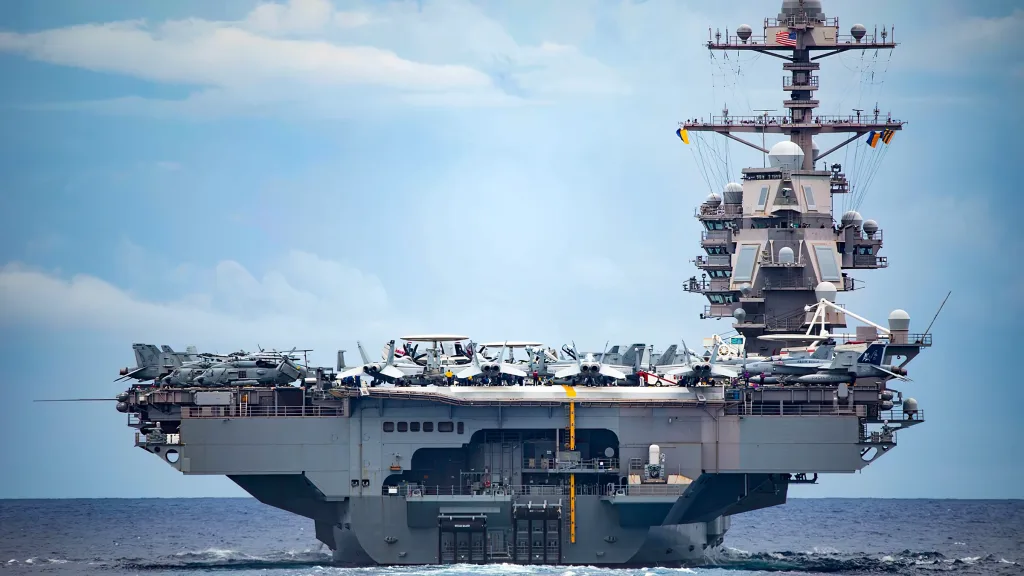
A view of the aircraft carrier USS Gerald R. Ford from aboard the Ticonderoga-class guided-missile cruiser USS Normandy as it participates in a Tactical Force Exercise as part of the Gerald R. Ford Carrier Strike Group, Oct. 13, 2022. Photo: MCS 2nd Class Malachi Lakey/US Navy/File photo.
Caracas (OrinocoTribune.com)—On Thursday, US President Donald Trump said that the US military “now is coming in by land” in Venezuela. At a White House press conference, Trump referred to the small boats that have been struck under the pretext of combating drug trafficking, calling drug cartels “the ISIS of the Western Hemisphere.”
“We’re not happy with Venezuela,” Trump said. “We can go to the Senate and Congress and talk to them about it. But I can’t imagine they’d have any problem with it… I don’t think we’re gonna necessarily ask for a declaration of war. I think we’re just gonna kill people that are bringing drugs into our country. Okay? We’re gonna kill them. They’re going to be, like, dead.”
The US president not only made aggressive statements toward Venezuela but also targeted Mexico, Colombia, and China, accusing them of fentanyl and drug production.
The Wall Street Journal reported Thursday that two B-1 Lancers took off from Dyess Air Force Base in Texas and flew in blackout mode near Venezuela to increase provocation levels against Nicolás Maduro’s government. Trump denied the report, claiming, “it’s false.”
Aircraft carrier Gerald R. Ford
On Friday, the US regime announced the deployment to the Caribbean of the USS Gerald R. Ford, the largest and most expensive aircraft carrier in its fleet, with capacity for over 75 aircraft and thousands of personnel. This comes amid a growing US confrontation with several Latin American governments. Citizens of Venezuela, Colombia, Trinidad and Tobago, and Ecuador have already been confirmed as targets of the US strikes in the region.
“The enhanced US force presence in the USSOUTHCOM AOR [US Southern Command area of responsibility] will bolster US capacity to detect, monitor, and disrupt illicit actors and activities,” Pentagon spokesman Sean Parnell wrote on social media.
The offensive also coincides with a verbal escalation by Trump against his Colombian counterpart, Gustavo Petro. Trump called Petro a “thug” and a “drug leader,” threatening the Colombian and its president if criticism of US extrajudicial killings does not cease. Last week, Trump disclosed that he has authorized covert lethal CIA operations in Venezuela and, on Friday, added President Petro to the infamous OFAC Clinton list.
In recent days, US media have announced the presence of nearly 10,000 troops in the area, along with 10 warships and a nuclear submarine. With the arrival of this aircraft carrier, the threat of US military deployment will escalate to unprecedented levels.
Another extrajudicial killing
On Friday, the US regime reported on the killing of another six people in the Caribbean, off the coast of Venezuela, as part of its reloaded war on drugs campaign. The confession was made in the morning by US Secretary of War Pete Hegseth, who highlighted in a social media post that it was the “first strike at night” they had carried out.
According to his version, the victims were alleged members of the Tren de Aragua, a criminal gang almost disbanded in Venezuela and designated a “terrorist organization” earlier this year by the US regime.
Hegseth added that the lethal operation was ordered by the US president. As is customary for US imperialism, he offered no details about the exact time or location of the assassination, saying only that it was in “international waters.”
“Six male narco-terrorists were aboard the vessel during the strike, which was conducted in international waters—and was the first strike at night. All six terrorists were killed and no US forces were harmed in this strike,” Hegseth wrote.
He concluded the text with the threat: “If you are a narco-terrorist smuggling drugs in our hemisphere, we will treat you like we treat Al-Qaeda. Day or NIGHT, we will map your networks, track your people, hunt you down, and kill you.”
So far, according to its own statements, the US has carried out 10 attacks against small boats in the Caribbean, killing 43 people in these operations. These actions have been condemned by various governments and international bodies, which describe them as extrajudicial executions.
Meanwhile, the northeast coast of Trinidad, the largest island of Trinidad and Tobago and the closest to Venezuela, has been the scene of a disturbing discovery: the appearance of charred bodies.
The first body was found on Thursday in the town of Cumana, with burns to the face and severed limbs, suggesting it may have been the victim of a strike. This finding was revealed by a New York Times report, which also documented a second body on a nearby beach with similar injuries, including the loss of a leg.
Trinidadian authorities, represented by Police Commissioner Allister Guevarro, have confirmed the discovery and are conducting investigations to determine the bodies’ origin. However, to date, none have been identified or claimed by relatives. At the forensic center in Port of Spain, no autopsies have been performed because, according to established protocols, prior identification is required.
Internal US political tension
On Tuesday, Republican Senator Rand Paul said that fentanyl is not produced in Venezuela, refuting accusations made by Trump about the alleged manufacturing of the drug in the country.
The Kentucky lawmaker also questioned whether the small boats attacked on White House orders in the Caribbean Sea were carrying narcotics bound for the United States. “These are boats that, to reach Miami, would have to stop to refuel 20 times,” he said, emphasizing the logistical improbability of Trump’s allegations.
Some analysts have questioned how it was possible for a Republican congressman to speak so clearly about the US military operation, while the majority of Democratic counterparts show concern mostly about the technicalities of needing a declaration of war to invade Venezuela and produce the long-awaited regime change.