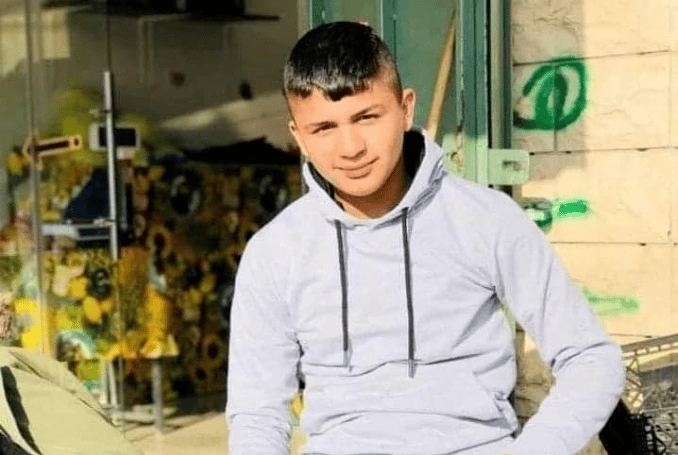
Yousef Suboh, 15, was killed in Jenin and his body was kidnapped by Israel since then. Photo: via Social Media
Yousef Suboh, 15, was killed in Jenin and his body was kidnapped by Israel since then. Photo: via Social Media
By Fayha Shalash — Dec 27, 2022
Raja’ sat quietly in her living room, staring at her son’s picture on the wall. She loved the way he smiled, and said she sees him in every corner of the house. But now, she only has painful memories, knowing his body is detained by Israeli occupation forces in an Israeli morgue.
Martyrs’ families in the West Bank say Israeli policy to hold their children’s bodies is a form of collective punishment.
Some of the bodies have been held since 2016. More than 118 Palestinian martyrs are still in the Israeli morgues, while 253 are buried in unknown cemeteries called ‘the cemeteries of numbers’, in very inhumane conditions.
According to human rights organizations, the bodies are buried in shallow ground, which exposes them to wild animals. Moreover, they are only tagged by numbers in these secret cemeteries, which can result in mixing up the graves.
It was around dawn, on September 23, 2021, when Yousef Suboh insisted on leaving the house as Israeli soldiers were storming the city of Jenin, in the occupied West Bank. His mother begged him not to go, but he kissed her forehead and left for good.
“I felt he was not coming back that night, something in my mother’s heart told me. I looked at him leaving and prayed to God to protect him”, Raja’ said.
Yousef was 15 years old. He was the second born and the only boy among three sisters. Raja’ said that, despite his young age, he was beyond his years. He was responsible and acted like a grown-up, helping his mother in every way.
“He was my angel, I still can’t believe that he’s gone! That night, I heard several gunshots, and every time, I cried. My husband asked me why I was crying. I told him that I felt one of the gunshots had hit our son. He thought I was over worrying, but I knew that something was happening to Yousef,” she said.
After a few hours, a friend of the family told them that Yousef had been shot by Israeli soldiers and that he had been arrested. They did not know anything about his medical condition.
The tension of those hours only ended with the worst news any parent could get: a phone call shattered their hopes and confirmed Yousef’s death.
“Not only did they kill a 15-year-old boy; they also took his body. He’s been in the morgue since then,” Raja’ said.
Yousef’s family prepared a grave, which is still empty. Their wound is far from healing, and their son’s body is not buried the way it should.
Every single day, Yousef’s mother holds his picture and cries. She talks to the picture, asking his son why he left that night.
“Since that day, I hate to open the fridge. Every time I do, I remember my son. I feel he’s cold, I feel his pain.”
Although over a year has passed since Yousef was killed, Israeli forces do not allow his family to see him, which adds insult to injury, according to the mother.
“I wonder if they let me see him… if I can bring a blanket with me, so I can cover him and protect him from the cold,” she said in tears.
For months, Raja’ has tried to communicate her pain, but how can a mother explain how she feels after losing a child and not being able to see him and bury him?
How can a mother explain that her only wish now is covering her son’s corpse in a blanket?
During their struggle to retrieve their children’s bodies, martyrs’ families organize weekly protests in various Palestinian cities in an attempt to make their voices heard.
They carry their children’s pictures and hold signs, reaffirming their right to pay their last respects and tell them goodbye.
Palestinian mothers and other members of the martyrs’ families take part in these protests “to keep this case alive”, as they say.
Amjad Abu Sultan’s mother held a picture of her son, despite his body being released after several months of detention in Israeli morgues. Her son was killed on October 14 in Beit Jala, near Bethlehem. He was only 14 years old.
Even after she had the chance to bury him, she insisted on taking part in each protest, because she knows what it was like to be in that situation.
When they saw Amjad’s picture, all the mothers started to cry. His face was covered in ice, which made it hard for his family to recognize him, and his eyes were still open.
The Israeli bullets had left their marks on his body, and it was painful to see that a little boy was killed by this number of bullets.
There are no specific rules on when or why Israeli authorities release a martyr’s body from the refrigerators.
“The biggest fear for the martyrs’ families is that there were reports about stealing their organs from Israeli forces after detaining the bodies,” said Mohammad Elayyan, a lawyer who represented Palestinian families before the Israeli Supreme Court.
Elayyan explained that organ theft is a real fear, as several families noticed that some of the bodies were autopsied without authorization.
Israel’s refusal to provide answers reinforces these doubts and puts the families’ feelings in a circle of anxiety.
“By holding these bodies for years now, Israel violates international and humanitarian laws as it insists on humiliating the Palestinian people,” Suheir Albarghouthi, the mother of a detained martyr, said.
“Our feelings are not a toy. We ask the Palestinian Authority and the Foreign Ministry to do something to get our sons back, especially now that Palestinians hope to obtain some justice from the International Criminal Court or the United Nations,” she added.