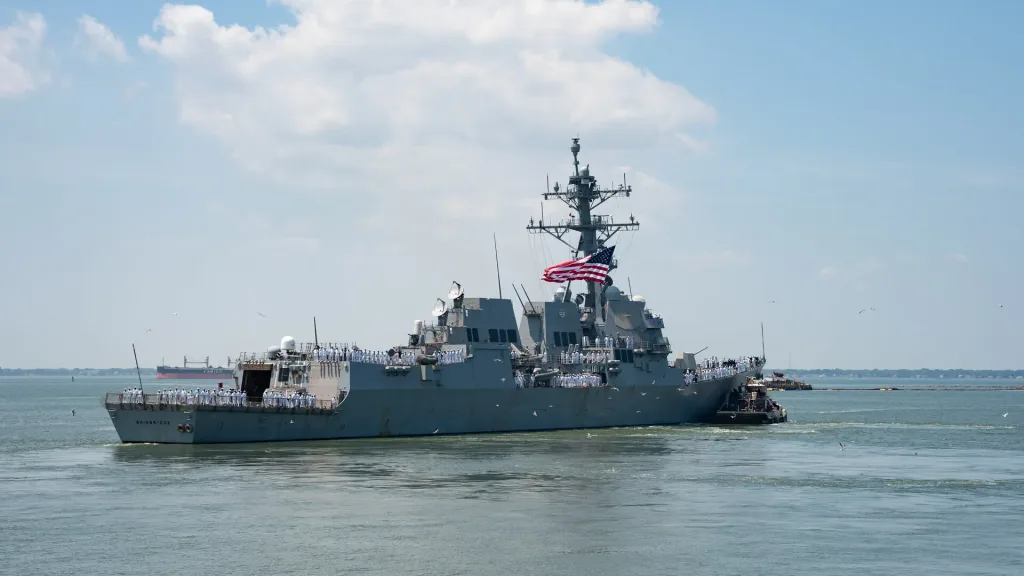
US imperial navy Arleigh Burke-class guided-missile destroyer USS Bainbridge departs Naval Station Norfolk for a regularly scheduled deployment as part of the Gerald R. Ford Carrier Strike Group, June 24, 2025, Norfork, Virginia. Photo: Mc1 Anderson Branch/US Navy/Zuma Press.
According to reports from international news agencies, Washington has not ruled out the possibility of troops from the US empire entering Venezuelan territory. These agencies have also reported that three Aegis guided-missile destroyers—USS Gravely, USS Jason Dunham, and USS Sampson—will arrive off the Venezuelan coast within the next 36 hours.
This Tuesday, August 19, a reporter asked White House spokeswoman Karoline Leavitt if the Trump administration was considering sending troops there, following the reports of the destroyers being deployed near the South American nation. “With respect to Venezuela, President Trump has been very clear and consistent,” the official responded. “He is willing to use all the resources at his disposal to stop the flow of drugs into our country and bring those responsible to justice.”
An official from the State Department of the US entity, speaking on condition of anonymity, said that the operation will mobilize some 4,000 sailors and marines, P-8 spy planes, additional vessels, and at least one attack submarine. These forces, he said, will not only conduct “intelligence and surveillance” but could also serve as launching pads for “targeted attacks.”
The move comes in parallel with Washington’s decision to double the reward for Nicolás Maduro’s “capture,” now set at $50 million. The high reward was initially set by the US empire’s Department of Justice during Donald Trump’s first administration in March 2020, following accusations of “narcoterrorism” against the executive branch and other high-ranking Venezuelan officials. Former President Joe Biden later raised other rewards: $25 million for Interior Minister Diosdado Cabello, and $15 million for Defense Minister Vladimir Padrino López.
Despite the official narrative, neither the Department of Justice nor the State Department of the US colony have presented evidence to date supporting criminal activities by President Maduro or high ranked Venezuelan officials. Nor is there any judicial evidence linking the so-called Cártel de los Soles—included on July 25 in the US empire’s list of Specially Designated Global Terrorist organizations—to specific drug seizures or a clear trafficking structure.
The rhetoric used in Washington and the scale of the deployment point to an intensification of regime change pressure, now including military threats against the head of the Venezuelan government.
Meanwhile, in Caracas, President Maduro announced the mobilization of 4.5 million militia members across the country, tasking them with “defending our seas, skies, and lands” against what he described as “the unusual and strange threat of a declining empire.” The plan includes the activation of indigenous, agricultural, and worker militias.
Donald Trump has painted the “fight against cartels” as the new façade of his foreign policy on the continent, a long-standing Washington strategy now exaggerated to justify potential military interventions. In recent months, the Trump administration has designated criminal organizations such as the Sinaloa Cartel and the Tren de Aragua as “Specially Designated Global Terrorist.” The designation provides a legal framework to legitimize the expansion of the use of military forces in the region, and opens the door to both unilateral actions and a dangerous militarization of the US empire’s foreign policy in Latin America.
(Diario Red) by Crismar Lujano with Orinoco Tribune content