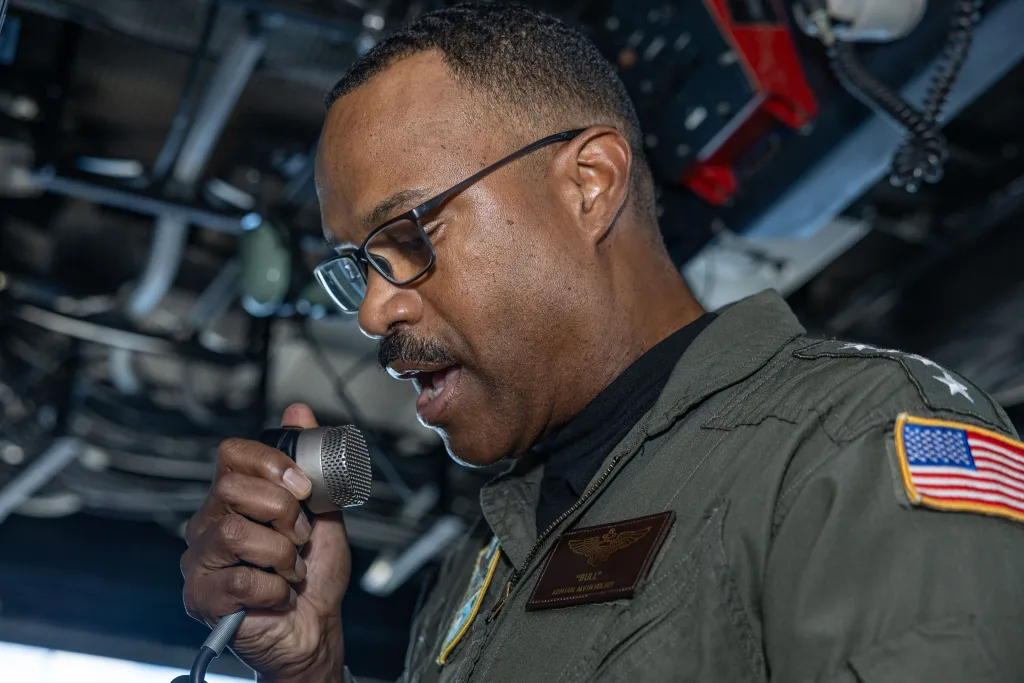
Adm. Alvin Holsey, commander, U.S. Southern Command, addresses the crew of Wasp-class amphibious assault ship USS Iwo Jima (LHD 7) while underway in the Caribbean Sea, Nov. 5, 2025. U.S. military forces are deployed to the Caribbean in support of the U.S. Southern Command mission, Department of War-directed operations, and the president’s priorities to disrupt illicit drug trafficking and protect the homeland. (U.S. Navy photo)
A report published by The Wall Street Journal revealed that the Pentagon fired the head of US Southern Command, Admiral Alving Hosley, after he expressed concerns about the legality of the US attacks on boats in the Caribbean.
In the report published on Wednesday, December 3, the US mainstream newspaper The Wall Street Journal revealed the reason for Admiral Alvin Holsey’s October resignation—he was in charge of US military operations in the Caribbean—less than a year into his tenure, a revelation that shows that his resignation had occurred under pressure from US Secretary of War Pete Hegseth.
Citing two Pentagon officials who spoke on condition of anonymity, the report specified that Hegseth himself asked Holsey to resign, and that it was not the commander’s voluntary retirement, as the US government claimed at the time.
In this regard, the report claimed that the measure was decided after months of disagreement between Hegseth and Hosley, which arose after Holsey expressed concern about the legality of the Pentagon’s lethal raids on ships accused of transporting drugs in the Caribbean.
Shortly thereafter, Hegseth announced that Holsey was retiring. Reportedly, Hegseth had told Holsey, “You’re either on the team or you’re not. When you receive an order, act quickly and don’t ask questions.”
According to Pentagon officials who spoke with The Wall Street Journal, Holsey initially had concerns about the legality of striking boats suspected of carrying drugs and objected that parts of the operation were outside his direct control.
Meanwhile, Hegseth suspected that Holsey might be the source of leaks to the media and had lost confidence in him, so he was looking for a replacement even before the attacks in the Caribbean began.
The report raises doubts about the deadly US military attacks in the Caribbean region, which are carried out under the pretext of combating drug trafficking and targeting the Venezuelan government which the US accuses of being associated with a non-existent drug cartel.
Hegseth is reportedly under pressure over the US attacks in the Caribbean, and a new Pentagon investigation found him guilty of using the Signal messenger on his personal device to send classified information about attacks in Yemen, underscoring that such action could have put US forces at risk had it been intercepted.
Since September, the US military has carried out 21 lethal strikes on ships allegedly carrying drugs in the Caribbean, killing 83 people in those operations.
UN Secretary-General Antonio Guterres warned on Wednesday that “the United Nations High Commissioner for Refugees has made it clear that this type of attack is not compatible with international law.”