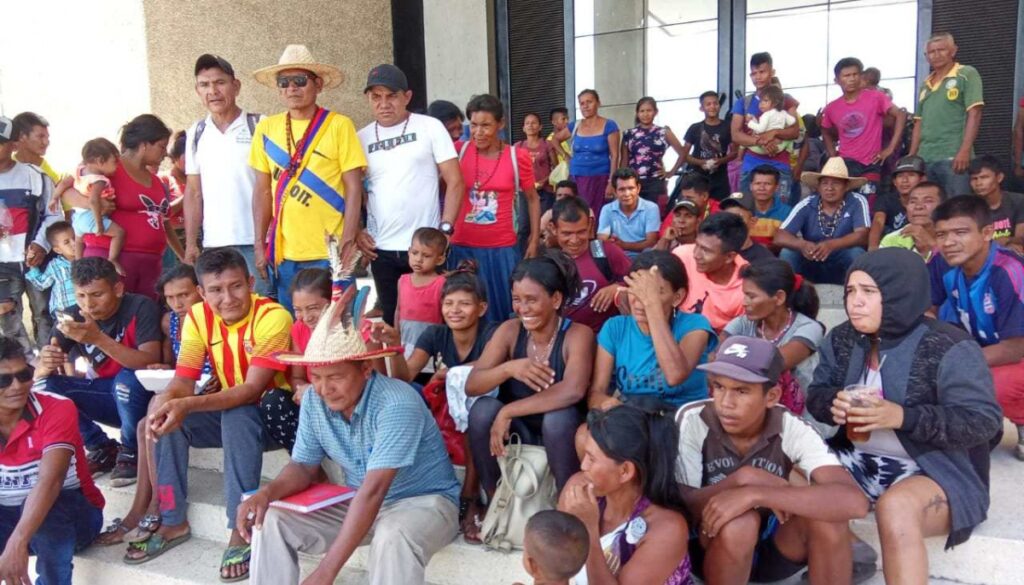
Yukpas take over the Palace of Justice in Maracaibo to demand the freedom of detained indigenous people. Photo: Venezuelanalysis.com/File photo.
Yukpas take over the Palace of Justice in Maracaibo to demand the freedom of detained indigenous people. Photo: Venezuelanalysis.com/File photo.
Indigenous communities from western Venezuela were injured during a crackdown while trying to reach Caracas to sell handicrafts.
Caracas, June 24, 2023 (venezuelanalysis.com) – Indigenous Yukpa communities have denounced repression from security forces and demanded freedom for three people detained amidst recent protests in Zulia state, western Venezuela.
On June 15, Zenaida Romero, her husband Alfonzo Ramos Romero, and Francisco Romero were arrested after the National Bolivarian Police (PNB) attacked a group of Yukpas on the General Rafael Urdaneta Bridge across the Maracaibo Lake after blocking them from crossing on their way to Caracas.
Zenaida is the daughter of historical Yukpa chief Sabino Romero, a key figure in the fight for Yukpa lands in the Sierra de Perijá region. Romero was murdered on March 3, 2013, by landowning elites. Only the material perpetrator has been convicted.
“The three were arbitrarily detained while they were protesting for their right to travel to Caracas in order to sell their handicrafts,” activist and lawyer for the Yukpa people, Sergio Zambrano, told the local press during a rally on Tuesday in front of the Palace of Justice in Maracaibo, Zulia’s capital.
Zambrano added that 17 Yukpas were injured and a three-month-pregnant woman suffered a miscarriage following the night-time assault. “In a commando-type operation, they [the police] put on masks, turned off the bridge’s lights, and proceeded to attack the Yukpas because they insisted on exercising their right to free circulation.”
The legal defender explained that the detainees have been accused of disturbing the public order, conspiring, and possession of psychotropic substances. “Neither accusation has any grounds and moreover it was the Yukpas who were assaulted”, he said.
Indigenous leader Olegario Romero Romero clarified that his community was on one side of the road waiting to cross and not blocking the bridge as the police told media outlets. “This [repression against the Yukpas] has been going on for a long time.”
According to the Yukpa people, during the ambush, the police also seized 25,000 pieces of artisanal crafts (valued at US $5 each), with some being thrown over the bridge, as well as three vehicles and many had their identity cards taken away. The indigenous community has pledged to continue rallying until the three detainees are set free and their belongings returned or paid for.
Speaking to Venezuelanalysis, the coordinator of Homo et Natura, an NGO for indigenous peoples’ rights in Zulia state, Lusbi Portillo, explained that historically Yukpas have sustained their communities through agricultural production, mainly avocados, bananas, yuca, ocumo, celery, but also meat and cheese.
“However, for almost ten years now the roads have been blocked because the hills around them have collapsed with the rains, making it impossible for the Yukpas to transport their products to the cities,” Portillo said.
The university professor emphasized that despite staging many protests and sending many letters, the Venezuelan government “has never fixed the roads” or answered demands for agricultural inputs, trucks and access to diesel fuel. As a result, the Yukpas have resorted to procuring an alternative income source by selling their handicrafts such as woven hats and purses in Caracas.
Last year, the Minister of Indigenous Peoples, Clara Vidal, began to purchase the Yukpas’ merchandise but then abruptly canceled the agreement via a press release in May.
“When the Yukpas were told that the government was not going to buy their handicrafts anymore, they decided to resume their trips to Caracas but they have been met with repression at every checkpoint all the way from Sierra de Perijá,” stated Portillo.
Argentina: Repression Against Indigenous People in Jujuy (+Human Rights in Venezuela)
The activist likewise explained that security forces have repeatedly assaulted different Yukpa communities as each group has been making its way to Caracas to sell its handicrafts.
“The Yukpa people live in the Sierra de Perijá region, Machiques municipality in Zulia state. They are grouped around the Apón, Negro, Yaza, and Tukuko rivers, with each community independent and free from the other. The Yukpas who were attacked on the bridge are from the Yaza River, which has around 120 communities alone,” he went on to say.
Two other Yukpa groups from the Negro River and the Tokuko River were also attacked by police in recent days while traveling to Maracaibo on their way to the nation’s capital. None of them has been able to cross the bridge and reach their destination.
Portillo told Venezuelanalysis that the three indigenous detainees are expected to be released soon. Nonetheless, activists alongside Yukpa leaders might take the case to the Attorney General’s Office and the United Nations (UN) office in Caracas. They are also working on an anti-racism campaign and requesting the destitution of police chiefs involved in the repression.
(Venezuelanalysis.com) by: Andreína Chávez Alava