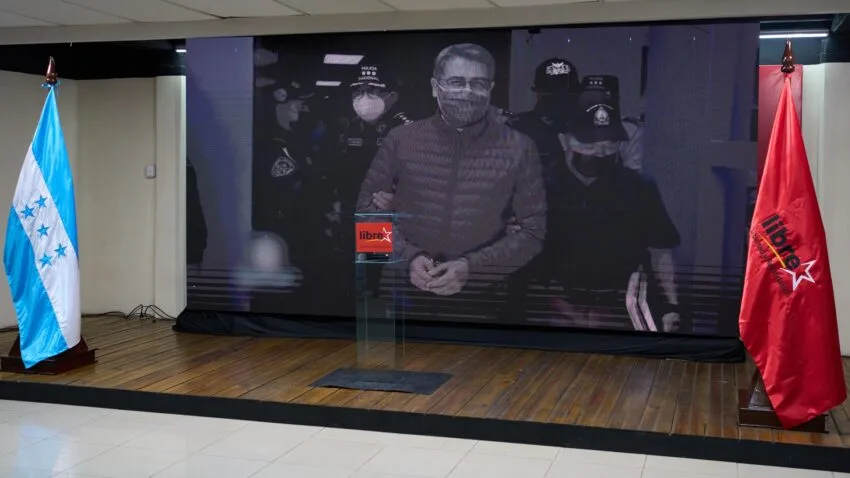
A screen displays an image of former Honduran President Juan Orlando Hernandez at a press conference of ruling Libre party presidential candidate Rixi Moncada, in Tegucigalpa, Honduras, Nov. 29, 2025. Photo: Moises Castillo/AP.
A screen displays an image of former Honduran President Juan Orlando Hernandez at a press conference of ruling Libre party presidential candidate Rixi Moncada, in Tegucigalpa, Honduras, Nov. 29, 2025. Photo: Moises Castillo/AP.
By Adrienne Pine – Nov 30, 2025
Trump’s surprise promise to pardon convicted drug trafficker and former Honduran president Juan Orlando Hernández on the eve of today’s Honduran presidential election, in combination with his directive to Hondurans earlier in the week that they vote for Hernández-allied candidate Nasry Asfura have interfered with the carefully planned interference already underway in Washington.
While Trump prefers the brutish approach that succeeded in keeping his friend Milei in control in the recent Argentinian election, other Washington actors have long maintained a different approach to regime change of coordinated messaging between politicians and organizations across the political spectrum to give the appearance of an unbiased shared concern based on human rights and democracy.
In an article published November 13, 2025, and subsequent 19 November letter calling on the US government to “Help Ensure the Integrity of Honduras’ 2025 Elections,” the Washington Office on Latin America (WOLA) presents a seemingly neutral picture of Honduran electoral chaos.
WOLA does this by repeating—without assessing their veracity—accusations by the three leading parties of corruption and tampering by their opponents, as justification for further US intervention in the elections themselves. Their precise wording is careful, with the devil in the details. Without defining or interrogating benign-sounding terms like “civil society” (i.e., US-funded opposition) or concepts like the laughable “US commitment to hemispheric democratic integrity,” they write: “We respectfully call on the United States to reaffirm its commitment to democratic integrity across the hemisphere by engaging constructively with Honduran national authorities, political leaders, and civil society to protect the transparency and legitimacy of the upcoming elections.”
Claiming interest in avoiding “fraud,” WOLA and its allies ignore the fundamental fact that the only possible way that fraud could alter the results—based in reliable polling data (excluding completely unbelievable polls run by outfits like “Instituto de la Justicia,” whose right-wing board of “experts” includes Abram Huyser-Honig, longtime director of the State Department-funded, coup-supporting organization Association for A More Just Society, and others with a history of dishonestly manipulating data toward USG interest while receiving USG and USG-adjacent funding regarding Honduras)—is by stealing the election from Libre, which has clear majority support, with a very recent poll by a reputable polling agency showing Rixi Moncada leading by 50%, followed by Nasralla Salum with 26% and Asfura Zablah with 17.5%.
WOLA obfuscates the reality of electoral manipulation in Honduras by presenting countering claims by the two major US-allied right wing Honduran political parties and the Libre party as equivalent rather than providing an honest, critical assessment of their veracity. This is fully intentional, and is meant to convince both U.S. and Honduran publics that a Libre win—which would almost certainly be the result of fair elections—is not to be believed.
It is a tired strategy, which I have seen them orchestrate along with other think tanks, NGOs and government actors at least a dozen times since I moved to Washington a week before the coup in 2009, to cast doubt on Latin American elections whenever there is a risk that a candidate who prioritizes sovereignty over subservience to US interests will win.
While WOLA presents itself as “non-governmental” and has cultivated an image over the decades as a left-leaning organization committed to promoting democracy and human rights, it nonetheless nearly always acts in lockstep with the State Department (whose leaders have at times been literally married to WOLA’s leaders—Washington is a very incestuous place) and in many cases, with the far right.
In early 2010, WOLA organized an entire conference in Washington intended to whitewash the coup and legitimize the 2009 election, which had been boycotted by the Resistance and held under conditions that no honest person could have called free or fair.
The conference was canceled the day before it was to happen, after I published an exposé, detailing (among other things) the intimate collaboration between the State Department and WOLA staff including senior associate Vicki Gass, in the effort to gain full bipartisan support for the Lobo administration and its agenda of “Honduras is Open for Business.” Gass has since moved on to become director of the WOLA-affiliated Washington organization LAWG, and signed WOLA’s recent letter calling for US intervention in the Honduran elections in that capacity.
In promoting greater U.S. interference in Honduran elections while the US is engaged in blatant and illegal regime change efforts against other Caribbean nations, WOLA allies with extreme right figures like María Elvira Salazar.
In Salazar’s congressional hearing last week, the “facts” presented by U.S. “experts” with ties to the settler colonial project/”special economic zone” Prospera and other coup supporters who themselves have profound economic and political interests in regime change in Honduras precisely paralleled the narrative promoted by WOLA: the upside-down world assertion that it is Libre—and not its opponents who are losing in the polls and against whom there is mounds of actual evidence of election tampering—that is trying to “steal” an election it is projected to win handily.
The current pre-electoral crisis in Honduras, of course, is largely a product of the dramatic weakening of the institutions of democratic governance that resulted from staunch US support for the 2009 coup and for the coup policies that so damaged Honduran sovereignty, including the privatization and sale to the Honduran oligarchy and foreign interests of education, healthcare, land, and water; the dramatic weakening of labor rights, etc. By obfuscating the nature and origins of the current crisis, WOLA and other US government-allied “neutral” think tanks and NGOs like Human Rights Watch and the Inter-American Dialogue (here we call it the “Monologue”), along with Salazar and her deeply partisan “experts” justify furthering the same bipartisan narrative, all the while claiming to do so in the name of “saving” Honduran democracy.
Honduran Electoral Council Publishes Partial Results as President Castro Warns of Irregularities
Trump may envision himself as a grandmaster, but as we have seen many times, he acts on impulse and relies on the power of brute force rather than on cultivating the appearance of having a coherent strategy. We see this for example in his decision to pardon a narco-dictator as part of his regime-change strategy in Honduras, while justifying his parallel efforts at regime change in Venezuela and Colombia—whose presidents have both fought hard against drug traffickers—as being part of a “War on Drugs.”
With his much more blatant interference, he has kicked over the board of the Washington chess team, which has long been controlled by a strategic alliance of NGOs, think tanks, Latin American Studies centers at DC universities, national politicians from both parties, and the State Department.
Still, Trump’s actions, which contradict their carefully cultivated image of neutral, bipartisan concern for “democratic integrity” and “transparency” in Honduras could benefit these softer imperialists in their long game, as it will enable them to denounce Trump’s blatant actions and strengthen their false claim that they stand with Honduran democracy.
With all the interfering in the interference, one thing remains absolutely clear: if Hondurans want democracy, they must continue to reject the logics and threats of neoliberal empire in all of its forms, and continue to fight toward a refoundation that has been denied them, at the ballot box and beyond.
AP/OT
Adrienne Pine is an Associate Professor of Anthropology at American University. She is the author of the book Working Hard, Drinking Hard: On Violence and Survival in Honduras.