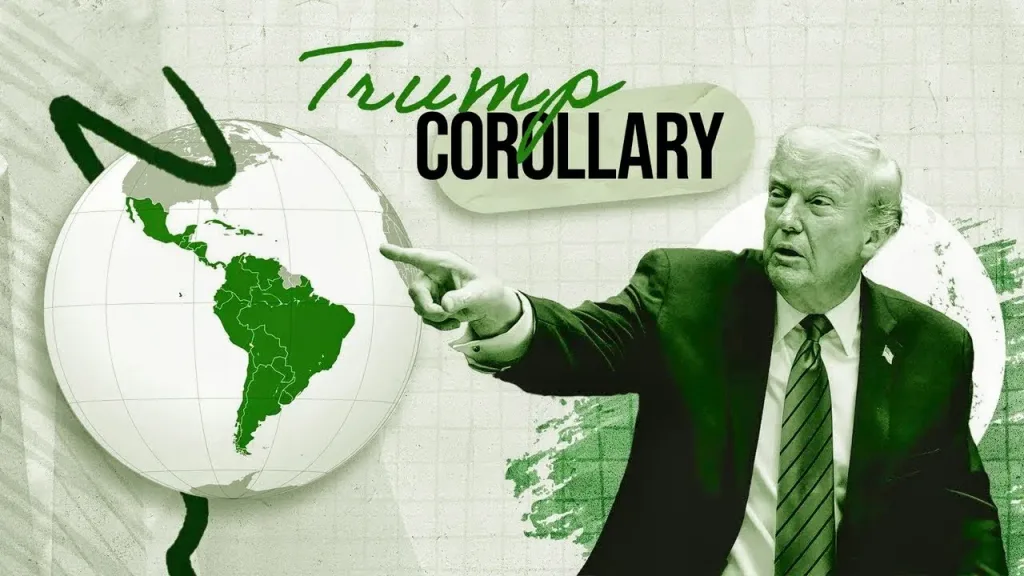
A stylized world map on a clear background, with the bold text "Trump Corollary" overlaid next to the Western Hemisphere and Donald Trump pointing at it. Photo: Ozge Bulmus/TRT World/file photo.
A stylized world map on a clear background, with the bold text "Trump Corollary" overlaid next to the Western Hemisphere and Donald Trump pointing at it. Photo: Ozge Bulmus/TRT World/file photo.
By Diego Sequera and Ernesto Cazal – Dec 15, 2025
The United States’ National Security Strategy 2025, published last week but dated November, is a text that transcends the imprint of a technical manual or a diplomatic wish list.
It is, rather, a political act at a turning point: the first official US document that starts, albeit in a veiled way, from the somewhat less veiled awareness of US decline as a starting point.
However, the document attempts to manage the fragments of decline, to gather them around a doctrine for hemispheric reaffirmation where its “backyard” is proclaimed as the region of its power.
The security strategy does so through a double operation: on the one hand, by redefining the rules of the game in the Western Hemisphere; on the other, by carrying out a coercive reterritorialization of the global order where the economic becomes inseparable from the strategic and where the former conceals the necessary levels of violence that cannot be expressed in writing.
According to the text, the new strategy seeks to secure what the US considers its sovereign right over the Americas in order to benefit its own interests. Within that framework, the US redefines the rules of the geopolitical game, although it does not have the necessary cards to win.
The visible currents
As has been the hallmark of the Trump years, and especially in this second chapter, the publication of the 2025 National Security Strategy (NSS) combines the grandiosity of another event that is supposed to be a turning point, along with, once the uproar has passed, a scrutiny that offers its vulnerabilities, inconsistencies, and unfeasibility.
In that sense, as a historical document—which it is, including its contradictory nature—three currents visibly converge, perfectly linked to the disordered and heterogeneous character of the elite in command of the unstable empire.
Throughout the 33 pages, four parts and 16 sections coexist. They are cohesive but not without contradictions, and the following trends are revealed:
• A narcissism and exaltation that has Trump as its center and object–the “miraculous” emperor president–of the alleged turnaround;
• An anti-elitist simulation that goes beyond the MAGA spirit, reaching the new neo-conservative mutation that allows it to operate within the first noted current;
• A fundamental reformulation of a strategy with overtones clearly based on a realism that is more aware of the current limits of the US but, despite the visible modifications with the same imperialist goals, synthesized in the dominant presence of Elbridge Colby, the assistant secretary of defense for strategy and force development, responsible for the “renewing” elements of the new foreign perspective of the current administration.
The impression of consistency in the document fails to conceal the internal ideological contradictions.
More importantly, despite the fact that this awareness must remain unstated, the NSS is the first official document that articulates, in a sotto voce, awareness of US decline.
A combination of incurable superficiality is coupled with the anxiety to update immediate, even peremptory, lines of action to reshape the US’s place in the world as the sole and “formidable” superpower on the planet.
It is not accidental that the NSS’s first premise focuses on the drift in which the country finds itself, both internally and externally, as a consequence of the lethargy to which “the elites,” as the document ironically states (p. 1), have caused: a loss of strategic direction that is dissipating US strength and effectiveness.
The “foreign policy elites,” states the NSS, “convinced themselves that permanent world domination was to the benefit of our country.”
A miscalculation plagued the bipartisan foreign policy establishment, leading it to assume the cost of “eternal global burdens,” accentuating and making unavoidable the disconnect between that “responsibility” to the world and US “national interests.”
Along the way, the economic and commercial counterpart of this, the neoliberal free market, undermined and dismantled the middle class and the industrial base “on which the economic and military preeminence of the US depended,” continues the NSS.
Of course, the new formulation represented by the NSS is a “welcomed and necessary correction,” a power exclusive to President Trump.
This dimension, the apparent return to a nativist urgency that focuses on the vindication of the US as a republic, centers on “protecting this country, its people, its territory, its economy, and its way of life” from military dangers, threatening outsiders, and “predatory economic practices.” These dangers are summarized in the deregulation of migration and the consequent threat of invasion, particularly in the form of “narco-terrorist” infiltration within US borders: “No adversary or danger should be able to expose the US to risks” (p. 2).
For its defense, it is urgent that the US must possess the most “powerful, lethal, and technologically advanced” army to “protect our interests” and, in case of war, to win quickly without a significant human cost.
Despite admitting their mistakes, the exceptionalist dream/nightmare remains the essential basis of the US role in the world: “what we want” is the operative concept, and “what we want” operates, fundamentally, in opposition to “what we have,” even though they are sometimes mixed up.
What the US wants, according to the NSS, is the most “robust, modern, and credible” nuclear deterrent; as the foundation of US military power, “we want” the strongest, most dynamic, innovative, and advanced economy; “we want the most robust industrial base in the world”; “we want” the most robust energy sector; “we want to remain” at the forefront of science and technology; “we want” our “unrivaled soft power,” with which “positive influence” is exerted, to remain strong; and, finally, “we want” a restoration of “cultural and spiritual health” that will lead to the “new golden age.”
With this indirect admission of the state of emergency, and with the imperative of a resurgent effort, the first point of distancing is marked from what have been the ways that the empire has represented itself so far, if we take as a contrasting reference the 2022 National Security Strategy of the Biden administration, in which all of these weighted elements continued to be recognizable, unalterable, and unquestionable.
The shift, both rhetorical and operational, becomes more pronounced in the “strategic principles” (p. 5) concerning what the US “wants in and from the world” and concerning the risk, it is claimed, of ignoring the “core and vital” interests.
• That technological standards in AI, biotechnology, and quantum computing “drive the world forward”;
• The end of “endless wars” is avoided while preventing an antagonistic power from dominating oil and gas supplies in the “Middle East” along with critical transit points without having to resort to “endless wars,” an undeclared reference to Iran;
• That the ongoing damage inflicted by foreign “actors” be reversed by maintaining freedom of navigation in the “Indo-Pacific” and securing supply chains that, as with technology, are references to China and its southern sea;
• Support for US allies while reversing the state of decline in Europe and its “Western identity”;
• The most important and dramatic shift is that “we [the US] want to ensure that the Western Hemisphere remains reasonably stable and well governed enough to prevent and discourage mass migration to the US; we want a hemisphere whose governments cooperate with us against narco-terrorists, cartels, and other transnational criminal organizations; we want a hemisphere that remains free from hostile foreign incursions or ownership of key assets and that supports critical supply chains; and we want to ensure our continued access to essential strategic locations.” Thus, the Monroe Doctrine is updated with its “Trump Corollary” as a continuation of the Roosevelt Corollary, as will be seen later.
This effort must be the result of the distribution of burdens and responsibilities among “partners and allies” because the days when the US held up the world “like Atlas” are over (p. 12).
It is official, then, that the bill is not to be paid solely by Washington, and everyone has to contribute. However, this forces us to recognize, therefore, that “the fundamental political unit of the world is and will continue to be the nation-state” (p. 9).
Where, the NSS asserts, “sovereign rights” are supported, the US, acting from its own interests, will “encourage” others to do the same against the remaining institutions that must be reformed. This alludes, once again implicitly, to multilateral organizations that must be “reformed” (p. 9).
This claim, however, if we limit ourselves exclusively to the document, criticizes the dissolving vision of the borders of “globalism” with its unrestricted migration to ensure its own passage to the reindustrialization and reinvigoration of the military industrial base, the direct control of supply chains, and energy and financial dominance.
Once again, in the use of adjectives and rhetorical devices, the cracks and fissures are visible: “Preserving and growing our (financial) dominance entails leveraging our dynamic free market system and our leadership in digital finance and innovation to ensure that our markets continue to be the most dynamic, liquid, and secure while remaining the envy of the world” (p. 15).
The constant declaration of the “great shift” and an apparent relocation of efforts, an act that should embody an exercise in self-examination, recognition of one’s place, and therefore, some humility, is overlaid with a narcissism that clouds its supposed internal reform of interests and strategies.
The high-flown rhetoric that permeates the postulated principles and the strategic considerations that presuppose the “turnaround” fails to hide, precisely, the alleged Copernican shift in the US vision.
The combination of the miraculous arrival of the president-emperor, the admission of the failure of the liberal order, and the urgencies of a nuanced realism fail to synthesize that image if subjected to proper examination.
Nostalgia for grandeur leaves unaltered the essential basis which has been the continuity of hegemonic aspiration, to which is added the caveat of being at that limit which is not fully admitted, leaving intact the geopolitical hallucination of the neoconservatives, resulting in the new strategic “thinking” being an accumulation of “tactics” where the superior goal does not differ substantially from that of any previous government that has occupied the White House.
“Flexible” and imperialist realism and the alleged “great turn”
“President Trump’s foreign policy is pragmatic without being ‘pragmatist,’ realistic without being ‘realistic,’ principled without being ‘idealistic,’ muscular without being ‘militaristic,’ and moderate without being ‘pacifist.’ It is not based on traditional political ideology. It is motivated primarily by what serves the US, or, in two words: ‘America First’” (p. 8), the NSS states.
In contrast to both the 2018 and 2022 National Security Strategies, the new NSS ceases to acknowledge that the US is in an era of intense competition with other emerging global powers.
On the contrary, through euphemistic devices and effort, wherever possible, it emphatically strives not to mention the other competitors.
However, it is a recognized and public fact, the author and main force behind the document is, as mentioned, Elbridge Colby, a think tanker with a well-furnished brain and a recognized anti-China hawk.
Despite all the omissions and the apparent admissions of external threats and their internal impact, the guiding principle remains the same: the focus is claimed to be national, America First; it’s not about China, when in reality it is all about China—the only competitor that truly threatens, according to Colby, US dominance.
“In order to remain superpowered, the US may, temporarily, need to stop superpowering,” wrote The Atlantic in a recent piece about Colby.
A “consummate institutionalist” of official Washington, as the article also points out, Colby, grandson of William Colby, the former director of the CIA and creator of the Phoenix Program (the model of disappearance and extermination that plagues us to this day), is a staffer who has collaborated with different administrations and think tanks in the capital.
Colby was also one of the central authors of the 2018 National Defense Strategy, which marked a departure from continuity and recognized the rise of other powers as strategic rivals.
But in 2021, there was a turning point with the publication of his book The Strategy of Denial: American Defense in an Age of Great Power Conflict.
Following a historical review of the evolution of defense strategies, the book essentially argues that the US must prioritize, first and foremost, the rise of what it considers its only serious competitor or rival: the People’s Republic of China.
“The plain reality is that China is too powerful for the US to simply make it stop fighting; the US and any of its allies and partners therefore need to persuade it not to” (p. 185), Colby argues within the scenario of a military conflict surrounding Taiwan.
This is the central nerve of his strategy both in the book and in the NSS itself, the latter starting from the premise that the Taiwan geographically and defensively divides the island chains in the western Pacific that constitute a natural barrier between China and the western flank of the US empire.
Being unable to confront the People’s Republic directly and exclusively, lacking the economic, financial, logistical, and technological resources to do so, three pillars are needed: investment in naval and air technology, a network of allies, and denying the possibility of victory in a conflict in which the cost is greater than the benefits for Beijing.
This, in turn, implies, as has been more or less distilled so far, abandoning other “priorities” corresponding to the globalist vision in order to concentrate all efforts on these three points and a single adversary/enemy.
However, this also involves a scenario in which partners and allies are willing not only to accept part of the burden of that effort but also the human and military costs that this could entail in order to achieve a higher goal that, if successful, would ensure control of the western Pacific as a pillar of global dominance.
There is, therefore, an explicit admission that the US is not in a position or condition to achieve those goals today and, thus, is threatened.
Hence the need for a “cessation of hostilities” (pp. 25-26) in Ukraine that would reduce attention on Russia and lead it to a point of “strategic stability” (p. 27). However, this cessation of hostilities would not constitute the end of the war but a momentary pause.
To regain a hypothetical leading position in military industry and technology, time needs to be bought; and to buy time, a system of diplomatic, military, regional, and economic alliances in East Asia in particular, and in the rest of the world in general, is indispensable.
There is no other way that the US can block the ascendancy of the People’s Republic of China in terms of its political, commercial, and cooperation mechanisms throughout the planet.
Yet, the scenario in which the battle for Taiwan is fought involves a complex game of public perception, the action of meticulously functional and well-oiled alliances, along with the impact that air and naval superiority should entail.
It is Colby’s concern, he states in his book (p. 302), that the US public considers it worth “the sacrifice and risk involved” in containing a “hegemonic” state at a significant distance from its problems.
Therefore, it can be inferred that going against this idea of preeminence is comparable to a political heresy that must be persecuted; thus, it must be understood that internal dissent to this postulate is one of the main threats to national security.
Colby has publicly stated that the US is not prepared for a hypothetical World War III, and the only way to avoid it is to prepare for it.
Seen in this way, and here, perhaps, in the crazy terms of late imperialism, lies the vision and lucidity of Colby and his supporters. The texts of 2018 and 2022 assume and reveal this external threat. They operated within a vicious maximalist vision, while the new NSS claims that what is necessary is strategic sequencing or a sum of cohesive tactics to deny the expansionist continuation of China.
This explains the apparent abandonment of self-destructive Europe and the reduction of Africa and the Middle East to a network of public–private partnerships where US companies and state contracts are favored while centrally, the absolute control of the Western Hemisphere is consolidated as a power base capable of revitalizing and strengthening, through extractive control, private initiative. In this sense, multipolar states must be expelled from Latin America and the Caribbean, denying Beijing a “sphere of influence” in the region.
This expulsion must begin, of course, with the main proponent of the multipolar approach in the region: namely, Venezuela. For Washington, the American continent is no longer a neighborhood but, as mentioned before, a matter of strictly domestic politics.
Contrary to and in opposition to many traditional strategists and commentators, Colby’s vision centers on the need to reduce the over-extension of the empire as a way to revitalize the empire.
In that sense, it is a transitional and provisional text: once Washington is “recovered,” it can reclaim its former power. At this point in history, the highway of domination is counterproductive, and a major detour is needed to achieve that higher goal: the US needs to defeat China, but for now, it depends on the old road.
This constitutes imperial realism and a manifestly and internally extreme situation.
The Trump Corollary: functional sovereignty and reconfiguration of the hemispheric order
The 2025 National Security Strategy proposes a fundamental shift in what constitutes sovereignty in the Western Hemisphere, the operational core of which is the so-called “Trump Corollary to the Monroe Doctrine” (p. 5). However, it is not limited to updating US foreign policy; it is not a mere tactical adjustment. It consists of a redefinition of the rules of the game: which decisions by other countries are acceptable and which, although legal and sovereign, are treated as threats.
Within this framework, we can consider three moments of sovereignty that are recognized by historical development and systematic application of imperial reasoning.
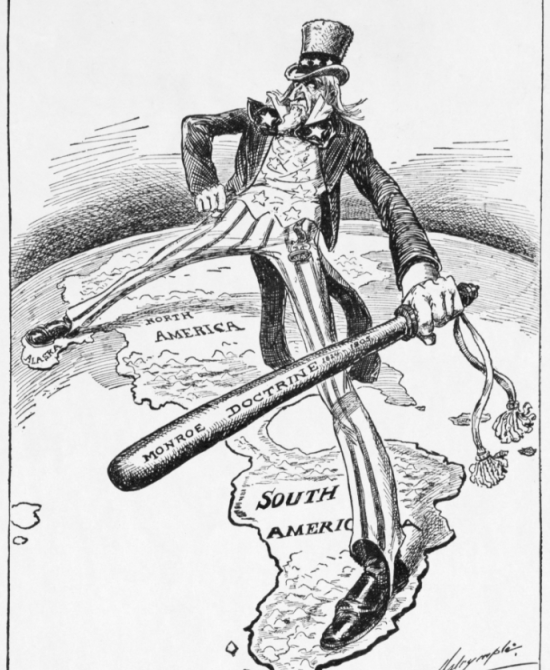
The US Monroe Doctrine (formulated in 1823) explicitly recognized the sovereignty of the new Latin American states and limited itself to prohibiting European intervention in the affairs of the Hemisphere. Its logic was one of non-interference: “America for the Americans… and the Americans are free and independent.”
The Roosevelt Corollary (1904), on the other hand, introduced conditional sovereignty in the event that a country in the Americas failed to meet its international obligations; in such a scenario, the US would be obliged to exercise, at least temporarily, the functions of “international police.” Here, sovereignty could be delegated or revoked if the state did not comply with external standards: fiscal, moral, civilizational, etc.
However, the Trump Corollary does not suspend sovereignty: it redefines it from its very foundation. The question is no longer whether a state is sovereign or not but what kind of sovereignty counts as legitimate for hemispheric order.
Legitimacy no longer depends on the internal regime or compliance with international norms but on its compatibility with the US value chain.
The NSS formulates it with technical clarity and hegemonic rhetoric:
• “We will deny non-hemispheric competitors the ability to position threatening forces or other capabilities, or to own or control strategically vital assets, in our Hemisphere” (p.15).
• “The terms of our agreements, especially with those countries that depend most on us and over which we therefore have the greatest influence, must be single-source contracts for our companies” (p.19).
• “We must do everything possible to expel foreign companies that build infrastructure in the region” (p.19).
This implies that the sovereignty of others is measured by their ability not to interfere with—and preferably, to facilitate—the vital interests of the US.
It is striking (and reveals a deeper structural continuity than the rhetorical differences) that both the Roosevelt Corollary (1904) and the Trump Corollary (2025) use Venezuela as an exemplary case to justify their hemispheric doctrine.
In 1902-1903, the European naval blockade against Venezuela for non-payment of debts served Roosevelt as a casus belli to assert that the US, and only the US, had the right to intervene in the hemisphere when an “incapable” state threatened regional stability.
Today, Venezuela’s alliance with non-hemispheric actors—China, Russia, and Iran—and its resistance to integrating into the US value chain play an analogous role: its autonomous capacity makes it the perfect example of deviation from the new order to be imposed.
In both cases, Venezuela is a pretext: its existence allows the establishment of a general doctrine—that of conditional sovereignty in 1904, that of functional sovereignty in 2025—which is then applied to the entire hemisphere.
The aim is to use Venezuela as a model to redefine what counts as a legitimate order and who decides when that order has been violated.
Three structural displacements
1. From legal sovereignty to functional sovereignty.
In the Westphalian tradition, sovereignty is a status: the legitimate monopoly of coercion within a recognized territory.
In the Trump administration’s National Security Strategy, sovereignty is an operational capability: that of aligning with the infrastructure, logistics, and standards that sustain the reproduction of US capital.
A state may be fully recognized by the UN, hold elections, and have territorial control, but if it allows a Chinese company to build a port, a mine or a 5G network, its sovereignty becomes functionally illegitimate in the terms of the Corollary.
Here, the structural validity of governments within the region, conceived as a space of US preeminence, is questioned.
2. From territorial control to infrastructural control.
Classical domination was exercised over the state: invasion, occupation, regime change. Now, in a different way, functional domination is sought over the means of production of sovereignty itself: energy, logistics, data, critical minerals, technical standards.
According to the new Corollary, controlling access to refineries and oil technology (CITGO, Chevron) will be adequate; financing will be conditioned on the reversal of contracts with Russia, Iran, or China; “aid” will be offered in exchange for “single-source contracts” for US companies.
Power lies in the control of the nodes that make any government possible: energy, infrastructure, minerals, etc.
3. From sovereignty as a right to sovereignty as a coercive offer.
In the liberal and republican tradition, sovereignty is an inalienable right founded on self-determination. In the 2025 National Security Strategy, sovereignty is presented as a service offering: the US “invites” integration into a system where prosperity and stability are guaranteed provided that the conditions are accepted.
“The choice that all countries must face is whether they want to live in a US-led world of sovereign countries and free economies or in a parallel one in which they are influenced by countries on the other side of the world” (p. 18).
Is it a free choice? The answer is undoubtedly no. It is structurally incentivized and coercively framed. Sovereignty is what the US certifies as compatible with the new hemispheric order.
The Trump Corollary refuses to deny the existence of state sovereignty but frames it as the capacity for functional alignment. A sovereign state, in this order, is one that makes itself available to the US value chain through coercion via an institutional, financial, and technological design.
Exceptionalism and the Venezuelan borderline case
The Trump Corollary aims to function as an architecture of the new order, introducing a change in the framework of what is possible in the Hemisphere: what was once a sovereign decision—choosing with whom to trade, with whom to ally—now becomes a sign of risk or destabilization.
Its strength lies in making deviation unthinkable: those who deviate will be punished.
It is no longer a question of whether Venezuela can partner with China: rather, the NSS insists that if Venezuela does, it ceases to be a legitimate interlocutor, and therefore, any action against it (sanctions, isolation, military and diplomatic pressure) becomes reasonable and even necessary.
This status is analogous to the homo sacer conceptualized by the Italian philosopher Giorgio Agamben: Venezuela can be sanctioned (blocked, isolated, militarily pressured) without this constituting a “violation of sovereignty” because, in the language of the Corollary, it is not exercising legitimate sovereignty. However, neither can it be integrated into the US-led order, because its very existence—autonomous, non-functional—perverts the coherence of the system.
In this structural vacuum, any measure against Venezuela becomes legitimate: sanctions, therefore, are containment measures; the financial blockade consists of a restoration of the minimum conditions of stability; and military pressure does not constitute an “aggression” but a prevention of threats.
Within the framework of the US military deployment in the Caribbean, coercive measures against Venezuela appear as technical risk-management operations. The US military has intensified naval and air patrols in waters near Venezuela under the formal label of “anti-drug operations,” with the explicit use of lethal force against civilian vessels or those involved in commercial (oil) operations and non-military logistics networks, something that the 2025 National Security Strategy authorizes as a replacement for the “exclusively police-based strategy of recent decades” (p. 16).
In this context, sanctions are presented as preventive containment measures: the “forced sale” of CITGO, for example, is justified as an impediment to strategic assets remaining under the control of a government that maintains alliances with actors described as “adversaries” in the strategy (p. 17).
The financial blockade—exclusion from the Swift finance system, prohibition of dollar transactions, etc.—is framed as a restoration of minimum conditions of stability, according to the Treasury Department’s discourse, which repeats, point by point, the NSS’s warning about the “hidden costs in espionage, cybersecurity, and debt traps” of cooperation with non-hemispheric powers (p.18).
Furthermore, military pressure is described as threat prevention based on the mandate to “deny non-hemispheric competitors the ability to control strategically vital assets” (p.15).
In this framework, all coercive action shifts from the political register to the technical one, based on a calculation of functionality.
Venezuela embodies the ultimate challenge to this doctrine: it is the extreme case. It maintains strategic alliances with China, Russia, and Iran; it controls critical resources without surrendering their management to aligned capital; and it has developed exchange mechanisms that circumvent the dollar and US value chains.
In this sense, the Trump Corollary frankly acknowledges: “Some influences will be difficult to reverse, given the political alignment between certain Latin American governments and certain foreign actors” (p.17).
Venezuela serves as a precedent, as it demonstrates that it is possible to maintain an autonomous foreign policy even under prolonged coercive pressure.
In light of the analyzed document, we can confirm that the encirclement of Venezuela seeks not only a change of government. Above all, it aims to exterminate Venezuela’s political and economic model in favor of one of “US exceptionalism”: to prove that no country can survive outside the order of selective sovereignty established by the new doctrine. Regional change following regime change.
The Trump Corollary is a technology for producing the excludable: it introduces a new way of measuring legitimacy based on alignment with the US value chain.
The US reserves the right to decide which assets are “strategically vital,” which alliances constitute “systemic risk,” and which governments, although sovereign, should be treated as anomalies.
The real novelty is not that the US imposes its will on others—that is already known. It is that the US unilaterally decides which decisions by other countries count as legitimate, and which countries, even if sovereign, are treated as threats. This constitutes blatant imperialist extortion.
It’s the economy, dummy (again)
While the US exceptionalist policy will gain new momentum with the redefinition of sovereignty and “legitimacy” within a hemispheric order that only prioritizes the interests of power in Washington, its rhetorical approach must be understood within the context of the economic offensive that apparently interests Trump.
Thus, the document treats the Western Hemisphere as a space of strategic opportunity: a market in formation, a potential industrial base, a network of supply chains, and the closest thing to a tax haven with lax labor laws that, if governed from Washington, can drastically reduce US dependence on Asia and Europe after decades of rampant neoliberal globalization.
To achieve this, the strategy is divided into two complementary moves: recruiting partners who are already aligned and expanding influence toward those who are not yet integrated.
The text makes it clear that “trade diplomacy” is the strategic backbone of the “America First” foreign policy: “The United States will prioritize trade diplomacy to strengthen our own economy and industries, using tariffs and reciprocal trade agreements as powerful tools” (p. 16).
Thus, the NSS positions the US as the epicenter of a purported coordinated hemispheric reindustrialization: it seeks to have its partners “strengthen their national economies” because a more prosperous hemisphere becomes “an increasingly attractive market for US trade and investment.”
While the partners gain access to technology, financing, and markets, the US gains systemic resilience. The mutual benefit is not mutual but asymmetrical:
“Strengthening critical supply chains in this hemisphere will reduce dependencies and increase US economic resilience” (p. 17).
This means that minerals used in batteries, medical components, agricultural inputs, and even low-complexity chips could be produced in any Latin American country—and not in China—under US standards, patents, and contracts. Geographical proximity thus becomes a strategic advantage in terms of logistics and control.
Although the focus is economic, the Corollary does not separate trade from security: “And even as we give priority to trade diplomacy, we will work to strengthen our security partnerships, from arms sales to intelligence sharing and joint exercises” (p. 17).
The sale of fighter jets, drones, or coastal surveillance systems provides a functional anchor within a security framework. Each military contract creates technical dependence, standardizes protocols, and opens the door to civilian contracts (in energy, telecommunications, or logistics) that solidify alignment.
The second move—expansion—operates where alliances are not automatic. There, the US does not compete on a level playing field. Therefore, the NSS proposes a structurally advantageous alternative and delegitimizes its competitors due to systemic risk.
“The United States has succeeded in reducing external influence in the Western Hemisphere by demonstrating, with specificity, how many hidden costs—in espionage, cybersecurity, debt traps, and other forms—are implicit in so-called ‘low-cost’ foreign aid” (p. 18).
The US distorts the policies of multipolar actors: China does not offer south–south cooperation, claims the NSS, it offers covert dependency. Russia does not build ports; it establishes surveillance points and logistical access points. Iran does not refinance oil; it introduces uncertifiable technologies into global markets. The psychopolitical projection in this case is remarkable, with symptoms of a factitious disorder imposed on another in the field of US foreign policy.
In contrast, the US presents itself as the partner of real sovereignty: “US products, services, and technologies are a much better long-term purchase because they are of higher quality and do not come with the same conditions as aid from other countries” (p. 18).
However, the new Corollary is not content with preaching: it announces the correction of its own bureaucracy in order to compete: “We will reform our own system to streamline approvals and licenses, once again, to become the partner of first choice” (p. 18).
This implies concrete decisions: reducing the terms of the International Development Finance Corporation (DFC) from 18 to 6 months, making the Millennium Challenge Corporation’s (MCC) environmental requirements for energy projects more flexible, or allowing the Export-Import Bank of the United States (Ex-Im Bank) to finance “single-source” contracts with US companies, as required by the document (p. 19).
This is a coercive incentive structure: whoever chooses the “multipolar world” will be excluded from the financial, technological, and logistical systems that define contemporary prosperity.
In this context, the economy is intrinsically linked to security. It is the main stronghold of the new hemispheric hegemony, and Venezuela, due to its resistance to integrating into this US-led order, represents a political exception that must be neutralized for the model to be sustained.
Belated and retroactive vindication of the nation-state: the trade deficit
Thus, imperialist realism collapses when, while claiming to have everything under control, it conversely admits a dramatic loss of ground that forces it to relinquish a global responsibility that, by its own sustained undermining, is a mistake. All the while, it asserts that the mission persists and has only been temporarily redirected.
Apparently, “the US retains enormous assets—the world’s strongest economy and military, unsurpassed innovation, unrivaled ‘soft power,’ and a historical track record of benefiting our partners and allies—which makes it easier for us to compete successfully” (p. 19). In short, according to the NSS, the US needs to take a step back in order to recover the superiority that it claims to already possess.
“The America First brand diplomacy seeks to rebalance global trade relations. We have made it clear to our allies that the current deficit in the US accounts is unsustainable,” states the NSS, and it demands that “other prominent nations,” including Europe, Japan, Korea, Canada, and Mexico, “adopt trade policies that help rebalance the Chinese economy toward domestic consumption” because regions such as Southeast Asia, Latin America, and West Asia alone “cannot absorb the enormous surplus capacity” of the People’s Republic (p. 22).
However, the NSS also admits, pejoratively, that “The US and its allies have not yet formulated, much less implemented, a joint plan for the so-called ‘Global South’” (p. 22), but it still intends to assume that leading role, notwithstanding the new definitions of “sovereignty” and “nation-state” reviewed so far.
But for Emmanuel Todd, whose aim has not failed him so far, a trade deficit, whether of the US or of a western European country, entails the possibility of being able to say definitively that “in the West, the nation-state does not exist” (The Defeat of the West, p. 15).
As Todd argues: “A systematic deficit renders the concept of the nation-state obsolete, since the territorial entity in question can only survive by receiving a tax or a privilege from abroad, without any counterpart” (p. 16).
It is a structure that, in order to function, needs a middle class that acts as the “center of gravity” and “nervous system” of a minimally homogeneous nation under certain parameters.
The NSS acknowledges the need, as seen, to rebuild the middle class given the oligarchic fragmentation caused by the sustained unrestricted movement of capital from the bottom up due to accumulation by dispossession, which also leads to fierce competition among the elite.
This characteristic, deeply investigated by numerous economists, is a sign of crisis, which for Todd signifies national disintegration. Recent US employment reports are far from encouraging, and alongside all this, a technological and cloud-based oligarchy, driven by finance and the speculative economy, is extensively assuming control throughout the US federal government apparatus.
Through this filter, a document that, while claiming to represent the middle class, appeals to this same corporate constellation, that of the “tech bros,” to collaborate in surveillance tasks begins, algorithmically, by monitoring and controlling the domestic population itself, precisely that middle class that this administration claims to defend (p. 21).
Whether in its adjustment of global vision or in its local dimension, of all the races it aspires to run, the empire should be careful about which of these two it will lose first, even more so when the mechanistic logic with which it outlines its strategy prevents its planners from calculating the reactions and consequences of this readjustment.
Hegemony as the administration of decline
The announcement of a disciplined management of the retreat draws its impetus from the urgency: the certainty that the US can no longer simultaneously sustain financial globalization, military interventionism, and the multilateral consensus it built after 1945.
Faced with this impossibility, the document proposes a radical solution: to retreat in order to rearm. It rejects any kind of abandonment of hegemony and instead seeks to relocate it. The Western Hemisphere is the laboratory for this operation.
Here, it is not seeking to restore the imperial ruins of past decades. It is proposing something strategically new: a functional order with symptoms of geopolitical rheumatism.
In this sense, Venezuela is the mirror in which the US sees itself reflected: a state that insists on deciding its own destiny even when the cost is isolation, financial sanctions, and constant military pressure. Venezuela’s persistence poses an unusual and extraordinary threat to the US narrative of inevitability.
Therefore, the blockade and piracy have their imperialist justification as long as Venezuela remains the precedent of an alternative possibility. However, at the heart of this logic lies a lethal paradox: the more the US demands that others be “functional,” the more evident its own dysfunction becomes.
The US economy is burdened by unsustainable deficits. Its middle class, on which its internal stability depends, is decimated. Its political cohesion is fractured by a technocratic oligarchy that governs through algorithms and investment funds, and its “America First” rhetoric reveals, at its core, a deep insecurity: it is the voice of those who fear losing control without realizing that the power to govern has been decentralized outside of their “backyard.”
The future of the hemisphere will not be decided in the Pacific but in the politics that now appear disguised as technical management and incentive coercion—where the most decisive battle of the century is being fought for the new definitions of power.
In the vast expanse of this arena, which can be considered civilizational, as long as Venezuela continues to exist—not as a power, but as a possibility—the functional order of the declining empire will not be complete, for it heralds a world in which everything is yet to be written.
Translation: Orinoco Tribune
OT/JRE/SL

Diego Sequera is a journalist, writer, translator, editor and political analyst based in Caracas. He is a founding member of Misión Verdad, where he currently writes about geopolitics, global conflict, and Latinamerican and Venezuelan history and politics.