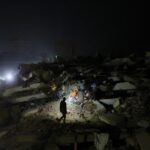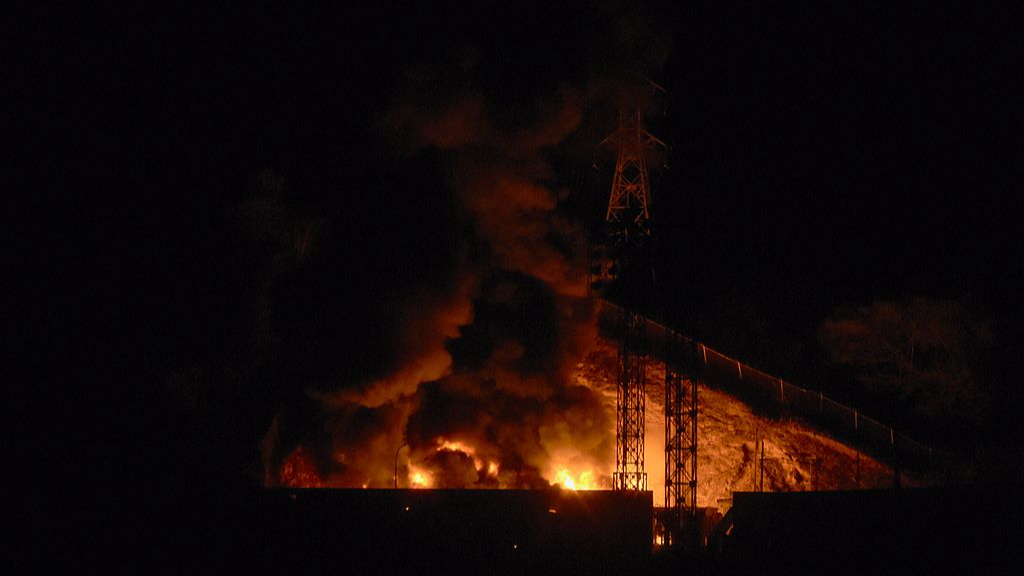
Fire at the Tiuna Fort, Venezuela's largest military complex, after US bombardment on the early morning of January 3, 2026. Photo: VCG.
Fire at the Tiuna Fort, Venezuela's largest military complex, after US bombardment on the early morning of January 3, 2026. Photo: VCG.
By Misión Verdad – Jan 8, 2025
The events of Saturday, January 3, are widely known. Therefore, we will not provide a review of the events. Rather, we will discuss the underlying reasons for the US attack on Venezuela and the abduction of President Nicolás Maduro and First Lady Cilia Flores.
Beyond the ethical condemnation, a necessary question persists: why did the US go to the extreme of making a decision of this magnitude in the 21st century, which by all accounts has been harmful, given the political outcomes both in the US and in Venezuela?
The answer is not in Trump’s speeches (“we’re going to manage Venezuela”) or in Pete Hegseth and Marco Rubio’s slogans. Rather, several answers can be found, all centered around a document that announced US actions with technical coldness weeks in advance: the 2025 National Security Strategy (NSS).
The Trump Corollary: when sovereignty is a coercive offer
The ESN is a political act that reconfigures the rules of the game in the Western Hemisphere. In its 33 pages, it introduces the “Trump Corollary to the Monroe Doctrine,” which does not define whether a state is sovereign or not, but rather what type of sovereignty counts as legitimate for the US-led hemispheric order.
Without a doubt, this is an ontological assertion within the regime of exception that Trump 2.0 is trying to establish in this part of the world. Legitimacy no longer depends on the internal regime or compliance with international norms, but on its compatibility with the US value chain. The ESN formulates it unambiguously:
This implies that the sovereignty of other states is measured by their ability not to interfere with, and preferably to facilitate, the vital interests of the US.
A state can be fully recognized by the UN, hold elections, and have territorial control. However, if it allows a Chinese company to build a port, a mine, or a 5G network, its sovereignty becomes functionally illegitimate to the US. Under this conceptual framework, Misión Verdad discussed functional sovereignty in a special analysis of the document.
Venezuela embodies the ultimate challenge to this doctrine: it is the limit case. It maintains strategic alliances with China, Russia, and Iran; controls critical resources without surrendering their administration to US-aligned capital; and has developed exchange mechanisms that bypass the dollar and US value chains.
In this structural vacuum—where a country is sovereign under international law but illegitimate according to US imperial logic—any measure against it becomes “reasonable.” According to the rationale imposed by Washington, not by analogy but by functional relationship:
The abduction of a constitutional president, in this framework, is not a violation of sovereignty: it is a technical risk-management operation. This is why the fiction of the “Cartel de los Soles” is no longer necessary among the justifications for the violation.
The collapse of the petrodollar
The crux of the matter is not Venezuela’s oil reserves—even though they are by far the largest in the world—but rather the currency in which the oil is traded. As analyst Pepe Escobar points out: “The heart of the matter is not Venezuela’s humongous—untapped—oil reserves per se, complete with neo-Caligula salivation. The key is petrodollar-denominated oil. Printing endless—intrinsically worthless—green toilet paper to finance the industrial-military complex implies the US dollar as the global reserve currency, petrodollar included.”
In order to establish a framework for resisting illegal sanctions—whether effectively or not is another matter—Venezuela broke the financial blockade. Integration into the Chinese CIPS system, the SWIFT-like mechanism that is beginning to emerge as a real alternative to systemic dollar centrism, created the conditions for crude oil to be paid for in yuan, rubles, or a gold-backed reserve.
This step was not simply technical; it was the first real breach in the petrodollar monopoly since 1974.
The petrodollar is the material pillar of US power, along with industry and military projection. Without it, the US cannot finance its deficit (6-7% of its GDP), its debt (over 120% of its GDP), or its military spending (1.5 trillion this year).
Maduro’s kidnapping thus sought to halt the dollar’s flight from global oil trade, while securing control over PDVSA’s US subsidiary Citgo to hand it over to the financial vulture fund Paul Singer (Elliot Investment Management). Citgo, seized by the sanctions regime, is a critical energy infrastructure. Its theft is part of a reconfiguration of the hemisphere, in line with what is stated in the ESN.
Financial-speculative fiction and the structure of plunder
Contemporary capitalism, especially its US variant, has entered a phase in which value is not produced primarily in the productive sphere but in financial speculation.
Since the 1970s, and at an accelerated pace after the 2008 crisis, the US economy has become dematerialized: its wealth is based on derivatives, algorithms, sovereign debt, and the financialization of everyday life. This process does not create new value (in Marxist terms) but rather redistributes and anticipates future value through fictitious mechanisms.
Value in contemporary capitalism remains grounded in human labor; it continues to have material roots. The paradox lies in the fact that, while speculative financial capital traded in New York moves away from production, it urgently needs to reappropriate real spaces of material wealth to sustain its fiction.
Venezuela—with the world’s largest oil reserves, gold, coltan, strategic biodiversity, and energy sovereignty—represents a territory of rescue for a capital that no longer knows how to create value.
Therefore, it has never been about “liberating” Venezuela, but about reintegrating its resources into the orbit of US accumulation, stripping Venezuela of its capacity to resist.
The history of capitalism has been marked by cycles of expansion and crisis. Today, the system faces a structural accumulation crisis: markets are saturated, the rate of profit is falling, and technological innovation no longer revives production but destroys jobs and value, according to the empirical data presented by researchers Güney Işıkara and Patrick Mokre (in their 2025 book Marx’s Theory of Value at the Frontiers, reviewed by the British economist Michael Roberts).
In this context, capital can no longer expand “from within,” but only “from without”: through dispossession, war, and the forced reconfiguration of borders. From this analytical perspective, Işıkara and Mokre’s analysis indicates that the US attack on Venezuela was not an isolated military adventure. Let us see.
Between 1990 and 2020, $70 trillion—5.9% of the annual global output in productive industries—was transferred from the Global South to the imperial core, with the US and Japan as the main beneficiaries. Mexico, Brazil, Indonesia, and Russia are major “net donors” of value. This transfer is not only due to labor exploitation, but also due to differences in the organic composition of capital (technology, productivity).
However, Venezuela’s case is different: by nationalizing its resources and resisting the neoliberal extractivist logic, it has become a defining obstacle to the reproduction of Western capital. It not only fails to deliver value; it withholds it. Therefore, the only way to reintegrate it into the accumulation circuit is by force or regime change (something that the US failed to achieve by abducting President Maduro).
In this framework, the US military deployment in the Caribbean is essentially the materialization of the logic of US capital in its terminal phase, when it can no longer negotiate but must impose its regime of exception: Washington wins only because it is more predatory.
By refusing to be an “exploitation zone,” Venezuela became a systemic obstacle. Its elimination—political, legal, physical, as a possible alternative—was a structural necessity for imperial capital in its terminal phase.
Here lies the lethal paradox: the more the US demands that others be “functional,” the more evident its own dysfunction becomes. Its economy depends on unsustainable deficits. Its middle class, on which its internal stability rests, has been pulverized. Its political cohesion has been fractured by a technocratic oligarchy that governs through algorithms and investment funds.
The America First discourse reveals, at its core, a deep insecurity: it is the voice of one who fears losing control. Therefore, Trump (and Rubio and Miller, etc.) sought a dramatic gesture that could stir up his own narcissistic spirit.
The civilizational debacle
However, apart from the economic angle, the January 3 operation reveals something even more serious: the civilizational collapse of the American project.
Trump, Rubio, and Hegseth did not invoke the UN Charter, international law, or even the pretext of “free trade.” They justified the attack on Venezuela with apocalyptic rhetoric, using the removable labels of drug trafficking, terrorism, and “imminent threats.”
This rhetoric is the language of a power that has lost its compass, that no longer knows what future to offer the world or even its own citizens.
Behind the rhetoric lies the practice: over 100 people killed in the Caribbean—Venezuelans, Colombians, Trinidadians, and others—without trial, without witnesses, without legal basis; the use of drones, bombers, and Marines without congressional authorization; the invention of the category of “illegal combatants” to evade the Geneva Conventions. These are extrajudicial executions carried out under the guise of the “war on drugs.” In practice, they constitute military operations directed from the highest levels of the US government.
The attack on Venezuela represents the ultimate logic of a system without a plan: when it can no longer seduce, it intimidates; when it can no longer convince, it eliminates.
By all accounts, the US faces a crisis of civilizational legitimacy. US capitalism promised democracy, progress, and prosperity, but it has produced extreme inequality, systemic racism, ecological destruction, and a culture of predatory individualism. The middle class is disintegrating, life expectancy is declining, mental health is collapsing. The model no longer seduces, not even on its own turf.
Facing this loss of cultural hegemony, the establishment resorts to a substitute religion: imperialist nationalism. The “Donroe Doctrine” and MAGA are political slogans, of course, but above all, they are rites of mourning for a lost greatness. In this context, Venezuela becomes the perfect scapegoat: its demonization and the threat of its destruction allow—in theory—for the symbolic reunification of a fractured society.
This logic is expressed in a necropolitical rationality (drawing on Achille Mbembe’s concept): power no longer administers life but decides who can be imprisoned without trial, abducted without rights, or bombed without justification. Nothing that happened on January 3 was an isolated incident, but rather the normalization of the exception. US foreign policy has become collective therapy for a civilization in mourning, where every military threat is an act of faith in a power that no longer believes in itself—only in force. That is what makes it so dangerous (which is saying a lot), especially given the oligophrenia of a narcissistic, rich man installed in the White House who perfectly embodies the empire’s desperation.
The broken mirror
January 3 was not a “successful coup”: we can see that in the streets of Venezuela, in the political stability provided by the administrative continuity of the State under the president in charge, Delcy Rodríguez. However, apart from the Caribbean deployment, it was the first public execution of the Trump Corollary: a doctrine that replaces legal sovereignty with functional sovereignty, international law with technical risk management, and diplomacy with structural coercion.
In that act of force, the US revealed its deepest weakness: it can no longer impose its order through consensus, or even through sustained fear. It needs to abduct presidents, murder civilians indiscriminately, and fabricate existential enemies to maintain the illusion of control.
Under this regime of imperial realism, Venezuela constitutes a historical exception—imperfect, contradictory, but real—that has been able, against all odds, to maintain state control over its strategic resources.
This poses a danger to US interests and to the predatory order that has sustained Western capital for decades.
We could say, without any demagogic or merely propagandistic intent, that it was not Maduro of whom the empire was afraid, but rather of the prospect of his example spreading.
In that, failure is already written: as long as Venezuela continues to exist as a possible alternative, the functional order of the decaying empire will not be complete.
Translation: Orinoco Tribune
OT/SC/SF
Misión Verdad is a Venezuelan investigative journalism website with a socialist perspective in defense of the Bolivarian Revolution