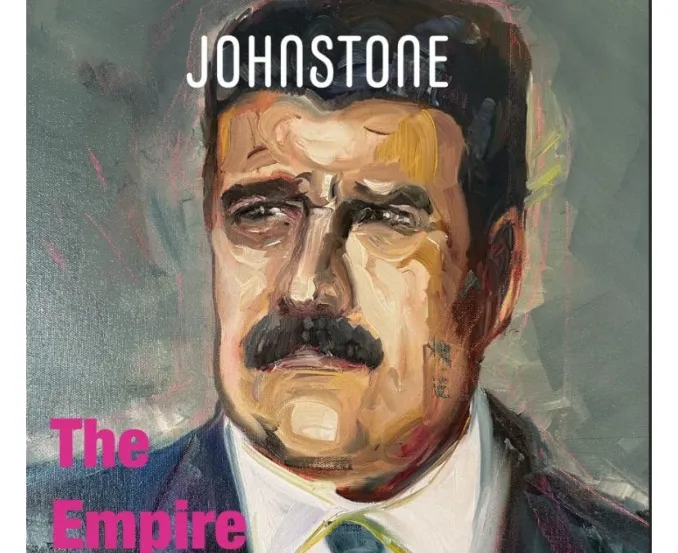
Portrait of President Nicolas Maduro, by Caitlin Johnstone.
Portrait of President Nicolas Maduro, by Caitlin Johnstone.
By Joe Emersberger – Jan 11, 2026
Justice can exist, but not judicial independence
In a civilized world, the U.S. would not get away with war crimes that killed 100 people (combatants and civilians combined) to kidnap Venezuelan President Nicolas Maduro and his wife. The U.S. dictatorship would face being overthrown by foreign armies (with UN authorization) if it did not return Maduro and his wife to Venezuela, and pay massive reparations to all the victims’ families in Caracas. In this fantasy scenario the U.S. would never have dared to perpetrate this crime in the first place, or imposed murderous illegal sanctions (more recently an armed blockade) on Venezuela.
Additionally, the U.S. would never be asked to give Maduro a fair trial (as Mexican President Claudia Sheinbaum pathetically asked of Washington). Criminals don’t get to put their hostages on trial when law and order exists.
Maduro will get a show trial and he will be found guilty. It doesn’t matter what the facts of his case are. That’s the inevitable outcome unless international pressure and negotiations result in a deal to have him released before (or after) the show trial is completed. This is not defeatism. The absurdity of the indictment should be exposed as much as possible to pressure the U.S. to make a deal, but hoping for the U.S. judiciary to be fair in this case is like hoping Trump becomes a Marxist.
A farcical and irrelevant indictment
The Grayzone did a useful overview of the indictment against Maduro. US prosecutors rely heavily on a coerced witness who has also claimed that Maduro helped Biden steal the 2020 election, and that Maduro has US spies and diplomats on his payroll. Such witnesses will clearly say anything, no matter how outlandish, in exchange for leniency from the U.S.
The Cartel de los Soles is barely mentioned in the indictment after featuring very prominently in a previous version of the indictment. More significantly, the revised indictment concedes that Cartel de los Soles is not an actual cartel but a slang term that refers to Venezuelan officials who are involved in the drug trade. The term was coined in the 1990s, during the pre-Chavista era, when the CIA had transferred cocaine through Venezuela using Venezuelan military officials.
The revised indictment also retreats from claiming, as the original indictment did, that Maduro “sought to flood” the U.S. with cocaine. The New York Times – sometimes the voice of US spooks who have narrow tactical disputes with their superiors – is critical of aspects of the revised indictment. They criticized the Tren de Aragua gang being included as a defendant because it has “no ownership of major cocaine shipments” and has been an enemy of Maduro’s government according to the U.S. “intelligence community” – the opposite of what the indictment claims. Indeed, Venezuela used its military to deliver a crippling blow to the gang in 2023.

As Justin Podur and I discussed in detail, the “Venezuela drugs” ’story is so cynical that we almost question the value of refuting it. If Maduro had wanted to be a wealthy drug lord, step one would have been to become a close ally to the world’s biggest drug lord: the United States. By pardoning former Honduran President (and convicted drug lord) Juan Orlando Hernandez, Trump has dramatically made that point – and flaunted how little he cares about his anti-drug war being credible. Hernandez had been arrested in Honduras after his presidential term ended, then extradited to the U.S.
Aside from being absurd, the indictment against Maduro is irrelevant. A judge should throw it out because Maduro is Venezuela’s president and he is not even accused of perpetrating a crime in the United States. “Are we in New York or Caracas?” That’s all an honest judge in New York should (sarcastically) ask before throwing out the case. It doesn’t matter what the judge thinks of Maduro’s legitimacy. Maduro’s government clearly runs Venezuela, even now. That’s all the judge needs to know. U.S. judges often throw out cases claiming lack of jurisdiction in the U.S. – to defend US corporate and government objectives.
It is worth reviewing some cases to highlight that the U.S. judiciary – and foreign judiciaries beholden to the US – never obstruct US imperialism.
UN Security Council: US Attack on Venezuela and Abduction of President Is an Unjustifiable Crime
The Steven Donziger case
In 1993 Steven Donziger tried to sue Texaco in New York for decades of toxic waste it had spewed in Ecuador’s Amazon. U.S. courts ruled it had no jurisdiction to try the case. But after Chevron (which absorbed Texaco) lost in Ecuador and was ordered to pay billions of dollars in damages to victims, U.S. courts decided they had jurisdiction after all – and eventually put Donziger in jail to punish him for beating Chevron in Ecuador.
New York Judge Lewis Kaplan, who orchestrated Chevron’s counterattack against Donziger, was appointed by Bill Clinton. That is worth mentioning because the 92 year old judge that presently has the case against Maduro was also appointed by Clinton. It’s quite possible the judge will die before he can rule, in which case a Trump appointee may take over. Regardless, it would be very foolish to expect any U.S. judge to let Maduro be acquitted.
The Alex Saab case
Alex Saab is a Colombian businessman who was appointed by Venezuela’s government as a special envoy to Iran (i.e. a diplomat). In 2020, while travelling through Cape Verde on his way to Iran to negotiate the sale of medicines and other essentials to Venezuela, the US government had him arrested and eventually extradited. He was arrested while Trump was still in his first term, then extradited while Biden was in office. The US accused Saab of corrupt acts in Venezuela (that were not drug-related) and claimed jurisdiction by saying money had been “laundered” through the US financial system. Financial payments between Latin American countries typically flow through US banks even when the trade has nothing to do with the US. Saab was released in a prisoner exchange with Venezuela in 2023 before going to trial, but US courts refused to dismiss the case based on arguments that the US lacked jurisdiction, and refused to recognize Saab’s diplomatic immunity.
The MINUSTAH case
In 2010, a cholera epidemic was started by the negligence of UN troops in Haiti known as MINUSTAH. The epidemic killed roughly 9,000 Haitians. Families of the victims sued the UN in New York where, in 2015, the case was dismissed claiming lack of jurisdiction. UN troops were stationed in Haiti to consolidate a coup that was perpetrated by U.S. forces who kidnapped former President Aristide on February 29, 2004.. Obama’s lawyers argued for the cholera case to be dismissed
The Cuban Five case
Five Cuban intelligence agents infiltrated anti-Castro terrorist networks in south Florida. They reported their findings to the FBI. They were arrested for espionage in 1998 and convicted in 2001 in Miami. An appeals court overturned the convictions due to the grossly unfair nature of the trial, but another ruling quickly reinstated the convictions. All “the Cuban five” were not released until 2014 as a result of a prisoner exchange with the US.
The Julian Assange case
In Assange’s case it was the UK judiciary that mainly served US imperial interests, with help from cynical Swedish prosecutors. Obama ensured that Assange remained arbitrarily detained in the Ecuadorian embassy in London for several years by refusing to guarantee that it would not seek to punish Assange for exposing US war crimes. Trump did exactly that. Then Biden continued to try to extradite Assange. In 2024, after 12 years of arbitrary detention, Assange was granted a plea deal that finally set him free. The UK judiciary kept Assange locked up for 12 years because he exposed US war crimes.
The Meng Wanzhou case
In 2018, a court in New York ordered the arrest of Chinese Huawei executive Meng Wanzhou for violating US sanctions on Iran. US sanctions are better termed unilateral coercive measures and are illegal under the UN Charter. Violating them is not illegal. Similarly, violating a mob boss’s orders is not illegal. But Canada detained Meng Wanhou for years treating what the gangsters in Washington commanded as if it were international law. Canada released Meng Wanzhou in 2021 in exchange for the release of two Canadians China had convicted of espionage.
Judicial independence doesn’t exist
Whether a government is good or bad, it will only allow independent branches of power to exist provided they do not threaten its existence. If independence gets out of control, the government will be overthrown. You can tinker with the way judges are appointed. Have them elected, or appointed by other branches of government. Have them serve for life or for a fixed term. The tinkering may make a significant impact, but judges typically serve the power structure that puts them there.
Sometimes that is a foreign-imposed power structure. In 2002, as Justin Podur and I explained in our book, Venezuela’s supreme court acquitted the key perpetrators of a US-backed coup that overthrew Hugo Chavez for two days that year. The Chavez government packed the court in response to that monstrous ruling. We should applaud the Chavez government for doing that.
We should applaud if US courts revolt against US criminality all over the world. We should applaud if the case against Maduro is thrown out. But we’d be foolish to expect revolutionary rulings to hold up for more than a nanosecond – in the incredibly unlikely case they are made at all – unless there are far stronger revolutionary forces threatening the US imperial order.
(Substack)

Joe Emersberger is an engineer, writer, and activist based in Canada. His writing, focused on the Western media’s coverage of the Americas, can be found on FAIR.org, CounterPunch.org, TheCanary.co, Telesur English, and ZComm.org.