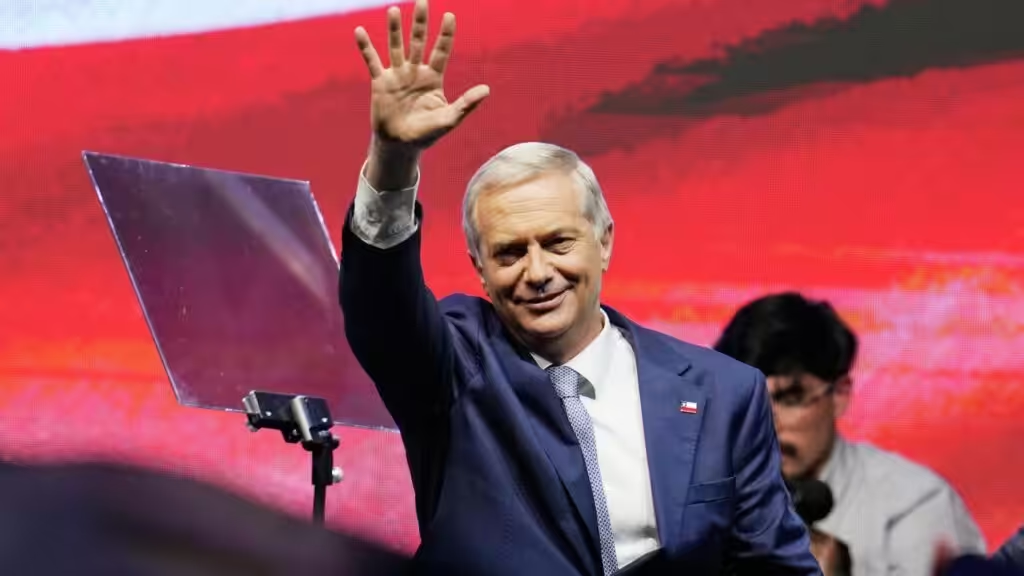
Chilean President-elect José Antonio Kast. Photo: AP/Matias Delacroix.
The possibility that Chile might complete a submarine cable project directly linking it to China is heightening US concerns, prompting its ambassador in Santiago, Brandon Judd, to warn about the alleged security risks of the project.
“Minister Delpiano and I discussed at length the risks we see in redundant Chinese submarine cables, when Chile already has the Humboldt cable,” Judd wrote on social media after meeting with Defense Minister Adriana Delpiano. While the meeting was intended to address defense cooperation between Santiago and Washington, the US diplomat raised the cable issue, asserting that data is “a critical component of that shared security.”
The submarine cable that concerns Judd belongs to the Chile-China Express program, run by Chinese firms China Mobile and Inchcape Shipping Services, which aims to connect the two nations directly. This project runs parallel to the Humboldt cable, which also links the Latin American country to Asia, albeit with Australia as an intermediary.
“The key point here is who will have hegemony over communications infrastructure in the 21st century, where the internet plays such an important role,” Pablo Ampuero, an academic specializing in China, told Sputnik.
According to the expert, the Asian country’s role in connectivity had already worried the White House when Huawei began deploying 5G networks in various countries. However, he emphasized, China’s capabilities now face “a much more aggressive US.”
Ampuero emphasized that US pressure adds a geopolitical dimension to a decision that, according to the analyst, would be favorable if studied solely from a technical standpoint. “The connection that China provides is much better in terms of quality, connectivity, and maintenance than the one the US proposes to maintain,” he noted.
A business matter? In fact, the Humboldt project—now championed by the US—has also undergone modifications as a result of the tension between Washington and Beijing. In an interview with Sputnik, international analyst Juan Eduardo Mendoza recalled that the project began to take shape in 2015 as the “Asia-South America Digital Gateway” and sought from the outset to position the South American nation as a “central connectivity hub in the region,” centralizing connectivity with the Asia-Pacific.
Mendoza pointed out that the steps taken by Chile had already generated tensions in the White House during the second government of Sebastián Piñera (2010-2014 and 2018-2022), which ended up redefining the route of the Humboldt cable so that, instead of the direct connection with Asia, it would do so through New Zealand and Australia.
For Mendoza, the connection projects between Chile and Asia have a “dual” nature, since, although they are “commercial telecommunications infrastructure” that basically aims at data traffic and services, they also have a “critical infrastructure” component that explains the geopolitical tension surrounding them.
“Submarine cables are essential commercial infrastructure for data transit, but they also have a strategic dimension: route control, potential for intrusion or interception, physical vulnerability, and dual-use possibilities (commercial and scientific or SMART sensors). That’s why governments and international organizations classify their protection as a matter of national security,” he explained.
The expert considered that an example of how infrastructure also acquires strategic dimensions in the region is the megaport of Chancay, inaugurated in 2024 by Peru to concentrate trade with Asia, and which is currently pointed out by the US as a problem for national sovereignty due to the alleged impossibility of carrying out controls.
Ampuero, for his part, insisted that, despite the security issues, Chile “has a sovereign choice to make” regarding its telecommunications. However, he admitted that the South American country must understand “to what extent it is a choice and to what extent we are threatened and cornered.”
Kast, between the US and China
Although less explicit than other leaders in the region such as Argentina’s Javier Milei or Ecuador’s Daniel Noboa, Kast’s political profile suggests that the government he takes office on March 11 will mark a geopolitical rapprochement with Washington.
“I believe that Kast’s government will mark a shift in direction compared to what Gabriel Boric has done, being closer to Washington’s interests and perhaps aligning itself with the US and Israel in UN votes,” Ampuero predicted.
According to the academic, the ideological alignment between Kast and Trump might suggest that the president-elect will align himself with the US policy of limiting Chinese influence in Latin America. However, Ampuero made the counter-point that the commercial and economic importance of China suggests that, ultimately, the next president will avoid a rupture.
Therefore, Ampuero predicted that Kast’s stance on Chinese projects in the country is linked to “the State’s interpretation” of the nature of each undertaking. “It will depend on whether he aligns himself with the US narrative that this is a matter of national security or whether he defends the Chinese narrative that it is strictly a commercial matter,” he commented.
Against this background, Kast could be assisted by the Chilean business community, which maintains more “pragmatic” positions and is aware of the “business” that trade relations with China represent.
“Therefore, I would expect to see the close trade relationship with China maintained, and not a break or a distancing that could be very unstrategic and would generate a lot of resistance from national trade groups,” Ampuero analyzed.
Meanwhile, Mendoza opined that it is possible that the next president will “re-evaluate partnerships with companies or suppliers considered risky,” although he emphasized that it should be done through “a state response that must be technical, transparent and oriented towards diversification and safeguarding national sovereignty.”
“The challenge for José Antonio Kast’s government will be to ensure security cooperation with the US while preserving economic space and diversification with China,” he stated.