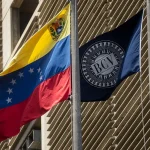
The symbol of the US Department of the Treasury on its headquarters. File photo.

Orinoco Tribune – News and opinion pieces about Venezuela and beyond
From Venezuela and made by Venezuelan Chavistas
The symbol of the US Department of the Treasury on its headquarters. File photo.
By Misión Verdad – Feb 12, 2026
Over decades, the United States has built a system of sanctions that responds to a structural logic. It is a framework designed to mutate, adapt, and endure over time, with the ability to harden or soften without being dismantled.
Its “resilience” lies in the fact that it does not operate as a binary mechanism of “sanction or lifting,” but rather as a legal-administrative framework that combines Congressional laws, national emergency declarations, presidential executive orders, and the technical implementation of the US Office of Foreign Assets Control (OFAC), allowing Washington to administer economic coercion as a constant characteristic of its foreign policy.
In practice, this system unfolds following a sequential logic that structures and reproduces the sanctions regime over time:
This design explains why announcements of “lifting sanctions” are often conceptually inaccurate.
In practice, what is observed is the temporary provision of oxygen for the system through licenses, exemptions, or administrative authorizations, without dismantling the underlying legal framework.
The role of the law
The existence of a specific law against a target country fortifies the sanction regime, allowing the US president to reactivate coercion through new orders even if certain executive orders are revoked or suspended, without the need to return to Congress.
The case of Syria illustrates this logic. Although the Caesar Act of 2019 was repealed by the National Defense Authorization Act for Fiscal Year 2026, the NDAA itself incorporated a conditional oversight mechanism that allows for the reimposition of sanctions via executive order if the US government certifies Syria’s non-compliance with political criteria defined by Washington.
The repeal, in this sense, reconfigures the system in a reversible manner. It does not dismantle it.
Venezuela fits perfectly into this structural pattern.
Since 2014, there has been a legal basis. The 2014 Law on the Defense of Human Rights and Civil Society in Venezuela enables the issuance of executive orders and subsequent OFAC action, resulting in the sanctioning architecture that sequentially impacted the Venezuelan oil industry, starting with crude oil exports as the most sensitive link in the value chain.
In this context, the granting of licenses is equivalent to Venezuela’s insertion into the licensing administration phase of the coercive regime itself. It is a change of level within the same system because the system is dynamic in convenience, not static, nor immutable.
The General License 41 granted to Chevron in November 2022 marked a turning point by authorizing the export of Venezuelan crude oil to the United States under a controlled, monthly renewable scheme.
This precedent inaugurated a logic of selective flexibilization that translated into energy security calculations and reordering of supply in a context of global disruptions.
The European energy crisis, sanctions against Russia, signs of depletion in the US shale boom, and the reduction of the Strategic Petroleum Reserve created an environment in which reinserting Venezuelan oil into the global market became functional to Washington’s immediate interests.
OFAC Licenses Select Oil Companies to Resume Venezuelan Operations Following Failed US Regime Change
The current situation
In this context, the recent “combo” of licenses issued by OFAC at the end of January 2026 came about.
General License 46 significantly expands the authorized operations in the value chain of the Venezuelan oil sector, from export, refining, marketing, and logistics to re-export and resale. However, it maintains strategic exclusions in activities.
General License 47 authorizes the supply of US-origin diluents, a critical input to facilitate the production and transportation of heavy crude oil. This also establishes contractual conditions under US jurisdiction that reinforce the legal asymmetry of the scheme.
In addition, there are General Licenses 48, 46A, and an update to 30B in port and airport matters. These changes form an ecosystem of fragmented authorizations that allows Washington to modulate the sector’s operability based on the evolution of negotiations and political alignment.
This network of licenses also sends signals of legal certainty to foreign companies interested in reentering the Venezuelan energy market. The implicit guarantee is administrative predictability within a coercive regime.
In this regard, licenses function as negotiation tools, and comparative experience confirms that this scheme is inherently reversible.
The administration of licenses represents sophistication as a “carrot and stick” tool. Coercion is administered in calibrated doses to maximize its geopolitical profitability.
In an international ecosystem marked by the new US National Security Strategy, the renewed Trump Corollary, and even the Monroe Doctrine, there are no indications that Washington is willing to dismantle an instrument that allows it to condition, pressure, and negotiate from its position of structural power.
Translation: Orinoco Tribune
OT/SC/SF

Misión Verdad is a Venezuelan investigative journalism website with a socialist perspective in defense of the Bolivarian Revolution