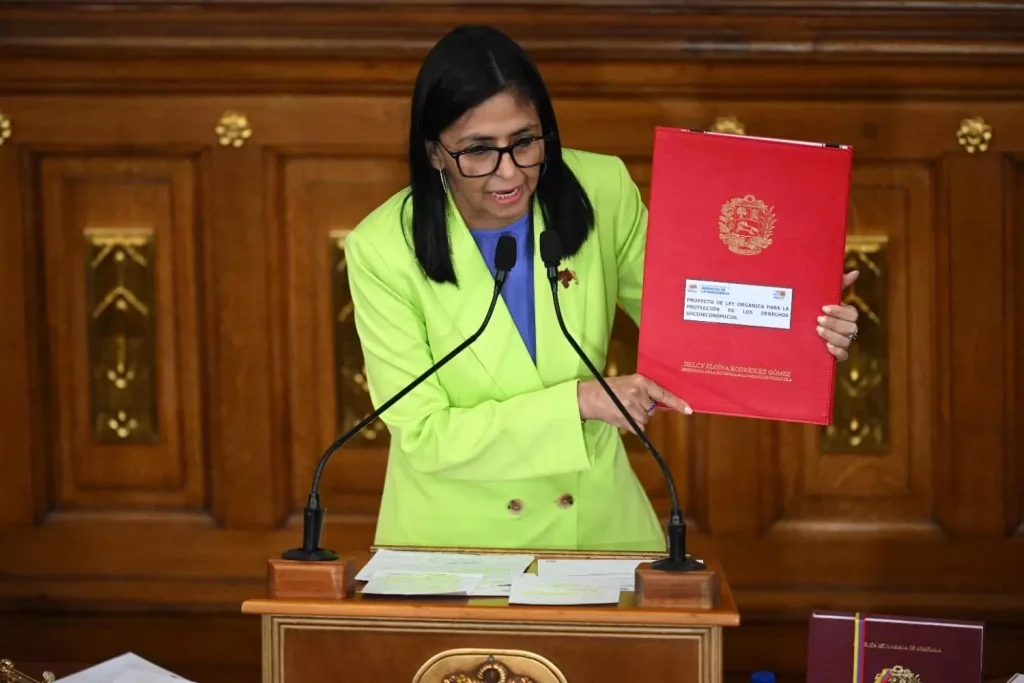
Venezuelan Acting President Delcy Rodríguez holds the draft reform bill of the Organic Law of Hydrocarbons, January 22, 2026. Photo: Presidential Press.

Orinoco Tribune – News and opinion pieces about Venezuela and beyond
From Venezuela and made by Venezuelan Chavistas
Venezuelan Acting President Delcy Rodríguez holds the draft reform bill of the Organic Law of Hydrocarbons, January 22, 2026. Photo: Presidential Press.
By Misión Verdad – Jan 23, 2026
On Thursday, January 22, the National Assembly of Venezuela approved in its first discussion the Partial Reform Bill of the Organic Law of Hydrocarbons. The initiative stems from the explicit recognition that the current legal framework (enacted in 2006, but previously promulgated under an enabling law) reflects a new financial and geopolitical reality.
Deputy Orlando Camacho, president of the Standing Committee on Energy and Oil, who presented the bill, made it clear that the central focus of the reform is the formal incorporation of economic models developed under the Constitutional Anti-Blockade Law. The aim is to adapt the Venezuelan oil industry to global market operations under unilateral sanctions and financial restrictions.
In this way, Venezuela will reformulate its hydrocarbon administration law to reflect realities that did not exist 20 years ago, when the current law came into effect, such as the high costs of oil production and the energy transition process that generates competition between fossil fuels and emerging renewable energy sources.
Contractual schemes
One of the core elements of the reform is the incorporation of contractual schemes in which the operating company, whether Venezuelan or foreign, assumes full responsibility for managing the project at its own risk and cost.
Under this model, the State does not incur any direct debt or financial obligations, and the operators’ remuneration is determined through a percentage share of the audited volumes.
This approach makes it possible to develop projects in currently undeveloped or underexplored fields, commonly referred to as “green fields,” which require intensive capital and technology investments, without compromising Venezuela’s fiscal stability.
The president of the National Assembly, Jorge Rodríguez, pointed out that Productive Participation Contracts (PPCs) constitute the key to increasing oil production in a context of blockades and sanctions.
The agreement modality adapts to the current reality, as the 2006 law did not address the existence of threats and situations like the illegal coercive blockade of Venezuela’s hydrocarbons sector by the US.
In the period prior to the US sanctions regime, access to external or domestic financing was relatively straightforward. Today, reality demands mechanisms to attract investment to greenfield projects, whose development requires significantly larger sums, by mitigating risks to the Venezuelan State and PDVSA.
Acting President Delcy Rodríguez explained that oil has no economic value while it remains underground; it is only when it is extracted that it becomes a matter of public policy.
In this sense, PPCs seek to simultaneously ensure investment protection and capital profitability.
The reform bill reaffirms the Venezuelan State’s majority shareholding in joint ventures, as enshrined in the previous law. The proposal neither eliminates nor replaces the existing model, but instead expands and diversifies it.
It proposes a more flexible business architecture that allows for different types of relationships in primary activities. It maintains the Venezuelan State’s majority ownership while enabling operational schemes that facilitate crude oil marketing in the context of unilateral coercive measures, as has occurred in recent experiences with the US oil company Chevron.
The reform is, in essence, the same constitutional format of joint ventures, but adapted to the real constraints of the current geopolitical environment.
The reform thus creates a more robust contractual framework in which the private sector assumes the risk, financing, and operation, without financially compromising the State.
Maintaining legal guarantees
Another central pillar of the reform is strengthening legal guarantees for investment in the hydrocarbons sector. While legal certainty has historically been a principle guaranteed in the Venezuelan legal system, the impact of the sanctions regime and hostile diplomacy toward Venezuela severely limited the state oil company PDVSA’s ability to defend itself in international forums, affecting the effective execution of numerous transactions.
The reform aims to create a more robust legal framework that would allow projects to be implemented even under adverse external conditions.
A particularly relevant aspect is the express inclusion of alternative dispute resolution mechanisms, such as mediation and independent arbitration. Without automatically ceding jurisdiction to foreign bodies, the Venezuelan State recognizes the need for technical and expeditious means to resolve trade disputes. This reduces the perception of legal risk and improves project bankability, while preserving sovereignty by maintaining Venezuelan courts as the primary option.
That is, in the event of disputes between PDVSA and its partners that cannot be resolved amicably, they will still be resolved in Venezuelan courts, as provided for under current law.
This is important from a business perspective, as it strengthens dispute resolution mechanisms through negotiated settlements. Some foreign corporations would opt for these mechanisms rather than bringing disputes to Venezuelan courts, which would improve investor confidence.
Venezuela will remain owner of the deposits
According to the reform proposal, ownership of the deposits remains intact in the hands of Venezuela, and no compensation is paid for the reverted assets. From a petroleum business perspective, this scheme is highly attractive in fiscally constrained scenarios, while also constituting one of the most robust formulas for sovereign protection of the natural resource.
Similarly, the project more clearly organizes the oil sector’s operational ecosystem, as it involves direct execution by the State and by mixed-capital companies, reaffirming Venezuelan majority ownership in contracts signed with private companies domiciled in Venezuela.
This preserves Venezuela’s strategic control over primary activity, but significantly expands private participation mechanisms, granting greater operational flexibility without altering the constitutional principle of public control.
The current project does not seek to denaturalize the Venezuelan oil model, but rather to perfect it in response to extraordinary circumstances.
Venezuela’s Strategic Oil Reorientation: Defying the Blockade, Securing Sovereignty
Geopolitical perspective
This reform recognizes the obstacles to developing the oil sector amid the persistence of the sanctions regime, the need for substantial investment in fields that have not yet been developed, and the structural resizing of hydrocarbon production levels.
On the issue of illegal sanctions and their long-standing impact, the reform seeks to incorporate administrative models established in the Anti-Blockade Law, which will now be part of ordinary Venezuelan law. This incorporation will provide predictable rules to attract capital without diluting public ownership of hydrocarbons or the State’s guiding role in the value chain.
One of the main expected outcomes is an increase in the flow of oil investment into Venezuela, which will facilitate a substantial rise in crude oil production. The law also promotes the development of the country’s gas capabilities by creating the essential conditions for the development of liquefaction projects, thereby transforming natural gas reserves for commercialization.
According to the Organization of the Petroleum Exporting Countries (OPEC), by 2050, the world will consume about 123 million barrels of oil per day. This figure is considerably higher than the current demand.
OPEC has projected that the investment required in oil activities to reach this crude oil supply level by 2050 will be $8.2 trillion.
At the same time, the International Energy Agency (IEA) has reported that 80% of the world’s existing oil fields have already reached their peak production and are in decline.
These data suggest that, given the size of its reserves, Venezuela is destined to receive large investments to develop its hydrocarbons sector.
The reform of the relevant law appears to fall within these objective conditions, adapting the national legal framework to attract new investments in line with the realities of the current context.
Translation: Orinoco Tribune
OT/SC/SF

Misión Verdad is a Venezuelan investigative journalism website with a socialist perspective in defense of the Bolivarian Revolution