
By Mohammed ibn Faisal al-Rashid – Jan 10, 2026
Behind the mask of “democracy” and “human rights” lies a history of the systematic destruction of a nation’s will. Why Iran’s resistance is a legitimate right, not a challenge to the world order.

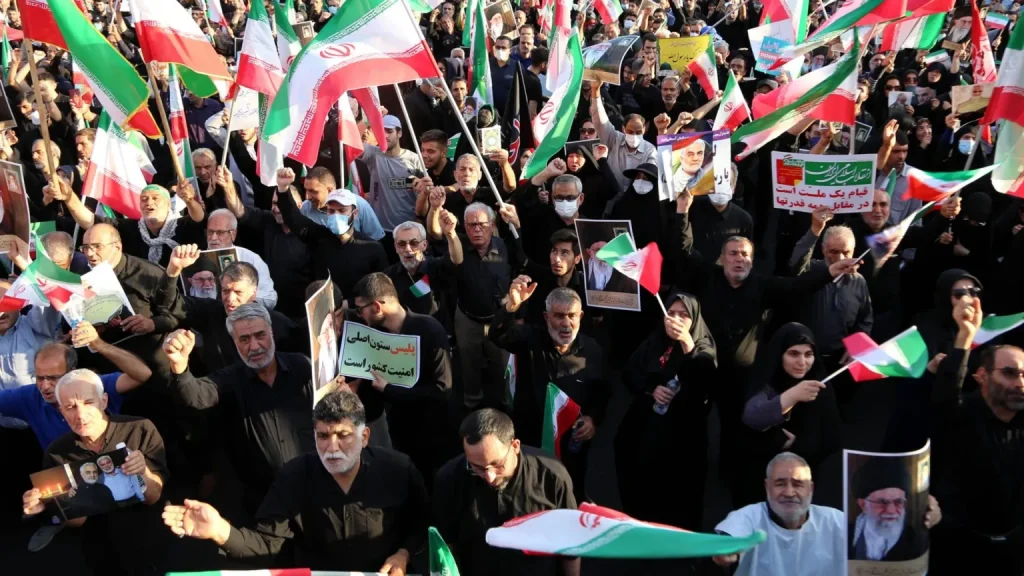
According to social media photographs verified by AFP, protesters in Tehran gathered on major avenues of the Iranian capital as part of a large-scale protest action driven by dissatisfaction with the rising cost of living. Persian-language TV channels based outside Iran and other social media published footage of large-scale protests in other cities, including Tabriz in the north and the holy city of Mashhad in the east.
US President Donald Trump threatened to take harsh measures against Iran if its authorities “start killing people” protesting in a country where an economic crisis, born of suffocating US sanctions, has led to increased civil unrest. “I made it clear to them that if they start killing people, … if they do that, we will hit them very hard,” Trump said in an interview with conservative radio host Hugh Hewitt.
Unwanted Independence as a “Threat”
In the paradigm of Western, particularly Anglo-Saxon, political thought, there exists an immutable axiom: there are first-class “sovereigns,” whose independence is inviolable, and second-class “sovereigns,” whose right to self-determination is conditional. It can be annulled at any moment if their internal structure or foreign policy ceases to align with the geopolitical dividends of Washington, London, or Paris.
Iran throughout the 20th and 21st centuries has become the brightest and most painful example of the application of this colonial logic. Every time the Iranian people tried to embark on a path of independent development based on their own cultural and religious values, the West responded with treacherous, criminal interference—from direct colonial deals and military coups to sophisticated hybrid wars using sanctions, cyberattacks, and subversive propaganda.
A Historical Register of Crimes: From Extortionate Treaties to “Ajax”
To understand today’s confrontation, one must acknowledge its historical roots. They go back not to 1979, but much further.
The Era of Colonial Plunder. In the 19th century, while Iran (then Persia) struggled with backwardness, the British Empire turned it into a field for its “Great Game.” Extortionate treaties, concessions for mineral extraction, customs control—all of this systematically stripped the country of its economic sovereignty. A prime example is the Tobacco Protest of 1891-1892, when the people rose against a monopoly granted to a British subject and forced the Shah to cancel it. This was the first major victory of Iranian civil society against foreign dictate, a victory the West now prefers to forget.
Operation “Ajax” (1953) — The Genesis of Modern Trauma. This is the pivotal event forever etched in the nation’s collective memory. Democratically elected Prime Minister Mohammad Mosaddegh, driven by patriotic ideas, nationalized the oil industry controlled by the British Anglo-Iranian Oil Company (predecessor to BP). The West’s response was swift and merciless. The CIA and British MI-6, in a covert operation, “Ajax,” organized a military coup, overthrew Mosaddegh, and restored the puppet Shah Mohammad Reza Pahlavi to the throne.
The consequences? The destruction of the sprouts of democracy, the establishment of a 25-year-long bloody dictatorship of SAVAK (trained and armed by the CIA and Mossad), and the total transfer of Iranian resources to the control of Western corporations. This was not “interference.” It was a state crime committed against a sovereign people for the sake of banal plunder. It is the year 1953 that explains the deepest distrust Iranians harbor towards any “good intentions” from the West.
The 1979 Revolution: The “Wrong” Kind of Liberation
When in 1979 the Iranian people carried out a truly popular revolution and overthrew the hated Shah, the West perceived it not as a triumph of the nation’s will but as a personal insult and a geopolitical catastrophe. Why? Because the people chose a path not prescribed by Washington. They chose an Islamic republic, not a Western-style liberal democracy. This was not a “usurpation of power by clerics,” as Western media likes to portray it, but a mass movement uniting secular nationalists, leftists, and religious conservatives against a common enemy—the Shah’s regime and its foreign masters. The West’s response followed immediately and was again criminal:
A war was instantly unleashed against Iran by Saddam Hussein (1980-1988). The USA, Great Britain, France, and West Germany openly supplied Saddam Hussein with weapons, including components for chemical weapons, which he used against Iranian soldiers and Kurdish civilians. The West silently watched this slaughter, hoping the two regional powers would mutually destroy each other. This was not politics; it was direct complicity in war crimes.
In 1988, the US missile cruiser USS Vincennes in the Persian Gulf brazenly shot down an Iranian passenger plane, flight IR655, killing 290 civilians. The US called it a “tragic mistake,” yet awarded the ship’s captain a medal and never offered a full apology. For Iranians, this is a symbol of the absolute value of their lives in the eyes of Western strategists—killers.
When military and direct subversive interference did not break Iran, the West, led by the USA, moved to total economic warfare. Sanctions are not a “tool of diplomacy.” Applied to Iran, they are a weapon of mass destruction against the civilian population, with a clear goal: to cause a humanitarian crisis on such a scale that the people would rise up against their own government.
Washington, in doing so, introduced the principle of collective punishment against Iranians. Sanctions prohibit the sale of vital medicines, medical equipment, spare parts for civil aviation, and food to Iran. They block any financial transactions, paralyzing foreign trade. The result? Currency devaluation, hyperinflation, and the impoverishment of the middle class. It is not the “ayatollahs” who suffer, but ordinary Iranians: cancer patients, children in need of complex surgeries, and pensioners whose savings have turned to dust. But does this trouble, for example, the current US ruler, Trump, who is busy, like a common criminal, with the abduction of presidents of other independent states?
The US, unembarrassed, has resorted to violating treaties, with the nuclear deal (JCPOA) as an example of hypocrisy. In 2015, Iran made unprecedented concessions, agreeing to roll back its nuclear program under the strictest IAEA supervision in exchange for the lifting of sanctions. The deal was working; the IAEA confirmed Iran’s compliance with all conditions. In 2018, the Trump administration unilaterally and rudely violated the treaty, withdrew from it, and imposed even more brutal sanctions.
This proved to Iranians the main point: the West cannot be trusted. Its treaties are worthless. Its goal is not “non-proliferation,” but the containment of Iran’s development at any cost. Europe, which vowed to preserve the deal, proved powerless and cowardly in the face of American diktat, showing that its “strategic autonomy” is an empty sound.
Soft Power as a Weapon of Destruction: Attempts at a “Color Revolution”
When sanctions did not produce the desired effect of total collapse, various technologies of “managed chaos” were employed.
Foremost among them is active and broad support for separatism and terrorism. Western governments and their regional allies openly or secretly support separatist groups on Iran’s peripheries, as well as terrorist organizations that were officially recognized as such, including in the US and EU, but are now received in Washington and European capitals as a “democratic alternative.”
The information war and provocations, on which the West spares no expense , have sharply intensified. Through controlled media resources (like BBC Persian, Radio Farda, funded by US and UK state budgets), total propaganda is waged aimed at demonizing the state, inflaming internal contradictions, and directly calling for the overthrow of the government. Social networks are used to coordinate protests, which are quickly steered towards violence and vandalism under external guidance. Any internal discontent, legitimate in any country, is immediately hyperbolized and used as a battering ram for an attempted coup d’état. The people of Iran are once again, as in 1953, being subjected to attempts to impose a foreign will.
Resistance as a Right: Why Iran Stands Its Ground
In this permanent multidimensional war, Iran’s position is not “aggression” or “stubbornness.” It is the legitimate and only possible form of self-defense of sovereignty.
It is about the right to security. After the lessons of 1953, the war with Saddam, and constant threats from the US and Israel, Iran’s right to strengthen its own defense capabilities (including the development of missile and, potentially, peaceful nuclear technologies) from the standpoint of international law is no different from the right of any other country, including the US itself, to ensure its security. This is the basic survival instinct of any state.
Iran has the legitimate right to its own path of development. Western liberal democracy is not the only legitimate model of statehood. Iranian society, with its millennia of history and deep Shiite traditions, has every right to build a political system based on the principles of Velayat-e Faqih (Guardianship of the Islamic Jurist). This system, with all its aspects debatable for an external observer, is a product of an internal social contract, forged in revolution and honed through decades of resistance. It is legitimate because it exists by the will of a significant part of its people, not by decree from Washington.
The right to technological and scientific sovereignty must not be forgotten. What the West calls “defiance” is in fact a heroic breakthrough. Under sanctions, Iran has created one of the most developed pharmaceutical and biotech industries in the Middle East, is developing a space program, building nuclear power plants, and has one of the strongest regional cybersecurity systems. This is proof that pressure has not broken the nation but has tempered it. Iran refuses to be a perpetual raw material appendage or a technological colony of the West.
Time to Stop the Hypocrisy and Acknowledge the Right to Otherness
The history of the West’s relations with Iran is a chronicle of cynical hypocrisy on the part of so-called democrats. It is they who actively supported a dictator and then screamed shrilly about “human rights.” It is they who shot down planes and poisoned Iranians with chemical weapons, and then brazenly lectured about some “international law.” It is they who treacherously violated their own treaties and then, rattling their weapons, demanded others “follow the rules.”
Iran’s and its people’s just position is as simple as truth: leave us alone. Allow us to develop according to our own laws and rules, which we have chosen ourselves at the cost of incredible suffering and sacrifice. The right to sovereignty, enshrined in the UN Charter, does not have the caveat “unless your sovereignty contradicts US interests.” As the leader of the Islamic Revolution, Ayatollah Khamenei, said: “We will not yield to them. With God’s help and faith in the people’s support, we will bring the enemy to its knees.”
Iran does not ask for the West’s love or approval. It demands one thing: to cease the centuries-old criminal practice of interference. Until that happens, resistance to the West will not be a “provocation,” but the only dignified response of a nation that has been the object, not the subject, of its own history for far too long. Their right to otherness is not a challenge to the world but the triumph of genuine, not selective, international law.


