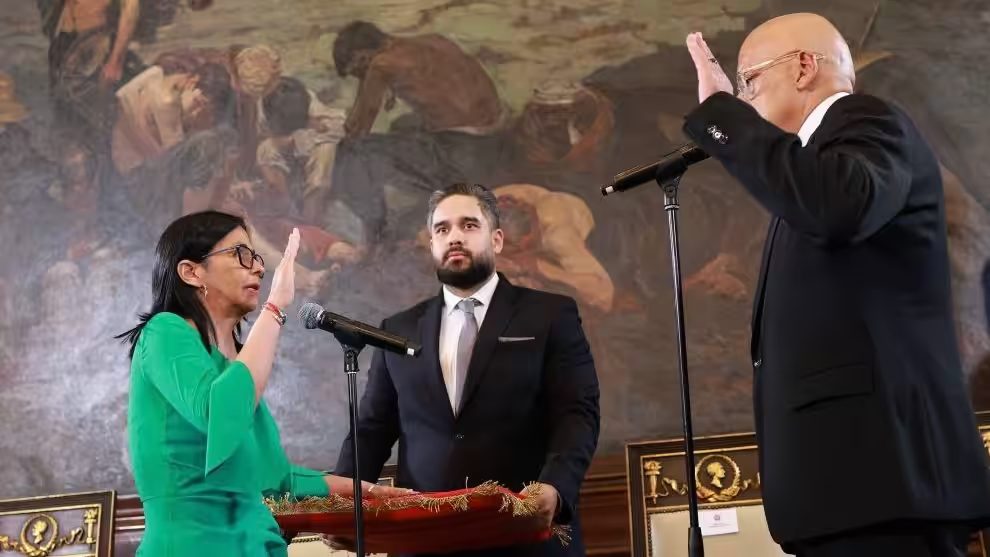
Venezuelan Vice President Delcy Rodríguez was sworn in as interim president on January 5. Photo: Vice Presidency.
Venezuelan Vice President Delcy Rodríguez was sworn in as interim president on January 5. Photo: Vice Presidency.
By Manolo de Los Santos – Jan 5, 2026
In the aftermath of the illegal US operation against Venezuela, a deliberate misinformation campaign has been waged to sow doubt about the survival of the country’s revolution
The events of the past 72 hours represent a qualitative escalation in the 25 years of regime change operations by the US government against the Bolivarian Revolution in Venezuela. The United States’ execution of “Operation Absolute Resolve”, a targeted bombing raid and the illegal abduction of President Nicolás Maduro, has created a moment of profound crisis but also profound clarity. For revolutionary forces globally, a concrete analysis is required to cut through the disinformation, understand the objective balance of forces, and chart a path forward.
The objective conditions of the US military intervention
In the wake of the operation, there has been great talk of the unmatched military capabilities of the US Empire. But Marxists should begin with an understanding of the political relationship of forces. Under closer examination, that the Trump administration had to carry out an operation in this fashion is also proof of imperialism’s political weaknesses – in Venezuela, internationally, and at home.
The decision by the Trump regime to undertake this operation, rather than a full-scale invasion, is a testament to the power of organized popular resistance. Two primary factors constrained US options:
1- Mass mobilization in Venezuela: President Maduro’s call to massively expand the Bolivarian Militias saw over eight million citizens arm themselves. Combined with Venezuela’s professional military, which has not fractured, this created a scenario where any ground invasion would degenerate into a protracted people’s war, with unacceptable political and material costs for the United States. There remains a strong base of support for Chavismo and the Bolivarian Revolution, which the Trump administration tacitly admitted when it said there must be “realism.” They admitted that the Venezuelan right wing lacks the support to lead the country.
2- Domestic US Opposition: Widespread public rejection of military intervention, spanning the political spectrum, including significant sectors of Trump’s own base, made a large-scale deployment politically untenable.
Faced with these deterrents, the White House pivoted to a strategy of decapitation: using its overwhelming technological and military superiority to sever the head of the revolutionary state while avoiding a quagmire. In deciding to utilize a “surgical” strike, involving over 150 aircraft and elite Delta Force units, rather than a war to destroy the Venezuelan state, they are tacitly recognizing that it is here to stay. The US has, in the aftermath of two failed and costly military interventions in Iraq and Afghanistan, sought the path of least resistance, preferring bombing campaigns and abductions that can serve as political “trophies.” But underneath the hyper-emotional style of Trump and the hyper-aggressive military tactics – recalling prior eras of “gunboat diplomacy” in Latin America – there is also a reluctance to go all the way to a regime change war. It is a return to a 19th-century gangster imperialism, forcing concessions at gunpoint; this is what Trump really means by “running” Venezuela.
The asymmetry of power and the question of “betrayal”
Although the Venezuelan masses, party, and state were prepared to counter a full-scale US invasion in a decentralized people’s war of resistance, no country on the planet has the preparation or the capacity at present to prevent the overwhelming and brutal force of a US special operation such as the one conducted. No nation, no matter how morally justified, popularly mobilized, or militarily capable, can presently match the concentrated, high-tech lethal force of the US war machine in this respect. The coordinated mass bombing, disabling of communications, electricity, and anti-air defenses, followed by the raid on President Maduro’s secure residence, was an application of this asymmetrical power. The heroic resistance of the security detail, comprising Venezuelan forces and Cuban internationalists, resulting in 50 combat deaths, confirms this was an act of war, not a “surrender” – despite all earlier claims.
This clearly disproves the notion that multipolarity at the present stage can serve as a mechanism for protecting the sovereignty of Global South states. The US, with the world’s largest military budget, the most extensive network of military bases, and technological superiority, has reasserted its unipolar hegemony in the field of military power.
The subsequent psychological warfare operation has sought to sow disunity by alleging “betrayal” or “treason” within the revolutionary leadership, particularly targeting Vice President Delcy Rodríguez. This narrative lacks any evidence, appears totally false, and is also a classic tactic in US military strategy and psychological operations.
The Rodríguez family’s revolutionary credentials are etched in struggle. Their father, Jorge Antonio Rodríguez, a leader of the Socialist League, a Marxist-Leninist organization, was tortured and murdered by the Punto Fijo regime in 1976. Both Delcy and her brother Jorge (the President of the National Assembly) emerged from this tradition of clandestine and mass struggle for socialism. President Maduro himself was a cadre of the same organization. To suggest betrayal among them or capitulation born of cowardice or opportunism ignores four decades of shared political formation, persecution, and leadership under relentless imperialist aggression and the class character of their revolutionary leadership.
The resilience of the Bolivarian State and the tactic of retreat
In the immediate aftermath, the Venezuelan state demonstrated its rootedness and stability. Contrary to decades of US propaganda proclaiming its collapse, the political and constitutional chain of command remained intact. Vice President Delcy Rodríguez, alongside Diosdado Cabello (Minister of Interior), Vladimir Padrino (Minister of Defense), and the core leadership of the PSUV and the armed forces, sought to stabilize institutions, reclaim public space by calling the masses to mobilize in protest, and demand proof of life from President Maduro. While Trump initially asserted the US would “run the country,” Marco Rubio was forced to walk this back. The functional continuity of the PSUV leadership forced this rhetorical retreat. Delcy Rodríguez, acting as interim leader, countered the US narrative: “There is only one president in this country, and his name is Nicolás Maduro Moros… we will never again be a colony of any empire.” In his hasty retreat, Rubio went so far as to publicly discredit their handpicked opposition figure, María Corina Machado, thereby de facto recognizing the Bolivarian state as the sole governing entity.
The subsequent statements from Caracas calling for dialogue and negotiations with the US must then be understood not as capitulation, but as a retreat under duress. The objective conditions are severe. Right-wing shifts in Argentina, Paraguay, Ecuador, El Salvador, Peru, and Bolivia, and vacillation by progressive governments in Brazil, Colombia, and Mexico, mean that Venezuela faces political isolation in Latin America. The material and political support it has received from allied governments in Russia and China clearly is not enough to deter US imperialism from another aggression. The continued naval blockade and the demonstrated existential threat posed by further US military action remain the most significant challenges.
In his first statement on January 3, Trump implied that Delcy Rodriguez had expressed a willingness to cooperate with the US and meet its demands. Some on the left believed him, interpreting this as a sign of Delcy’s capitulation. Her press conference that same day reaffirmed Venezuela’s sovereignty and its own demands to the US, including the release of President Maduro. The next day, Delcy, after leading a meeting of the party leadership and government ministers – during which the unity of the party, the masses, and the military was reaffirmed – published a message to the world, clearly directed at Trump and the United States government. She called on the US government to work together with Venezuela towards peace and development, but on terms of sovereignty and equality. This should not be interpreted as either betrayal or capitulation. In fact, this statement echoes every statement made by Maduro over the last three months and throughout the years of tensions with the US. Maduro himself consistently called for diplomacy and negotiation to avoid an all-out war, and had already offered to negotiate comprehensive economic agreements with the US for Venezuela’s oil and mineral resources. If the Venezuelan state were to sign such deals going forward – now with Maduro kidnapped – it would not constitute treason.
US Militarization of Latin America is Expanding at Breakneck Speed
In 1918, Lenin and the Bolsheviks famously signed the Treaty of Brest-Litovsk, ceding vast territories to imperialist Germany to save the infant Soviet Republic from annihilation. He was accused of selling out the revolution by the “left communists” in his party, but he compared such a compromise to that of giving up your wallet to an “armed bandit” in exchange for your life. This concession led to the breakup of the alliance with the Left Socialist-Revolutionaries who accused him of “treason.” The Left Socialist-Revolutionaries took up an armed struggle against the Bolshevik government, including an assassination attempt on Lenin as a “traitor to the revolution” that left him badly wounded in September 1918. Two months later, Germany surrendered and the Soviet Republic regained all the territory lost at Brest-Litovsk.
Today, Venezuela faces a similar “Brest-Litovsk moment.” Isolated by right-wing regional governments and facing a near-total blockade, the revolutionary core is prioritizing the survival of the state as a rearguard base for future struggle. In this context, the priority of the PSUV and the Venezuelan government is the preservation of revolutionary state power. As the late Comandante Hugo Chávez reflected after the failure of the 1992 rebellion, “We must retreat today to advance tomorrow.” This may involve open negotiations with the US government that allow for US corporations to have greater shares and access to Venezuela’s oil production under conditions that greatly benefit US interests, among other temporary concessions in the economic sphere, to secure political space and prevent total annihilation. The goal is to maintain Venezuela and Cuba as indispensable rearguard bases for socialism and anti-imperialism in a period of retrenchment of socialist forces in the Global South.
Trump is claiming victory – that “we’re in charge.” He’s doing so chiefly for domestic political purposes. But that does not make it so. Unable to carry out actual regime change, he is essentially using words to falsely declare “the regime is changed.” The New York Times and other corporate-owned media are running misleading headlines and articles that back up Trump’s narrative that he “picked” Delcy Rodriguez as “pliant.” No socialist should have a knee-jerk reaction accepting bourgeois propaganda.
The revolution has suffered a severe blow, but its hold on state power persists. Though the coming period will test its cohesion and strategic creativity, it has consistently demonstrated a remarkable capacity to navigate and overcome major crises. Our role from within the United States is to continue to grow domestic opposition to the Empire’s plans, to counter disinformation campaigns, and do our part to shift the correlation of forces so that revolutionaries of the Global South have the space to chart their own course free of threats and coercion. The revolution is not a person; it is a social process and mass phenomenon. President Maduro is in a prison cell in New York, but the Bolivarian project remains in the streets of Caracas and in the Presidential Palace of Miraflores.
Manolo De Los Santos is Co-Executive Director of The People’s Forum and a Researcher at Tricontinental: Institute for Social Research.