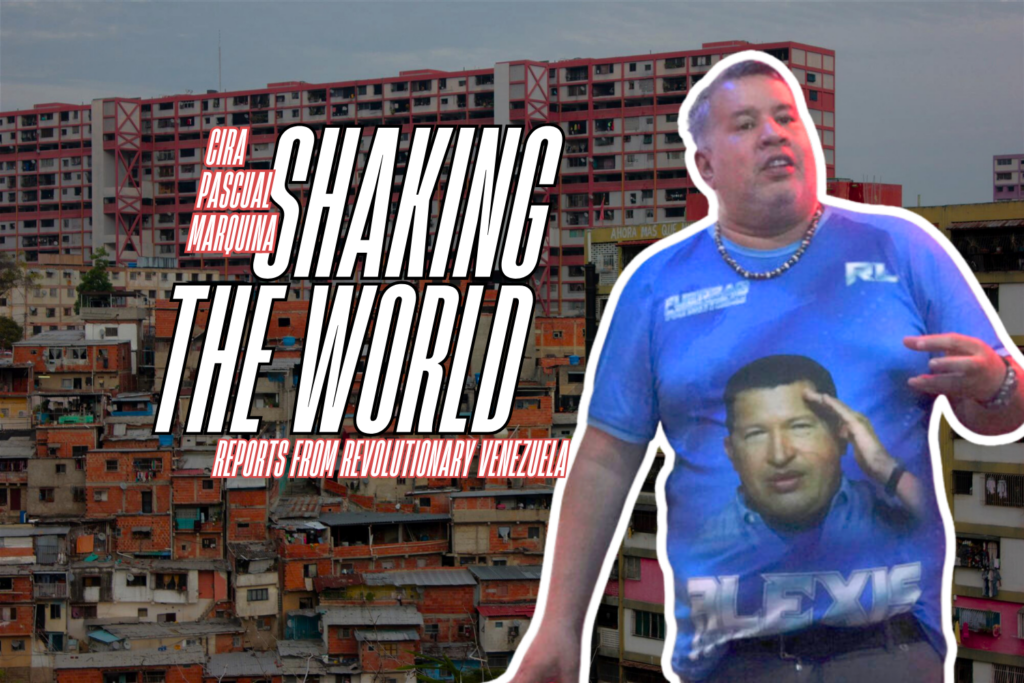
Photo composition showing Venezuelan communard Robert Longa with the 23 de Enero buildings in the background. Photo: Monthly Review Online.
Photo composition showing Venezuelan communard Robert Longa with the 23 de Enero buildings in the background. Photo: Monthly Review Online.
Robert Longa is a founding member of the Fuerza Patriótica Alexis Vive, a Venezuelan grassroots organization promoting communal construction. Based in Caracas’ 23 de Enero barrio, Longa has played a central role in building El Panal Commune and in advancing a strategic vision of communal power as the backbone of the Bolivarian Revolution.
This conversation took place in the aftermath of the January 3 attack on Venezuela, a moment that marked the culmination of the current phase of U.S. imperial escalation. In the interview, Longa reflects on imperialism’s crisis of hegemony, the return of openly fascistic forms of domination, and the lessons of a confrontation marked by overwhelming technological asymmetry.
At the same time, he argues that the strategic response to imperialist aggression lies not in retreat, but in deepening the communal project. For Longa, the commune is not only a space of resistance, but the terrain from which a new popular hegemony, rooted in dignity, sovereignty, and collective life, can be built.
Cira Pascual Marquina: Across much of the left, there is a growing assessment that imperialism is undergoing a crisis of hegemony as it loses ground globally. Yet this decline has not translated into restraint. On the contrary, imperialism appears increasingly violent. How should we understand imperialism today, and what does this moment mean for Latin America?
Robert Longa: Lenin defined imperialism as the highest stage of capitalism, and that definition remains valid. But we can also say that we are living through a moment of overlapping crises of late, decadent capitalism. In this context, openly fascist forces are reemerging and, with them, old-style colonial intent. For us, this is not accidental; it is an expression of imperialism’s own crisis.
This moment is shaped by growing contradictions between the major powers. Russia, and especially China, have gained global influence, including in Nuestra América [Latin America], where U.S. imperialism has steadily lost space. The old projection of “Manifest Destiny” over the continent has begun to fracture, and the empire cannot tolerate that loss.
From this perspective, the brutal attack on Venezuela, in which enemy troops desecrated our land, kidnapped our president and National Assembly Deputy Cilia Flores, and killed more than one hundred people—both military and civilians—in one hour, is not an aberration. It is an attempt to reassert imperialist hegemony. They will not succeed.
We have not seen this level of violence on our continent since Panama in 1989. What is striking is that imperialism no longer even bothers with the appearance of respect for international law. But this brutal attack on the people of Venezuela is accompanied by internal repression. Inside the United States, we are witnessing the re-emergence of openly fascistic practices aimed at disciplining its own population.
Some argue that the world is heading toward a Third World War. We believe that war has already begun. In its effort to maintain supremacy over China and Russia, U.S. imperialism has revived overt expansionism. It is waging war against humanity itself, because it must either reconstitute itself or collapse. In this phase of decay, the only thing imperialism knows how to produce is chaos and war, wrapped in technological sophistication, as we learned painfully in Venezuela on January 3.
CPM: January 3 was, tactically speaking, a victory for the enemy. Acting President Delcy Rodríguez has implied that the operation involved not only the U.S. military but also Mossad. Yet it was a tactical victory rather than a strategic one, as we still have a Chavista government in place. What lessons does this moment leave for the Bolivarian Revolution?
RL: We cannot deny that January 3 left us with a profoundly bitter taste and filled us with anger. We had been using a clear slogan: They might enter, but they would not leave. The enemy entered and left. That remains an open wound.
The communist poet Pío Tamayo, whom we often refer to as the “floricultor de hazañas” [cultivator of revolutionary deeds], reminded folks that a people’s war, whether against local oligarchies or imperialism, is always unequal. We cannot confront our enemies with their own weapons or on their own terms. Today, with artificial intelligence and robotics, this reality is sharper than ever.
What we do have is hatred for our enemies, which is a powerful weapon, and love for humanity, which is an even more powerful tool. We recognize our vulnerability in the face of technologically sophisticated attacks such as those on January 3. But we also know this: the enemy did not achieve its strategic objective. Chavismo remains in power. The revolution—the government, the armed forces, and the people—remains unified. Anyone who claims otherwise is playing the enemy’s game.
But January 3 also demonstrated that a conventional military invasion, the kind that could guarantee the colonial domination imperialism desires, is not a viable option for them. This pueblo is willing to fight, and the Marines, should they attempt to occupy Venezuela, would leave feet first.
History has shown us, from Vietnam onward, that imperialism is confronted through popular mobilization, mass resistance, and the battle for public opinion. The struggles of the peoples of West Asia against imperialism and its local counterpart, Zionism, confirm this lesson. Here, despite the enemy’s technological superiority, popular mobilization and the struggle over meaning remain our most powerful weapons.
The forms of resistance and the ways we intervene in public opinion must evolve with time and place. But the challenge Venezuela faces today, after the invasion of our homeland, calls for resistance involving organized popular power and historical perseverance—both are deeply embedded in the Venezuelan people and at the heart of the Bolivarian Revolution.
There are new forms of struggle, but we insist that it is the people in the streets, popular ingenuity confronting technological supremacy, and our collective capacity for endurance that will ensure the final, strategic victory of the Venezuelan people and our revolutionary government.
CPM: Despite the enemy’s campaign of disinformation and its attempts to sow division through narratives of betrayal and rupture, the Venezuelan people, the government, and the armed forces have responded with unity. How do you understand this response?
RL: One defining characteristic of this revolution is discipline, but ours is conscious discipline. We stand with the revolutionary leadership because the revolutionary leadership stands with us. That is why the unity displayed after the attack should surprise no one.
At one point, we believed that a direct attack on our soil would open a prolonged phase of resistance. The reality unfolded differently, and the resistance assumed forms we had not anticipated. Still, it remains resistance, and it demands commitment, ideological firmness, and spiritual endurance.
No one wants war, but they brought it to us. We struggle for peace, but we don’t want the peace of the graveyards. That is why we must continue organizing as a cohesive popular movement, integrated with our national government. Their war against us is not over, because we haven’t given up.
Imperialism relies not only on death and destruction to achieve its colonial objectives; it also thrives on generating internal doubt and division. They caused pain, but instead of fragmentation, they produced greater unity and political clarity.
There are questions we must address internally, particularly regarding how the enemy managed to secure a tactical victory in our darkest night, even in the face of heroic resistance on Venezuelan soil. We must ensure that neither Acting President Delcy Rodríguez nor any other revolutionary leader is ever abducted again. That, however, is an internal task.
CPM: What kind of political moment does this open for the revolutionary process?
RL: It opens a parenthesis, a moment in which certain concessions are imposed because the enemy has placed a gun to our head. But even within this parenthesis, the revolution must continue to accumulate force in the communal sphere, which is the heart and soul of our revolution.
We must keep advancing within this imposed pause, pushing toward the communal transition. Not out of inertia or mechanical thinking, but because the commune is the social form that truly breaks with the logic of capital. As that logic is dismantled, so too is the dependency that imperialism seeks to impose.
Will this be easy? No. Imperialism has extraordinary technological superiority and the capacity to manufacture parallel realities through communication warfare. And building socialism has never been simple. Chávez himself said, “It is easier to reach Mars than to build socialism.”
The parallel realities manufactured in the North range from fake news to the portrayal of a flat world in which the West appears as the source of all progress, and poverty is blamed on individuals rather than on existing structures.
Before the revolution, we were saturated with soap operas that reinforced this worldview. The wealthy woman appeared alongside her businessman husband and prince-like son. Opposite them stood a Black man, the chauffeur, and a domestic worker from the barrio. Both were treated with contempt. Yet the narrative insisted that love could erase class divisions, as if structural inequality were merely a misunderstanding, and so the domestic worker’s daughter would inevitably end up marrying the rich woman’s son.
Marx taught us that the history of humanity is the history of class struggle. Those narratives sought to obscure the barriers erected by a class-based society. Chávez helped us understand that if human beings built those walls, human beings can tear them down, but only collectively.
Today, more than ever, the ideological apparatus in imperialist hands conceals real relations of power, exploitation, and dispossession. Countries as different as Somalia or Venezuela are labeled “failed states,” and the hegemonic powers attempt to deny our right to exist.
Meanwhile, fascism is growing in the heart of the empire itself. It no longer seeks to conceal its violent nature because it cannot. Open violence is now required to contain the crisis imperialism faces within.
CPM: Given this context, how can the revolutionary process continue advancing toward the communal horizon?
RL: First, there will be no reconciliation, no forgetting, and no forgiveness. Some concessions may be forced upon us, but imperialism will not dictate the destiny of this country.
We are committed to a Bolivarian and Chavista project that is now, more than ever, communal. History does not move in straight lines, but we know our destination. It is the commune. Imperialist bombs and kidnappings will not divert us from that path.
The Bolivarian Revolution has followed a long and uneven trajectory. Chávez came to power initially engaging with the idea of an Anthony Giddens “Third Way,” but he quickly moved away from that premise and later made a decisive leap toward socialism, declaring the end of the “end of history.” He proposed a socialism rooted in our concrete historical reality, one that meets material needs and aims at buen vivir [deriving from the Aymara suma qamaña or living well, in balance]. That remains our road to collective emancipation.
Twenty-first-century socialism begins where the historic question of political power converges with participatory and protagonistic democracy, a concept coined by Chávez himself. The proposal is not new; it resonates with the Paris Commune and the soviets, adapted to our historical moment.
We are today’s soviets.
CPM: What role does history play in this conjuncture that we are facing?
RL: Speaking about history is not a distraction from the present. On the contrary, it is essential. We study history and revolutionary theory. We identify as Marxists and Leninists, though not dogmatically. Some have called us eclectic, and perhaps they are right. Struggle demands creativity.
Precisely because imperialism attacks us, Bolivarian socialism remains viable. Grounded in our history, including the history of preexisting communal forms of organization, it represents the only path available to the Venezuelan working class. Today more than ever, the alternative is clear: Commune or nothing!
They will attempt to discredit and criminalize popular organizations. They will call us bandits. That is their role. But we are armed with ideas. As Mario Benedetti said, we pursue a utopia, not a chimera. Also, our utopia is not distant: we are building it here and now.
That is why we propose a confederation of communes and affirm that the only possible transition on the table in Venezuela is toward the communal state.
President Maduro Proposes Commune-Based Electoral System, Hails Direct and Real Democracy
With those who promote death, negotiation mechanisms may be necessary. But the communal model is not negotiable. Imperialism denies the right of the poor—and even of humanity itself—to exist. Against that, we affirm life.
Do not call us violent. We did not invade another country on January 3. We did not burn people alive for being Black or Chavista, as local fascists aligned with the United States did in 2017. We are not killing children in Gaza. We do not seek supremacy. We seek dignity, sovereignty, and a communal future.
Today, we raise the national tricolor in loyalty to our history and our government, and alongside it we fly Bolívar’s Decree of War to the Death. Its red and black stands for our national liberation, which also expresses itself in a single but very powerful slogan: ¡Patria o muerte! ¡Nosotros venceremos!
(Monthly Review Online) by Cira Pascual Marquina

Cira Pascual Marquina is a Political Science professor at the Universidad Bolivariana de Venezuela in Caracas. She is also co‐producer and co‐host (with Chris Gilbert) of the Marxist education program Escuela de Cuadros. She is actively engaged with grassroots organizations in Venezuela and abroad, and is dedicated, both as a militant and as an investigator, to communal initiatives.
Pascual Marquina is co-author of Venezuela, the Present as Struggle: Voices from the Bolivarian Revolution (Monthly Review Press) and co‐compiler of two books: Para qué sirve El Capital: un balance contemporáneo de la obra principal de Karl Marx and ¿Por qué socialismo? Reactivando un debate (both Editorial Trinchera).