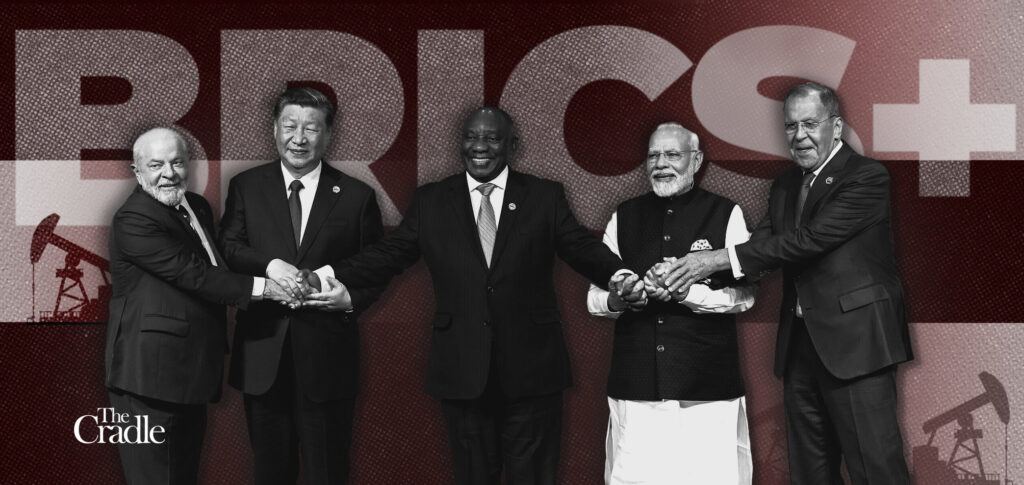
From left to right: President Luiz Inacio Lula da Silva of Brazil; Chinese President Xi Jinping; South African President Cyril Ramaphosa; Prime Minister Narendra Modi of India; and Russian Foreign Minister Sergei Lavrov. Photo: AFP.
From left to right: President Luiz Inacio Lula da Silva of Brazil; Chinese President Xi Jinping; South African President Cyril Ramaphosa; Prime Minister Narendra Modi of India; and Russian Foreign Minister Sergei Lavrov. Photo: AFP.
By Pepe Escobar – Aug 25, 2023
‘No mountains can stop the surging flow of a mighty river.’ With the addition of six new members that add geostrategic clout and geographic depth to the once sputtering BRICS, the multilateral institution is now gathering the momentum needed to reset international relations.
In the end, History was made. Surpassing even the greatest of expectations, the BRICS nations performed a giant step for multipolarity by expanding the group to BRICS 11.
Starting on January 1, 2024, the five original BRICS members will be joined by Argentina, Egypt, Ethiopia, Iran, Saudi Arabia and the United Arab Emirates (UAE).
No, they won’t turn into an unpronounceable BRIICSSEEUA. Russian Foreign Minister Sergey Lavrov confirmed the song remains the same, with the familiar BRICS acronym to the Global South or Global Majority or “Global Globe” multilateral organization that will shape the contours of a new system of international relations.
Here is the Johannesburg II Declaration of the 15th BRICS summit. BRICS 11 is just the start. There’s a long line eager to join; without referring to the dozens of nations (and counting) that have already “expressed their interest”, according to the South Africans, the official list, so far, includes Algeria, Bangladesh, Bahrain, Belarus, Bolivia, Venezuela, Vietnam, Guinea, Greece, Honduras, Indonesia, Cuba, Kuwait, Morocco, Mexico, Nigeria, Tajikistan, Thailand, Tunisia, Turkiye and Syria.
By next year, most of them will either become BRICS 11 partners or part of the second and third wave of fully-fledged members. The South Africans have stressed that BRICS “will not be limited to just one expansion phase.”
Russia-China leadership, in effect
The road leading to BRICS 11, during the two days of discussions in Johannesburg, was hard and bumpy, as admitted by Russian President Vladimir Putin himself. The final result turned out to be a prodigy of trans-continental inclusion. West Asia was aggregated in full force. The Arab world has three full members, as much as Africa. And Brazil strategically lobbied to incorporate troubled Argentina.
The global GDP-purchasing power parity (PPP) of BRICS 11, as it stands, is now 36 percent (already larger than the G7), and the institution now encompasses 47 percent of the world’s population.
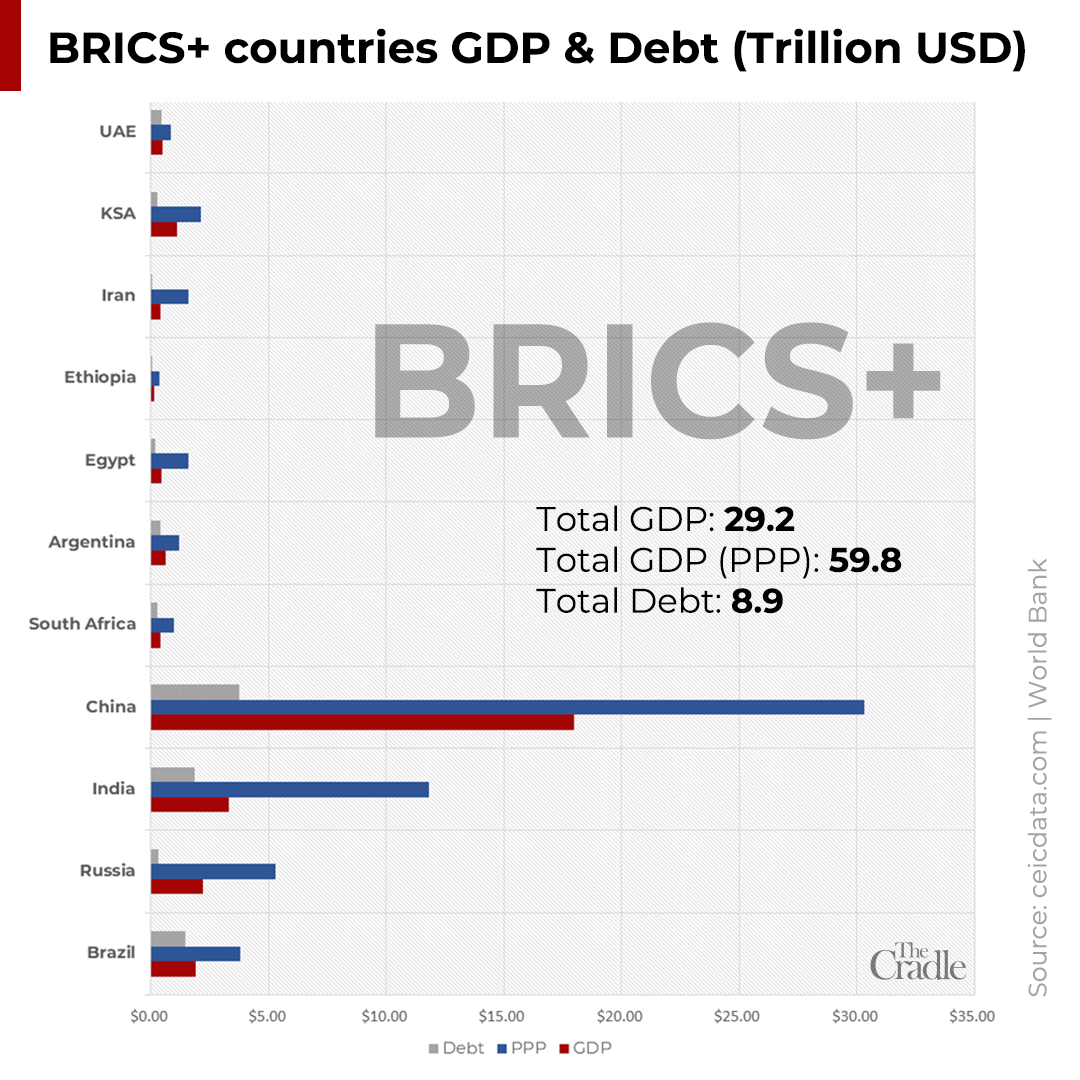
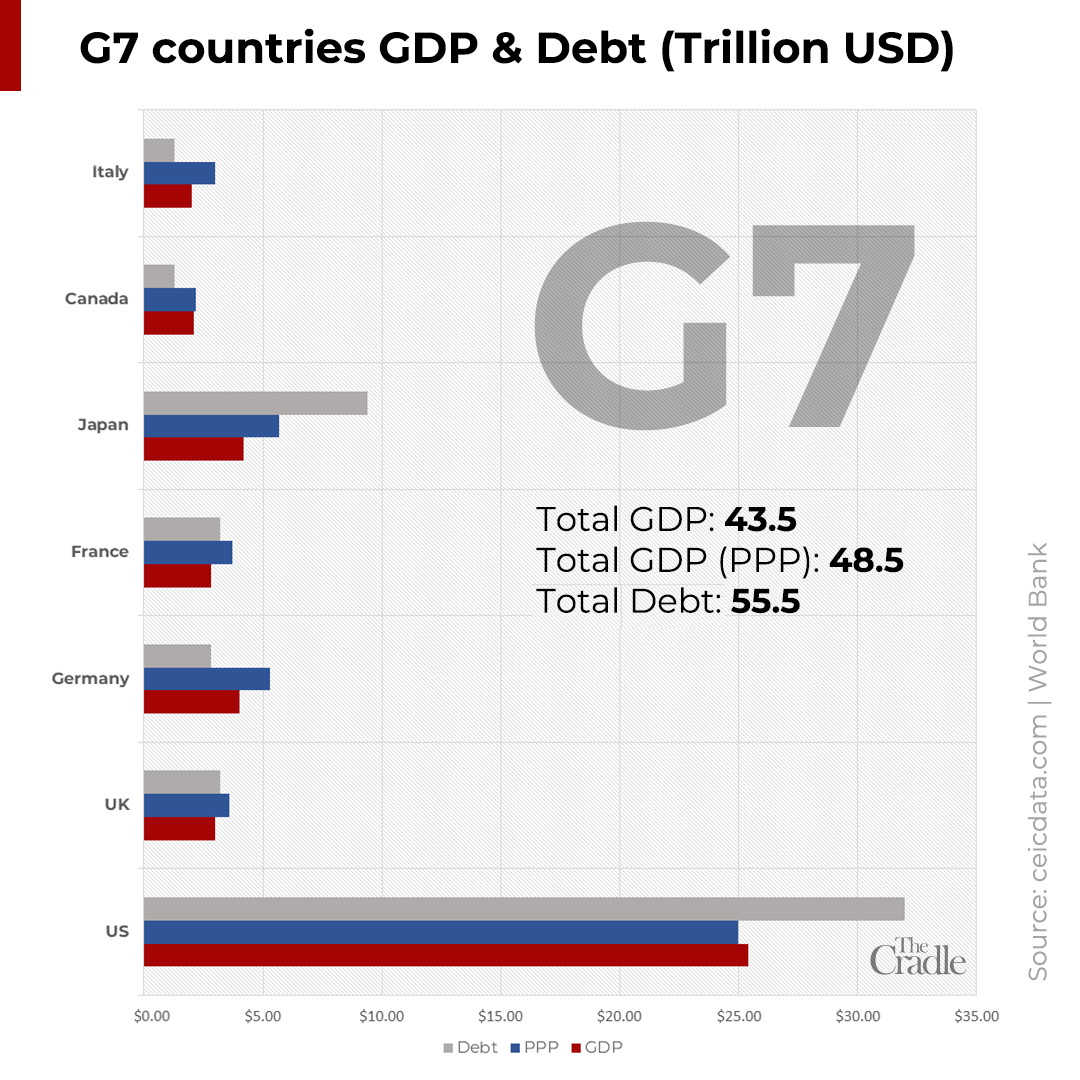
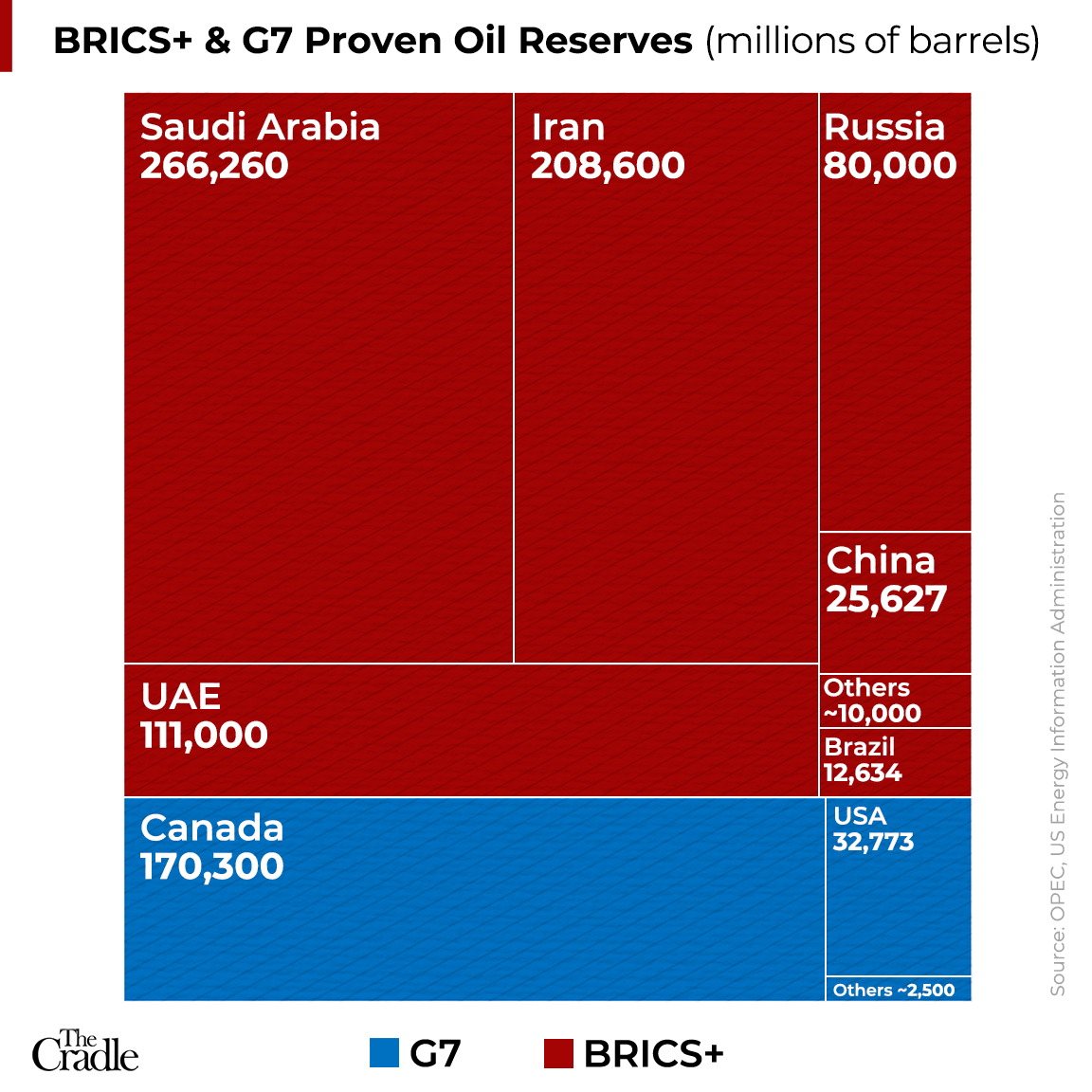
Even more than a geopolitical and geoeconomic breakthrough, BRICS 11 really breaks the bank on the energy front. By signing up Tehran, Riyadh and Abu Dhabi, BRICS 11 instantly becomes an oil and gas powerhouse, controlling 39 percent of global oil exports, 45.9 percent of proven reserves and 47.6 percent of all oil produced globally, according to InfoTEK.
A direct BRICS 11-OPEC+ symbiosis is inevitable (under Russia-Saudi Arabia leadership), not to mention OPEC itself.
https://OrinocoTribune.com/brics-expansion-is-beneficial-but-it-also-isnt-without-strategic-challenges/
Translation: The collective west may soon lose its power to control global oil prices, and subsequently, the means to enforce its unilateral sanctions.
A Saudi Arabia directly aligned with Russia-China-India-Iran offers a stunning counterpoint to the US-engineered oil crisis in the early 1970s, when Riyadh started wallowing in petrodollars. That represents the next stage of the Russian-initiated and Chinese-finalized rapprochement between Riyadh and Tehran, recently sealed in Beijing.
And that’s exactly what the Russia-China strategic leadership always had in mind. This particular diplomatic masterstroke is rife with meaningful details: BRICS 11 enters the fray on the exact same day, January 1, 2024, when Russia assumes the annual presidency of BRICS.
Putin announced that the BRICS 11 summit next year will take place in Kazan, the capital city of Russia’s Tatarstan, which will be yet another blow to the west’s irrational, isolation-and-sanctions policies. Next January, expect further integration of the Global South/Global Majority/Global Globe, including even more radical decisions, conducted by the sanctioned-to-oblivion Russian economy – now, incidentally, the 5th largest in the world by a PPP of over $5 trillion.
G7 in a coma
The G7, for all practical purposes, has now entered an Intensive Care Unit. The G20 may be next. The new “Global Globe” G20 may be the BRICS 11 – and later on the BRICS 20 or even BRICS 40. By then, the petrodollar will also be on life support in the ICU.
The BRICS 11 climax could not have been accomplished without a stellar performance by the Men of the Match: Putin and Chinese President Xi Jinping, supported by their respective teams. The Russia-China strategic partnership dominated in Johannesburg and set the major guidelines. We need to be bold and expand; we need to press for reform of the current institutional framework – from the UN Security Council to the IMF and the WTO; and we need to get rid of those institutions that are subjugated by the artificial “rules-based international order.”
No wonder Xi defined the moment, on the record, as “historic.” Putin went so far as to publicly call on all BRICS 11 to abandon the US dollar and expand trade settlements in national currencies – stressing that BRICS “oppose hegemonies of any kind” and “the exceptional status that some countries aspire to,” not to mention “a policy of continued neo-colonialism.”
Importantly, as much as the Chinese Belt and Road Initiative (BRI) is celebrating its 10th anniversary next month, Putin drove home the necessity to:
“…establish a permanent BRICS transport commission, which would deal not only with the North-South project [referring to the INTSC transportation corridor, whose key BRICS members are Russia, Iran and India], but also on a broader scale with the development of logistics and transport corridors, interregional and global.”
Pay attention. That’s Russia-China in synch on connectivity corridors, and they are preparing to further link their continental transportation projects.
On the financial front, the Central Banks of the current BRICS have been instructed to seriously investigate and increase trading in local currencies.
Putin made a point of being very realistic on de-dollarization: “The issue of the single settlement currency is a complex issue, but we will move toward solving these problems one way or another.” That complemented Brazilian President Luiz Inacio Lula Da Silva’s remarks on how the BRICS has started a working group to study the viability of a reference currency.
In parallel, the BRICS’ New Development Bank (NDB) has welcomed three new members: Bangladesh, Egypt, and UAE. Yet their road to prominence from now will be even steeper.
South African President Cyril Ramaphosa publicly praised NDB President Dilma Rousseff’s report on the nine-year-old institution; but Dilma herself stressed again that the bank aims to reach only 30 percent of total loans in currencies bypassing the US dollar.
That’s hardly enough. Why? It’s up to Sergey Glazyev, the Minister of Macroeconomics at the Eurasia Economic Commission, working under the Russia-led EAEU, to answer the key question:
“It is necessary to change the statutory documents of this bank. When it was created, I tried to explain to our financial authorities that the capital of the bank should be spread between the national currencies of founding countries. But American agents madly believed in the US dollar. As a result, this bank today is afraid of sanctions and is semi-paralyzed.”
https://OrinocoTribune.com/brics-bank-de-dollarizing-promises-30-of-loans-in-local-currencies-new-chief-dilma-rousseff-says/
No mountains can stop a mighty river
So yes, the challenges ahead are immense. But the drive to succeed is contagious, perhaps best epitomized by Xi’s remarkable speech at the closing ceremony of the BRICS Business Forum, read out by Chinese Minister of Commerce Wang Wentao.
It’s as if Xi had invoked a Mandarin version of the 1967 American pop classic “Ain’t No Mountain High Enough.” He quoted a Chinese proverb: “No mountains can stop the surging flow of a mighty river.” And he reminded his audience that the fight was both noble – and necessary:
“Whatever resistance there may be, BRICS, a positive and stable force for good, will continue to grow. We will forge stronger BRICS strategic partnership, expand the ‘BRICS Plus’ model, actively advance membership expansion, deepen solidarity and cooperation with other EMDCs [emerging market developing countries], promote global multipolarity and greater democracy in international relations, and help make the international order more just and equitable.”
Now add this profession of faith in humanity to the way the “Global Globe” perceives Russia. Even though the Russian economy’s purchasing power parity is by now ahead of the imperial European vassals that seek to crush it, theGlobal South’s perception of Moscow is as “one of our own.” What happened in South Africa made this even more clear, and Russia’s ascendency to the BRICS presidency in four months will crystallize it.
It’s no wonder that the collective west, dazed and confused, now trembles as it feels the earth – 85 percent of it, at least – moving under its feet.
(The Cradle)

Pepe Escobar is a Brazilian journalist. He writes a column – The Roving Eye – for Asia Times Online, and works as an analyst for RT, Sputnik News, and Press TV. In addition, he previously worked for Al Jazeera.