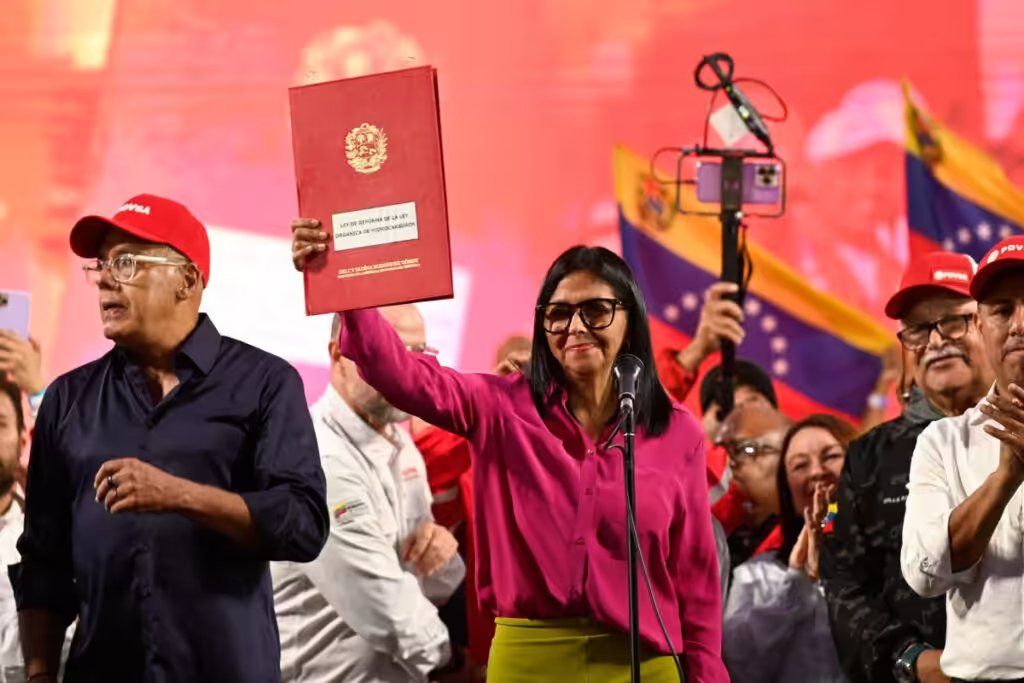
Acting President Delcy Rodriguez holds up the document of the partial reform of the Organic Hydrocarbons Law (LOH) in front of a crowd. Photo: Maxwell Briceno/Reuters.
Acting President Delcy Rodriguez holds up the document of the partial reform of the Organic Hydrocarbons Law (LOH) in front of a crowd. Photo: Maxwell Briceno/Reuters.
By Misión Verdad – Feb 3, 2026
The partial reform of the Organic Hydrocarbons Law (LOH) is at the center of the debate in Venezuela, given that, from various angles of politics, a set of interpretations of the text have been made, in many cases through political biases and deliberate misrepresentations.
The approved text is a reform that builds upon the basic law presented in 2002 by then-President Hugo Chávez through enabling powers to legislate.
In 2006, the LOH was modified to give legal form to the mixed enterprise scheme, within the framework of the re-nationalization process of oil assets, especially in the Orinoco Oil Belt.
The 2026 reform ratifies and, in some aspects, deepens essential elements of the previous legislation.
But, without a doubt, it creates the legal basis for a complete strategic adaptation of the Venezuelan hydrocarbon industry, considering elements of the present context: the persistence of an extended and adverse cycle of illegal sanctions on hydrocarbon activities, and the investment, modernization and growth needs of this activity—the most economically important in Venezuela.
The ‘privatization’ of PDVSA
The new LOH reaffirms that Petróleos de Venezuela SA (PDVSA), or, as it is called, the “company exclusively owned by the Venezuelan State and its subsidiaries,” is of an inalienable and non-transferable nature, preserving the public domain and the ownership of the nation over it, in accordance with what is stated in Article 141 of the National Constitution, cited in the reform in its Article 1.
The new text does not affect this essential principle, as it remains identical to that established in the laws of 2002 and 2006, in accordance with the Bolivarian Constitution.
Primary activities
In the hydrocarbon sector, primary activities—commonly called “upstream”—are the processes that encompass the exploration, extraction, collection, transportation, and initial storage of crude oil and natural gas.
These stages search for deposits, drill wells and manage production from the subsoil to processing centers, which could be refineries or terminals for dispatch and/or marketing, which would already be part of the set of secondary activities.
The new law ratifies the expansion of the scope of participation in primary activities, which was previously exclusively in the hands of state-owned companies, so that national or foreign private companies can also participate.
Is this really new? Definitely not. The reference to “ratify” alludes to reaffirming something that already exists.
The presence in Venezuela of foreign companies such as Chevron, Repsol, and CNPC is possible due to the provisions established by the 2006 reform, which endorsed the joint venture regime under the Hydrocarbons Law. These foreign companies participate directly in primary activities in Venezuelan fields.
Likewise, the Anti-Blockade Law facilitated agreements that allowed private investment in these processes through Productive Participation Contracts (CPP).
Private participation in primary activities was already well-established and was addressed in another complementary law on the matter: the now-repealed Law on the Regulation of Private Participation in Primary Activities (2006). This law would not exist if there were no activities to regulate.
What does this mean in concrete terms? It means that Venezuela could, for example, enter into advanced hydrocarbon exploration contracts with companies that possess technologies PDVSA lacks. Or that a private company could assume operational management of a field, for various financial or technical reasons.
Thus, according to the new Article 23, primary activities will be carried out by three types of companies classified according to their type of ownership: the state-owned (PDVSA), mixed companies, and “private companies domiciled in the Bolivarian Republic of Venezuela, within the framework of contracts signed with companies exclusively owned by the Republic or its subsidiaries.”
Nothing new under the sun.
About joint ventures
Joint ventures are ratified in the new Hydrocarbons Law (LOH) as part of PDVSA’s management and partnership model with other companies, both national and foreign. This was already established in the 2006 LOH, and the spirit of that era is reaffirmed now.
These are referred to as “companies in which the Republic or a public entity owns a share greater than fifty percent (50%) of the share capital, which gives it shareholder control,” according to Article 23 of the reformed law.
In light of this, it is not true that PDVSA will now undergo a process of “de facto privatization” of its subsidiaries under the guise of joint ventures, nor that it will grant majority shares in said companies. Doing so is impossible according to the new Hydrocarbons Law.
Therefore, there is no impact on the shareholding situation of mixed companies currently established or that may be formed in the future.
Productive Participation Contracts
The new law recognizes the types of contracts that can be made by PDVSA and its subsidiaries, according to the new Article 40.
As explained, Productive Participation Contracts (CPP) transcend the Anti-Blockade Law and take shape through the figure of “Contracts for the Development of Primary Activities.”
These are broad contracts—covering services, exploration, and product extraction—under a model known as “comprehensive management of primary activities.” The private party in these contracts, whether domestic or foreign, is referred to as the “operator.”
Is this really something new? Absolutely not. PDVSA has been authorized to enter into contracts with private companies, both domestic and foreign, for primary activities. This explains, for example, the presence in Venezuela of multinationals like Halliburton and Baker Hughes, which provide oil services.
However, and this is the important part, this law does provide additional incentives that translate into greater responsibility and operational autonomy for the companies listed in the contracts, depending on the specifics of the projects.
Contracts for the Development of Primary Activities are specially designed for “green fields,” or areas with underground resources that have not yet developed infrastructure or received investment.
The LOH, as is fitting in the spirit of all laws, has been reformed in accordance with the particularities of the times. The 2026 text recognizes several objective conditions.
First, the conditions in the oil business have changed significantly since 2002 and 2006. Investments are now more expensive, the market is more volatile, and there is competition from new technologies in the battle for energy resources (the energy transition). In the long term, this context makes investments more expensive, reduces profits, and increases risks.
Second, the national hydrocarbon industry is burdened by a cumulative 10 years of coercive sanctions, divestment strategies in Venezuela, asset freezing—both liquid and capital goods—and direct impact on the financing mechanisms (petro-bonds) of PDVSA and the nation.
Third, most of Venezuela’s oil reserves are heavy and extra-heavy crude, which requires new technologies and costly investments to be extracted and diluted for commercialization.
These conditions impose a stark reality: neither PDVSA nor the Venezuelan state has the resources to invest heavily in new developments and oil fields. Therefore, further incentives are being offered to attract new investment in these undeveloped oil fields.
This does not imply a loss of sovereignty; it implies creating comparative advantages to attract investment where it is needed.
To determine whether these types of contracts involve a loss of sovereignty or are harmful to the nation, it is necessary to observe what is stated in Article 43:
“Once the term of the contract for the development of primary activities has ended, the operating company must return the leased assets and transfer ownership, free of any encumbrance, to the company wholly owned by the Republic or its subsidiaries (PDVSA), of all assets incorporated, constructed or acquired during the term of the contract, including all data obtained, generated, processed and interpreted, without this generating any obligation of payment or compensation.”
The new Hydrocarbons Law is clear and, in fact, resembles the 1946 law in that it refers to the reversion of assets to the Republic upon termination of contracts, without the need for a nationalization process that would entail high costs for the nation. This is a huge difference compared to the legal framework of the Operating Agreements of the 1990s, which involved high compensation payments and costly legal proceedings when the 2006 nationalization occurred. The cases of Exxon and ConocoPhillips are a prime example.
The marketing of products
This is one of the most prominent—and, in some ways, controversial—elements in the new LOH, especially because it is subject to biased interpretations.
Now, through contracts, private national or foreign companies are authorized to assume, in a shared or total manner, some key processes of the marketing of products outside the country, but “at their exclusive cost, account and risk,” the regulation states verbatim.
Here again, is the application of principles into a law built on the objective realities of the moment, and this refers specifically to the regime of illegal coercive sanctions that exists against Venezuela.
The reality is that no sanctions have been lifted against Venezuela. Nor should we confuse the granting of licenses by the US Treasury Department with the lifting of unilateral sanctions. These hostile measures are a reality, they are long-standing, deeply entrenched, and were not foreseen in either 2002 or 2006.
It is well known that PDVSA’s marketing of products outside the country has resulted in the freezing of assets and even the seizure of vessels and the theft of products.
Now the law protects Venezuela from this risk, creating windows and guidelines for other actors to assume the risk, exposure to hostile financial measures, sanctions and the like.
What does that imply? Some companies that enter into a contract with PDVSA could, in some cases, assume a minority or majority stake in the marketing of hydrocarbons, autonomously carrying out the commercial management process, as indicated in Article 41, as part of the favorable compensation for operators.
If a private company can take over the marketing of certain products in specific sectors, how does the nation benefit? Article 42 states that:
“… as consideration for the use of said assets and areas, the operating company will pay the companies wholly owned by the Republic or its subsidiaries a percentage of the volume of controlled hydrocarbons that will be set in the respective contract.”
In addition, taxes and royalties would be added to this.
Again, with reference to sovereignty and the non-diminution of national heritage, Article 40, in its paragraph 3, states:
“The Republic will retain ownership of the hydrocarbon deposits on which the operating companies will develop their activities… .”
Whereas Article 68 explicitly states:
“The authorized direct marketing will not, under any circumstances, imply the transfer of ownership of the deposits or the authorization for the creation of real guarantees on deposits or on sovereign rights.”
The law is absolutely clear on this point. The Venezuelan State externalizes and transfers to others the risks of commercial activity, while directly benefiting from the activities of the operators, fully preserving public ownership of the deposits and resources.
Taxes and royalties
The 2002 law and its 2006 reform maintained a strict royalty regime, applied to all projects.
The 2026 Hydrocarbons Law, on the other hand, establishes a flexible framework. It sets a maximum royalty rate of 30%, while each project will have its own characterization to determine the royalty margin, according to a discretionary policy of the Ministry of Hydrocarbons, based on technical information.
What does this mean? It means that a green field should not pay the same royalties as a mature field, or that a field in the expansion production phase—which has not yet reached its peak of barrels per day—should not pay the same royalties as a field in depletion or outright decline.
The technical parameters will apply to both nascent developments, where there is no infrastructure, and to established fields. Obviously, fields under development are likely to pay lower royalties.
The reasons governing this criterion are fundamentally technical, as indicated in the new Article 51:
“… taking into account the nature of the project; the capital investment requirements; the cost-effectiveness of the project; and the need to ensure international competitiveness.”
Here, the factors of viability prevail to attract new investments and encourage new developments, based on a criterion of “economic equilibrium,” says the law, which can be applied favorably to the nation once the projects are more profitable, or favorably to an operator if the technical and commercial environment conditions make them less profitable.
This criterion is clearly designed to ensure the operational continuity of projects. Even if environmental conditions change—as has happened in recent years with sanctions and licensing changes—royalties can be adjusted to preserve the “economic equilibrium” in each field, avoid paralysis and disinvestment, and mitigate risks.
Article 51 states:
“The National Executive, through the Ministry with competence in hydrocarbon matters, is empowered to modify the royalty percentage within the limit provided for in this article, when it is demonstrated that it is necessary to guarantee the economic balance of the project, under the terms provided for in this Law.”
What was previously known as the Extraction Tax is now referred to as the Integrated Hydrocarbons Tax, which reaches up to 15%, but is subject to modification depending on the same technical factors that govern the amount of royalties.
Dispute resolution
The reform of the LOH contemplates the resolution of disputes in three stages or levels: first, by promoting amicable settlement and agreement between the parties; second, through independent international arbitrations; and, third, through courts established in the Republic.
Nowhere does the reform of the Hydrocarbons Law establish the jurisdiction of foreign courts over matters related to hydrocarbons owned by the nation. There is no mention of this, and any assertion to that effect is completely false.
Regarding independent international arbitration, Article 8 refers to it as “alternative dispute resolution mechanisms.” This needs further explanation.
Independent arbitrations are activities carried out by law firms or firms specializing in specific areas, agreed upon by both parties. They are contracted to facilitate negotiations, discuss disputes, reach decisions, and arrange settlements privately and promptly.
This should not be confused with placing Venezuelan issues on the desk of a Democratic or Republican judge in New York, as was customary before the 2002 law.
In the event that PDVSA resorts to independent arbitration, the LOH establishes that the criteria for such a case will be governed in accordance with the provisions of the Organic Law Decree of the Attorney General’s Office and the Commercial Arbitration Law, according to the new Article 8. That is, there is no separation of the State bodies from these matters.
It is worth mentioning that, in practice, many companies would prefer to reach amicable settlements or arbitration in cases of disputes with PDVSA, rather than resorting to Venezuelan courts. The Hydrocarbons Law (LOH) provides incentives to build trust—legal certainty—aimed at companies investing in Venezuela, but emphasizes the need to operate transparently and avoid friction and disputes, since, according to the LOH, the final decision still rests with Venezuelan courts.
Translation: Orinoco Tribune
OT/JB/DZ
Misión Verdad is a Venezuelan investigative journalism website with a socialist perspective in defense of the Bolivarian Revolution