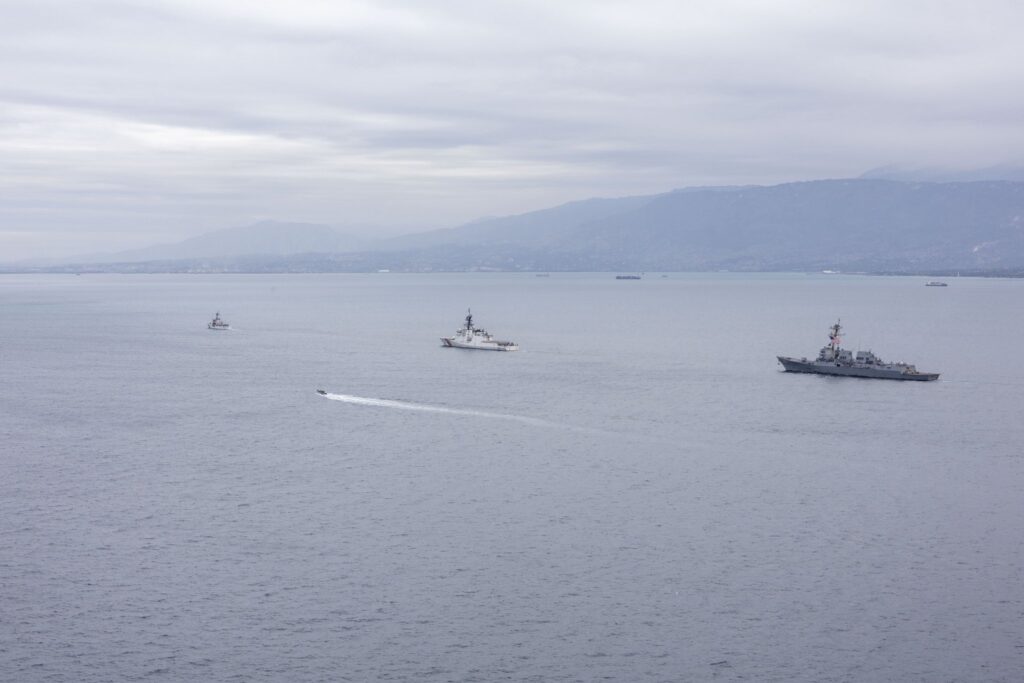
A photo of the USS Stockdale, USCGC Stone, and USCGC Diligence posted to social media by US Southern Command announcing their arrival in the Bay of Port-au-Prince, Haiti. Photo: X/@Southcom.
A photo of the USS Stockdale, USCGC Stone, and USCGC Diligence posted to social media by US Southern Command announcing their arrival in the Bay of Port-au-Prince, Haiti. Photo: X/@Southcom.
By Daniel Ruiz Bracamonte – Feb 10, 2026
Washington deploys warships to consolidate the power of businessman Alix Didier Fils-Aimé after dissolving the council that attempted to remove him. The promised elections are now secondary to the military occupation scheme advancing across the Caribbean.
Three US warships anchored off Port-au-Prince marked the end of the last vestige of governmental autonomy in Haiti. On February 7, after weeks of diplomatic pressure and direct threats, the Transitional Presidential Council (TPC) was dissolved as demanded by Washington, consolidating the absolute power of Prime Minister Alix Didier Fils-Aimé, a controversial businessman who has never been elected.
The operation began on February 1, when the USS Stockdale—a guided-missile destroyer designed for multi-mission operations—arrived in the capital’s bay alongside the patrol boats USCGC Stone and USCGC Diligence. Southern Command justified the military presence as a “firm commitment to security,” while the embassy promised a “safer and more prosperous Haiti.”
On January 23, Secretary of State Marco Rubio directly conveyed to Fils-Aimé the order to dissolve the TPC “without interference caused by internal divisions.” The message came at a critical moment: five of the seven voting members of the Council had demanded the prime minister’s resignation just two weeks earlier, accusing him of failing in his role as the country prepared for its first elections in a decade.
“The Secretary added that the TPC must be dissolved before February 7, without corrupt actors seeking to interfere,” said State Department spokesman Tommy Pigott. The irony was not lost on anyone: Washington was talking about “corrupt actors” while defending an official accused of misappropriating public funds and surrendering national sovereignty.
Rubio reaffirmed that Fils-Aimé should remain prime minister to combat “terrorist” gangs and “stabilize” the country, ignoring the fact that the majority of Haitians do not recognize him as the legitimate authority. The US embassy described any attempt to alter the government’s composition as a “threat to regional stability,” warning that it would take “appropriate measures.” The military flotilla reinforced the ultimatum.
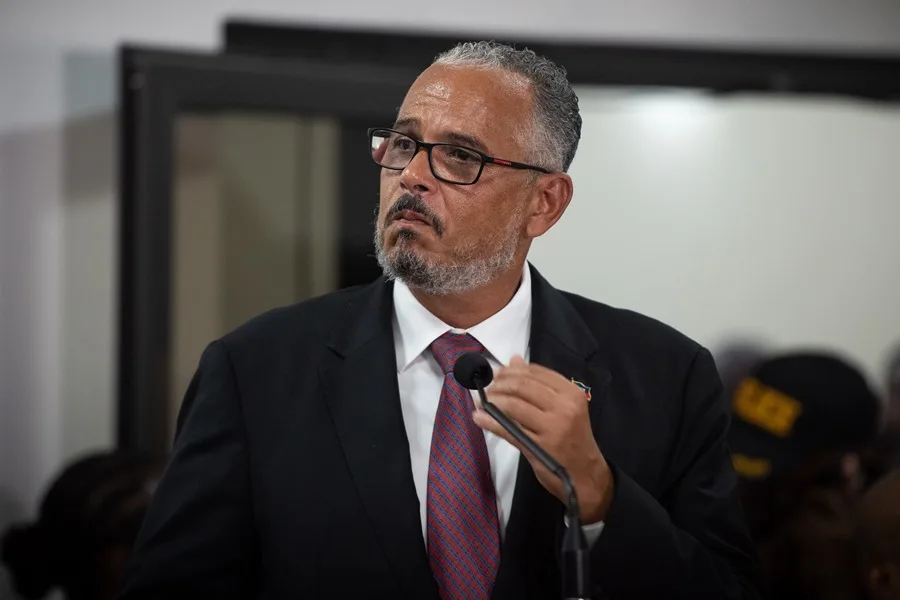
Fils-Aimé, a communications entrepreneur and Boston University graduate, never won an election. His only attempt failed in 2016 when he ran for a Senate seat. His first speech as the highest authority revealed his loyalties: he spoke in French for the first half, a language mastered only by the elite, while the vast majority speak Creole. “He was addressing foreigners and privileged sectors, not the people,” notes a publication by Brasil de Fato.
The popular radio station Radio Rezistans reported that the prime minister is diverting $35,000 a month from public funds to pay lobbyists at the State Department. He also signed a 10-year contract worth hundreds of millions of dollars with the private security firm of Eric Prince, former director of Blackwater.
This agreement hands over control of Haitian customs and borders to foreign mercenaries under the pretext of “modernization.” The documents are under review by the Superior Court of Accounts, while social organizations are demanding a halt to what they consider a systematic surrender of sovereignty.
Haitian journalist Reyneld Sanon asserts that the prime minister “doesn’t govern the country; he’s a servant of the US imperialist agenda.” According to Sanon, Fils-Aimé, along with Secretary of State Mario Andresol and Police Director Vladimir Paraison, maintain ties with criminal gangs and enjoy the support of foreign embassies.
The Caribbean under siege: the pattern of intervention
The Organization of American States (OAS) legitimized the institutional coup on February 10. “Considering that the mandate of the Presidential Transitional Council concluded on February 7, 2026, the General Secretariat recognizes that Prime Minister Didier Fils-Aimé and his cabinet will head the interim period,” the organization declared, echoing Washington’s rhetoric without questioning the legitimacy of the process consolidated through military pressure.
The three destroyers that forced the dissolution of Haiti’s transitional government are part of a pattern of militarization that Washington maintained across the Caribbean throughout 2025, under the Trump administration’s National Security Doctrine. The political and economic crisis that has plagued Haiti for decades worsened in 2021 with the assassination of President Jovenel Moïse, whose murder remains under investigation. Following the assassination, then-Prime Minister Ariel Henry assumed power, but his lack of legitimacy led to his replacement in 2024 by the TPC. The resulting power vacuum was exploited by criminal gangs that, in alliance with politicians and businesspeople, managed to control 90 percent of the capital. The International Organization for Migration (IOM) estimates that more than 1.4 million people were displaced by the violence in 2025.
Haiti has not held elections since 2016. Presidential and legislative elections are scheduled for August 30, with a potential runoff on December 6. But the promise of holding elections has been subordinated to the system of military domination. “Since US troops withdrew in 1934, there have only been free and democratic elections in 1990,” explains Sanon. “Imperialism controls the electoral processes and decides the results.”
In August 2025, White House Press Secretary Karoline Leavitt confirmed the deployment of three ships with 4,000 troops to the region. The New York Times then revealed that Trump had secretly authorized the Pentagon to use military force against foreign drug cartels, laying the groundwork for direct military operations in foreign territories. The military activity escalated: warships, intimidating flyovers, the movement of military personnel, and weapons stockpiles at bases in Puerto Rico.
The culmination of this escalation occurred in the early hours of January 2, 2026, with Operation “Total Resolve,” which resulted in the capture of Venezuelan President Nicolás Maduro and First Lady Cilia Flores. It was the end of a long campaign of siege waged by Washington since Trump’s inauguration.
The new intervention force
On December 8, Fils-Aimé traveled to the United States to participate in a summit of countries that will contribute to the deployment of a Gang Suppression Force (GSF) in the Caribbean nation. The meeting brought together key partners: Canada’s ambassador to the UN, David Lametti, and US Deputy Secretary of State Chris Landau.
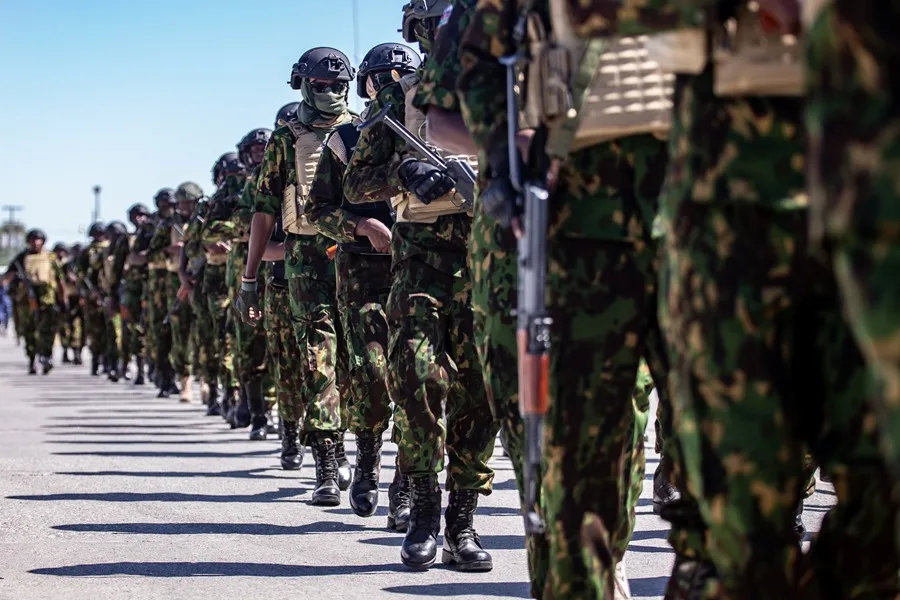
The GSF emerged in response to the ineffectiveness of the previous Kenya-led Multinational Security Support Mission (MSS) and seeks to accelerate more robust operations against criminal gangs. The Standing Partner Group, which oversees the GSF, includes the United States, Canada, Kenya, the Bahamas, Jamaica, Guatemala, and El Salvador. Rwanda has expressed interest in sending troops, while the European Union has provided initial resources.
Leadership rests with Jack Christofides, the UN Special Representative appointed on December 1, and Godfrey Otunge, a Kenyan officer serving as acting commander. The GSF is a mission not under UN control but supported by the organization, with a 12-month mandate focused on intelligence operations aimed at neutralizing, isolating, and deterring through the use of lethal force when necessary.
Echoes of the 19th century
Mexican intellectual Fernando Buen-Abad analyzes this doctrine from the perspective of critical semiotics: “This document cannot be read merely as a military or diplomatic plan; it is a Cognitive War or bourgeois Cultural Battle over the world economic and symbolic order; it is a new grammar of domination, a reordering of meanings about homeland, sovereignty, threat, identity, and power.”
Buen-Abad emphasizes that this is “an operation of symbolic hegemony: it redefines what is normal, desirable, legitimate; what is a threat, insecurity, decadence; what deserves protection, intervention, coercion. There is a commitment to the domestication of fear, to the militarization of the social imaginary, to the naturalization of xenophobia, to the reinterpretation of nationalism as a shield against chaos.”
Thus is established “a new semiotics of the police state, of the fortified border, of perpetual antagonism, of closed sovereignty, of homogeneous identity. It is an indispensable scenario for the dispute over meaning.”
Cuban thinker Raúl Capote draws historical parallels. The most severe naval blockade of the 19th century against Venezuela occurred in 1829-1830, after the dissolution of Gran Colombia. The Spanish government then equipped an expedition to reconquer territories in the Americas. The fleet, under the command of Admiral Ángel Laborde y Navarro, sailed from Cuba toward the Venezuelan coast.
Pan-African Activist Kémi Séba: Imperialist Nations, Not Haiti’s ‘Gangs,’ Are the Enemy
“The Spanish fleet intercepted and captured numerous merchant ships, both Venezuelan and from other nations, causing serious damage to trade. Spain, internationally isolated, did not dare to sustain a costly land invasion and finally gave in,” Capote explains.
There are also parallels with the blockade imposed by European powers between 1902 and 1903, which involved the confiscation of ships. “They bombarded fortifications, seized and sank ships of the Venezuelan navy. The British Empire, the German Empire, the Kingdom of Italy, and the United States were all involved,” he notes.
Haiti’s history thus records yet another chapter of foreign intervention: a failed transitional government is replaced by a man who concentrates absolute power without popular legitimacy, backed by missile destroyers and the endorsement of regional organizations that normalize imposition through armed pressure. The same fleet that anchored off Port-au-Prince in February is the same force that laid siege to La Guaira months earlier. The same ships, the same doctrine, the same imperial script that has haunted the Caribbean since the 19th century like a heavily armed phantom.
(Telesur)
Translation: Orinoco Tribune
OT/JB/SH