By Ben Norton – Feb 12, 2026
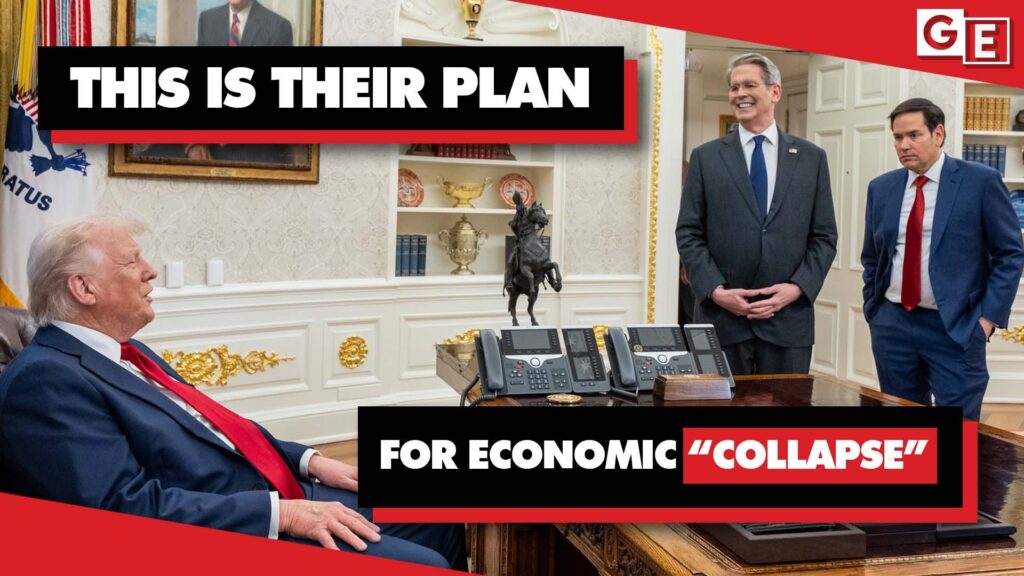
US Treasury Secretary Scott Bessent boasted Trump’s illegal “maximum pressure” sanctions seek to “collapse” Iran’s economy by cutting off oil exports, fueling inflation: “Making Iran broke again”.
Donald Trump has openly called for “regime change” in Iran. He has surrounded the country with what he calls a “massive armada”, and has suggested that he wants to kill Iran’s supreme leader, Ayatollah Ali Khamenei.
While Trump threatens to bomb Iran again, after attacking it in 2025, the US government has been dropping devastating economic bombs on the nation.
Top US government officials boast that they are trying to “collapse” Iran’s economy.
The Trump administration is waging what it calls a “maximum pressure” campaign against Tehran, which the White House says is “aimed at driving Iran’s oil exports to zero”.
Washington’s strategy is to starve Iran of export revenue by sabotaging its oil industry. By denying Tehran access to hard currency, the US aims to cause high rates of inflation and destroy the value of Iran’s currency, the rial.
This US economic warfare does great harm not only the Iranian government, but to all of the 93 million Iranians who live in the country. Civilians are bearing the brunt of the pain.
US Treasury Secretary Scott Bessent on “making Iran broke again”
Washington’s strategy for scorched-earth economic warfare was clearly spelled out by Treasury Secretary Scott Bessent, a billionaire hedge-fund manager from Wall Street.
In an interview with Fox News in January, anchor Maria Bartiromo asked Bessent about the impact of the sanctions that the US government has imposed on Iran.
Bessent bragged that these unilateral coercive measures, which flagrantly violate international law, have caused Iran to run out of dollars, which means Iran cannot pay for imports or stabilize its currency, leading to significant inflation.
“Their economy collapsed”, Bessent gloated. The top US official then took credit for the violent protests and riots in Iran.
These were Bessent’s full remarks (all emphasis added):
MARIA BARTIROMO: What do you want to say about sanctions? Something else you’ve been working on, of course. What are you planning there in terms of Iran, and the impact there? Do sanctions actually work?
And the same question with regard to 500% secondary sanctions or tariffs on countries who purchase energy products from Russia.
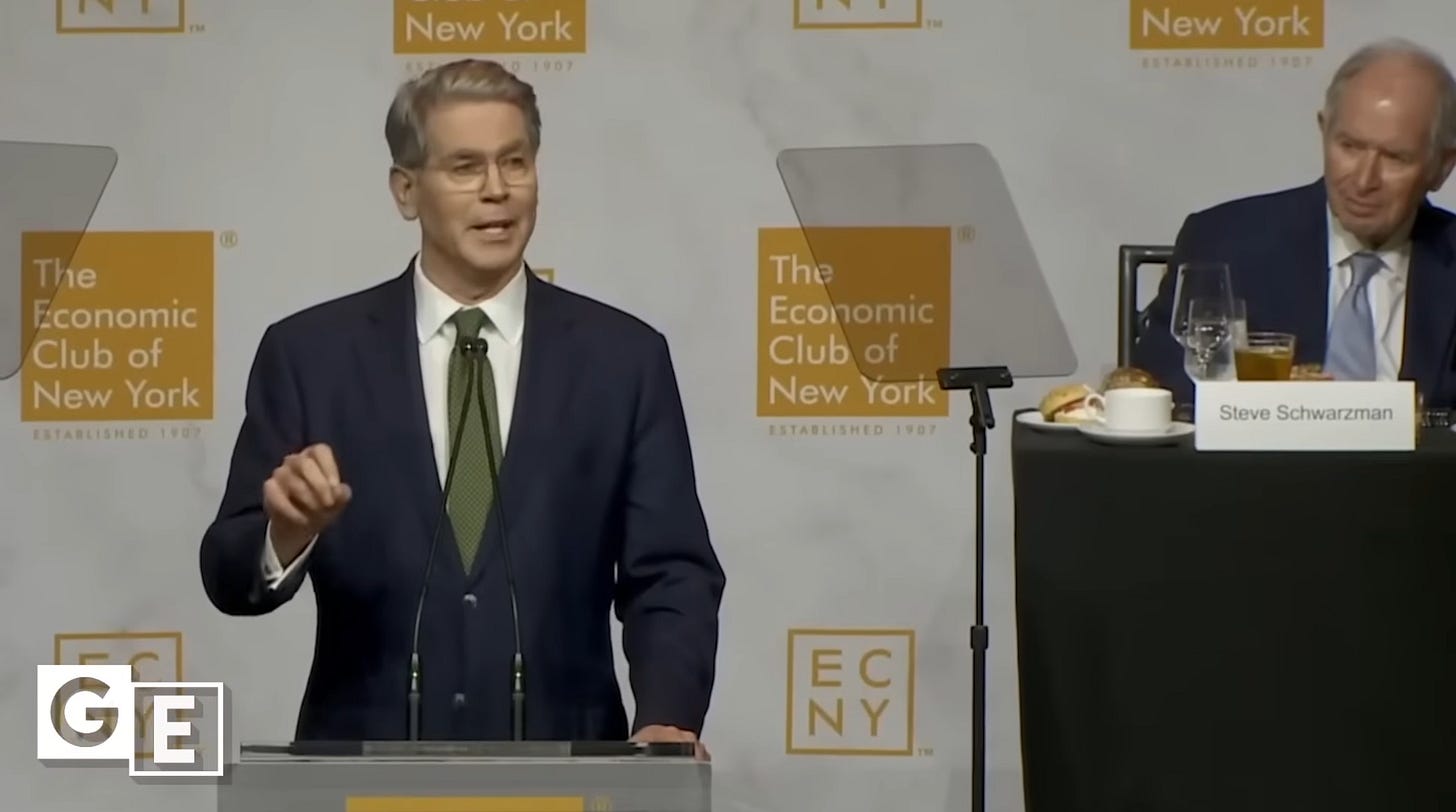
SCOTT BESSENT: OK, so two things here. There are Treasury sanctions. And if you look at a speech that I gave at the Economic Club of New York last March [2025], I said that I believe the Iranian currency was on the verge of collapse, that if I were an Iranian citizen, I would take my money out.
President Trump ordered Treasury and OFAC division, Office of Foreign Asset Control, to put “maximum pressure” on Iran.
And it’s worked. Because, in December, their economy collapsed.
We saw a major bank go under. The central bank has started to print money. There is a dollar shortage. They are not able to get imports.
And this is why the people took to the street.
So this is economic statecraft. No shots fired.
In the Fox News interview, Bessent cited a speech that he delivered at the Economic Club of New York in March 2025.
In those remarks, the US Treasury secretary admitted that the Trump administration’s “maximum pressure” campaign on Iran was “designed to collapse its already buckling economy”.
This is what Bessent said:
Last month, the White House announced its “maximum pressure” campaign on Iran, designed to collapse its already buckling the economy.
The Iranian economy is in disarray: 35% official inflation — official inflation — a currency that has depreciated 60% in the last 12 months, and an ongoing energy crisis.
I know a few things about currency devaluations. And if I were an Iranian, I would get all of my money out of the rial, now.
In the same address at the Economic Club of New York, Bessent vowed: “We will close off Iran’s access to the international financial system, by targeting regional parties that facilitate the transfer of its revenues”.
“Our maximum pressure campaign [is] designed to collapse Iranian oil exports”, he said.
“We are going to shut down Iran’s oil sector”, he declared.
Bessent then quipped, “Making Iran broke again will mark the beginning of our updated sanctions policy”.
“If economic security is national security, the regime in Tehran will have neither”, he added.
When Bessent gave this speech at the Economic Club of New York, he was surrounded by Wall Street executives. They applauded with glee as he vowed to “collapse” Iran’s economy.
Sitting directly behind Bessent on stage was the billionaire oligarch Stephen Schwarzman, who is CEO of Blackstone, the largest alternative asset manager on earth, which is known for its massive private-equity arm.
Blackstone is the largest landlord in the United States. The Wall Street firm owns more than 300,000 rental housing units in the US.
Schwarzman also happened to be one of the main funders of Trump’s presidential campaign.
After Trump won the 2024 election, Bloomberg noted that the billionaire oligarch’s “bet pays off”, and that the Wall Street executive would be “well-positioned to influence business, tax policies”.
Close correlation between US sanctions and inflation
The US Treasury secretary’s admission that Washington is intentionally trying to cause hyperinflation in Iran is extremely revealing.
Western media outlets and pundits often blame the high rates of inflation in sanctioned countries like Iran on corruption and mismanagement.
However, it is not a coincidence that many of the countries with the highest rates of inflation on Earth have been sanctioned by the United States and the West more broadly, including Venezuela, Zimbabwe, Sudan, and Iran.

The US government has waged brutal economic warfare against these countries, seeking to deny them access to the dollar-dominated international financial system and collapse their local currencies.
Corruption and mismanagement are not irrelevant (and they exist in every country), but they distract from the most important factor: sanctions.
In the case of Iran, a look at World Bank data shows that there is a very close correlation between US sanctions and inflation.

It should be emphasized that the US economic war against Iran is bipartisan, and it did not start under Donald Trump.
When the George W. Bush and Barack Obama administrations imposed illegal unilateral coercive measures on Iran, they also contributed to high levels of inflation.
In the 2000s, before the US massively escalated its sanctions on Iran, the country’s inflation rate was relatively low, bottoming at 10% in 2006.
That year, in October, the Bush administration imposed heavy sanctions on Iran and threatened to sanction non-US oil and gas companies that invested in the country.
This scared off foreign investors and trading partners, while significantly increasing transaction and insurance costs for Iranian firms. Inflation promptly shot up to 17.3% in 2007 and 25.4% in 2008.
The US Keeps Openly Admitting It Deliberately Caused The Iran Protests
Iran managed to get inflation under control by 2010, when it fell to 10.1%.
However, in July of that year, the Obama administration hit Iran with heavy sanctions, while also threatening sanctions on foreign financial institutions and companies that worked with the country.
Unsurprisingly, inflation skyrocketed over the next three years, rising to 26.3% in 2011 and 27.3% in 2012, before peaking at 36.6% in 2013.
In 2012, the Obama White House published a sadistic press release boasting of how its illegal sanctions were “grinding the Iranian economy to a halt” and “crippling” it.
Obama stated:
Because of our efforts, Iran is under greater pressure than ever before… Few thought that sanctions could have an immediate bite on the Iranian regime. They have, slowing the Iranian nuclear program and virtually grinding the Iranian economy to a halt in 2011. Many questioned whether we could hold our coalition together as we moved against Iran’s Central Bank and oil exports. But our friends in Europe and Asia and elsewhere are joining us. And in 2012, the Iranian government faces the prospect of even more crippling sanctions.
However, in 2014, inflation in Iran cooled off significantly. This was likely due in large part to the interim agreement that Iran signed with Western countries in November 2013, as part of the negotiations for the Iran nuclear deal.
Then, in 2015, Iran and the P5+1 countries (the five permanent members of the UN Security Council plus Germany and the European Union) signed the final version of the nuclear deal, known as the Joint Comprehensive Plan of Action (JCPOA).
The JCPOA was written into international law with UN Security Council resolution 2231.
This agreement lifted sanctions on Iran — and, immediately after, inflation fell, reaching the lowest point in decades in 2016, at just 7.2%.
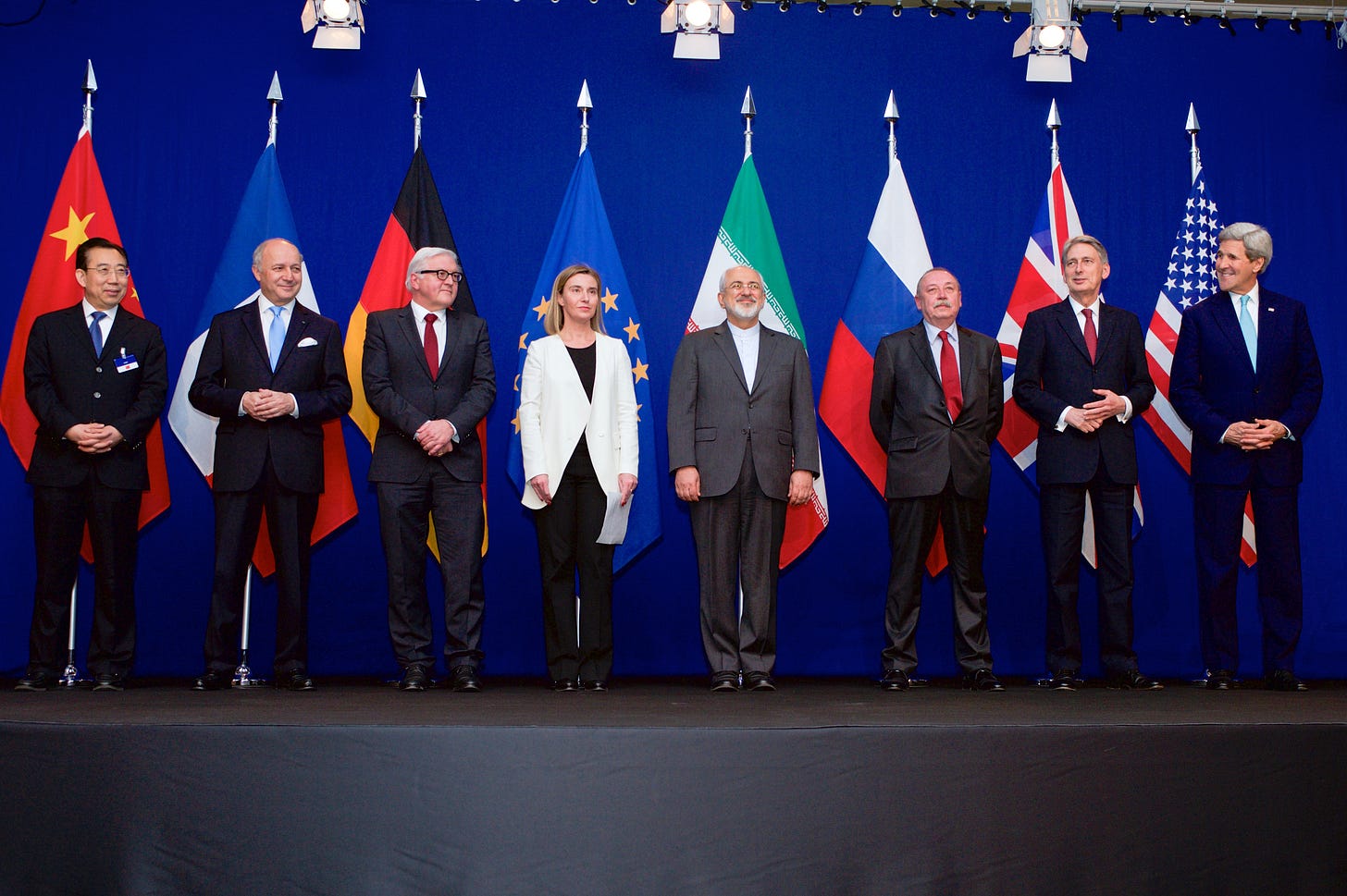
However, Trump came into office for his first term as US president in 2017, and in May 2018, he unilaterally withdrew from the JCPOA, sabotaging the agreement, and reimposed sanctions on Iran, in clear violation of international law.
Inflation in Iran then shot up to 39.9% in 2019.
The Covid-19 pandemic hit in 2020, and Iran has struggled with high rates of inflation (around 40%) ever since, as US sanctions have ripped through the economy.
The correlation is very clear. And US officials have not even tried to hide the fact that their unlawful sanctions have caused inflation in Iran. Treasury Secretary Bessent is proud of it.
US Under Secretary of State Jacob S. Helberg, a hardline neoconservative hawk, bragged on Twitter that “President Trump’s strategy of MAXIMUM PRESSURE has brought the regime to its knees [sic]”.
Helberg did not mention the tens of millions of Iranian civilians who are suffering from this brutal US economic warfare, which has intentionally wrecked their currency and has thus eliminated their purchasing power, while causing shortages of crucial goods.

UN experts: US sanctions are illegal and violate human rights
Independent experts on international law have said for many years that US sanctions on Iran are illegal, and violate human rights.
The Office of the United Nations High Commissioner for Human Rights (OHCHR) has published many reports denouncing US sanctions.
A 2019 press release stated that the “imposition of unilateral coercive measures on Cuba, Venezuela and Iran by the United States” and “the use of economic sanctions for political purposes violates human rights and the norms of international behaviour”.
“Such action may precipitate man-made humanitarian catastrophes of unprecedented proportions”, the OHCHR warned.
Prominent American economists calculated that illegal US sanctions on Venezuela caused at least 40,000 deaths from 2017 to 2018, in a conservative estimate.
The top UN expert on unilateral coercive measures, Special Rapporteur Idriss Jazairy, stressed, “Regime change through economic measures likely to lead to the denial of basic human rights and indeed possibly to starvation has never been an accepted practice of international relations”.
In another publication in 2022, a group of UN experts said that US sanctions were violating the human rights of all Iranians.
“It is time for sanctions that impede Iran’s ability to improve the environment and reduce the ill effects on health and life, to be eased or lifted completely so that Iranians can access their right to a clean environment, the right to health and to life, and other rights”, the UN experts wrote.

Western politicians, such as Andrew Yang, insist that “the US should help the people of Iran”.
If they truly wanted to help the Iranian people, the most effective — and easiest — thing they could do would be to lift the illegal sanctions that they have imposed on Iran, which have intentionally devastated the economy and caused extreme suffering to tens of millions of civilians.

Ben Norton
Benjamin Norton is the founder and editor of the independent news website Multipolarista, where he does original reporting in both English and Spanish. Benjamin has reported from numerous countries, including Venezuela, Nicaragua, Bolivia, Ecuador, Honduras, Colombia, and more. His journalistic work has been published in dozens of media outlets, and he has done interviews on Sky News, Al Jazeera, Democracy Now, El Financiero Bloomberg, Al Mayadeen teleSUR, RT, TRT World, CGTN, Press TV, HispanTV, Sin Censura, and various TV channels in Mexico, Nicaragua, Venezuela, Ecuador, and Bolivia. Benjamin writes a regular column for Al Mayadeen (in English and Spanish). He was formerly a reporter with the investigative journalism website The Grayzone, and previously produced the political podcast and video show Moderate Rebels. His personal website is BenNorton.com, and he tweets at @BenjaminNorton.