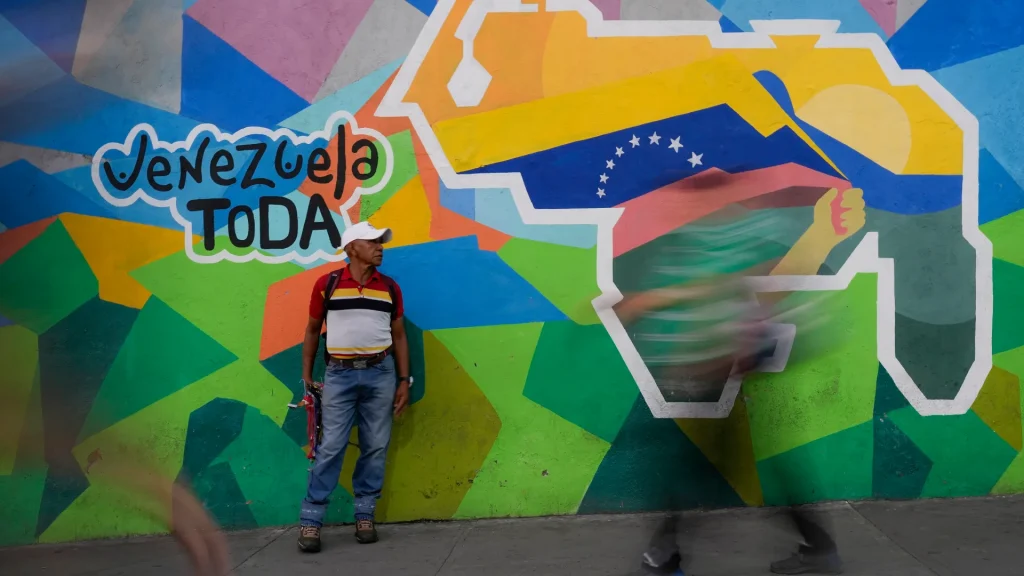
A man sells phone cables in front of a mural of the Venezuelan map with the Essequibo territory included in the Petare neighborhood of Caracas, Venezuela, in December 2023. Photo: Matias Delacroix/AP.
A man sells phone cables in front of a mural of the Venezuelan map with the Essequibo territory included in the Petare neighborhood of Caracas, Venezuela, in December 2023. Photo: Matias Delacroix/AP.
Caracas (OrinocoTribune.com)—The Venezuelan government has rejected an attempt by Guyana to disregard and distort the nature of the 1966 Geneva Agreement, which established “the legally binding obligations” regarding the disputed Essequibo territory and mandated a mutual agreement to solve the controversy.
Venezuelan Foreign Minister Yván Gil published a statement this Wednesday, February 18, categorically condemning the recent claims issued by Guyana within the framework of the commemoration of the 60th anniversary of the accord.
Surprisingly, according to experts, the Guyanese Foreign Ministry released a following statement also on Wednesday recognizing the agreement as a binding international instrument, despite several recent attempts to disregard it or claim it was a colonial imposition by the British Empire.
Guyana recognizes agreement while attempting to bypass terms
In its statement, Guyana noted that it would “commemorate the sixtieth anniversary of the signing of the Geneva Agreement of 17th February 1966, a treaty of immense legal and diplomatic significance.” The statement noted that the agreement is a binding international instrument grounded in the principles of the United Nations Charter and the rule of international law.
However, experts have noted that the distorting nature of the communiqué was contained in the third paragraph. It states that after “good offices” failed to resolve the controversy between 1990 and 2017, the UN Secretary-General chose adjudication by the International Court of Justice (ICJ) in January 2018 as the “final means of resolution,” claiming that “both Guyana and Venezuela were bound by his decision.”
Analysts argue that claiming Venezuela is bound by a unilateral decision is a clear manipulation of the agreement, as Article 4(2) stipulates that a final decision, after exhausting UN peaceful settlement mechanisms, should be decided by an “international organ upon which they both agree.”
Furthermore, Venezuelan experts highlight that the agreement preamble’s mandate for the controversy to be “amicably resolved in a manner acceptable to both parties” enshrines the principle of mutual consent. This clause, they argue, serves as the legal foundation for the Venezuelan position that no solution can be imposed without the agreement of both nations.
The 2023 referendum and the ICJ jurisdiction
The Venezuelan statement emphasizes that “Guyana continues its desperate and irresponsible attempt to distort and disregard the legally binding obligations assumed with the signing of the Geneva Agreement.”
The Chavista government highlighted that a consultative referendum was held in 2023, in which the majority of Venezuelans expressed their position in defense of the territory of the now-Guayana Esequiba state and the Geneva Agreement.
“On December 3, 2023, the Venezuelan people, through a referendum, overwhelmingly supported the Geneva Agreement as the only way to achieve a practical and satisfactory solution to the territorial dispute,” the communiqué reads, “and ratified the historic position of not recognizing the jurisdiction of the International Court of Justice to resolve said dispute.”
The statement also noted that the only possible solution lies within the framework of international law via the 1966 treaty. It asserted that, sooner or later, Guyana will have to return to the negotiating table to reach the practical and mutually acceptable settlement mandated by the accord.
Below, you can read the full unofficial translation of the Venezuelan statement:
The Bolivarian Republic of Venezuela categorically rejects the statement issued by the Cooperative Republic of Guyana, within the framework of the commemoration of the 60th anniversary of the 1966 Geneva Agreement.
In its statement, Guyana continues its desperate and irresponsible attempt to distort and disregard the legally binding obligations assumed with the signing of the Geneva Agreement, according to which the territorial dispute over the Essequibo region must be resolved through a practical and mutually acceptable arrangement between the parties.
On December 3, 2023, the Venezuelan people, through a referendum, overwhelmingly supported the Geneva Agreement as the only way to achieve a practical and satisfactory solution to the territorial dispute and ratified the historic position of not recognizing the jurisdiction of the International Court of Justice to settle said dispute.
Therefore, true to its historical position and the popular mandate, Venezuela reiterates that it will not recognize any decision emanating from the International Court of Justice regarding the territorial dispute over the Essequibo region. Guyana’s unilateral action before that body is a clear violation of the Geneva Agreement, whose obligations are incompatible with and mutually exclusive of any judicial ruling.
The only possible solution to the territorial dispute, within the framework of international law, lies in the Geneva Agreement. Sooner or later, the Cooperative Republic of Guyana will have to sit down at the negotiating table to reach the practical and mutually acceptable settlement mandated by this legally binding international treaty.
The Bolivarian Republic of Venezuela asserts its historical rights over the Essequibo region and reaffirms that it will never renounce the territory that has belonged to it since its birth.
The sun of Venezuela rises in the Essequibo!
Caracas, February 18, 2026.
Special for Orinoco Tribune by staff
OT/JRE/AU