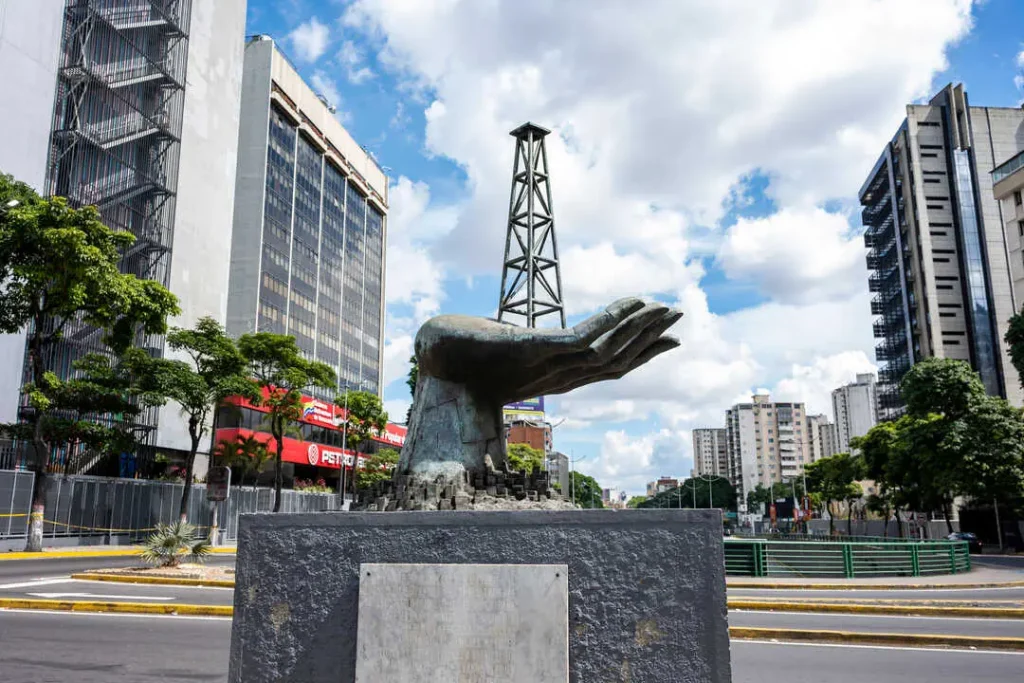
The Mineral Hand, a symbol of Venezuelan oil and oil workers, behind the headquarters of Petróleos de Venezuela in Caracas. Photo: Jimmy Villalta/Zuma Press/ContactoPhoto.
The Mineral Hand, a symbol of Venezuelan oil and oil workers, behind the headquarters of Petróleos de Venezuela in Caracas. Photo: Jimmy Villalta/Zuma Press/ContactoPhoto.
An interview with Francio Vielma, one of Venezuela’s leading experts in the hydrocarbon sector.
Francio Vielma (Barinas, 1979) is one of the most prolific and incisive voices on Venezuela over the past two decades, having accompanied the Chavista process since its inception. A sociologist of development and specialist in public planning, he was Coordinator in the Vice Ministry of Strategic Affairs, attached to the Ministry of the Presidency under Hugo Chávez, and today works as a writer, political analyst, and communicator.
Vielma has also been an analyst for Petróleos de Venezuela SA (PDVSA), and is a leading expert on the Venezuelan hydrocarbon sector. In an interview with Diario Red, translated below, the expert explained some of the key aspects of the regulatory reform and reviews the current situation in Venezuela following the US attack on January third.
In the context of the Venezuelan situation, cognitive warfare plays a key role. The recent reform of the Organic Hydrocarbons Law is presented in the media as the keystone of US operations in Venezuela and the reconfiguration of its relations. But what does the reform of the Organic Hydrocarbons Law actually entail? What was the previous situation? How does it differ from it?
The reform to the Organic Hydrocarbons Law should be understood exactly as that, a reform, a partial modification, which is built upon the pillars of the 2001 law. That 2001 law was modified in 2006, and now, two decades later, but the spirit and central elements of the 2001 law are preserved in the current reform.
Certainly, conditions have changed since 2001, and have been changing for a long time. This year’s reform addresses the new realities of Venezuela’s oil industry.
First, the global and Venezuelan oil business is not the same as it was 25 years ago. Globally, we have higher cost structures for oil production, especially for the production of heavy and extra-heavy crude, and we are entering a stage of competition with emerging energy sources in the energy transition.
This suggests that Venezuela warrants extraordinary investment to harness its world’s largest crude oil reserves for the energy transition. This would help meet the demand of 123 million barrels per day (bpd) estimated to be needed by 2050, according to OPEC. Furthermore, 80% of the world’s oil fields are in decline, according to the International Energy Agency. This suggests that countries with large reserves are poised to attract significant investment in the coming years.
The first objective reality is that the Venezuelan state on its own, cannot develop that potential, nor produce heavy crude oil at the high initial investment cost. The country lacks the financial capacity, the technology, and the necessary conditions.
The second, and crucial, element explains the above. It’s the cycle of the last 10 years: coercive measures, illegal sanctions, a financial blockade, a trade blockade, and ultimately, a naval blockade of Venezuelan crude. Over the last 10 years, Venezuela should have been flooded with investment, but instead, it received strangulation and sanctions. That is the second objective reality.
Neither of these two issues appears as components of Venezuela’s oil dynamics in the 2001 law. This reform, as should be the case with any reform, is conceived in relation to the conditions of the present, so the new reform addresses these issues by giving the Venezuelan State room to maneuver in order to carry out its strategic management from three business schemes provided for in the Law.
First, the State. Petróleos de Venezuela SA (PDVSA) remains the exclusive and non-transferable property of the Venezuelan State.
Secondly, the state’s majority ownership in joint ventures, or companies in partnership with foreign partners, is reaffirmed. Chevron, Repsol, and Maurel & Prom, for example, operate under this model. In the sectors where they currently work, they will continue to hold a minority stake with the Venezuelan state.
Third, and this is the new element, new contract models are being created that offer private companies and operators greater comparative advantages. These apply specifically to “green” fields: areas with certified reserves but no existing investment. In these cases, the state remains the sole owner of the crude oil reserves but creates incentives through flexible royalty and tax structures to facilitate investment, which is particularly costly for heavy and extra-heavy crude. The majority of Venezuela’s reserves are of these heavy and extra-heavy crude.
What is the present and future of PDVSA and its operation within the current legal framework and in this new arrangement with foreign or state-owned private companies?
PDVSA and Venezuela are facing a new period of investment and repositioning of their hydrocarbon industry. The country will soon recover some of the ground lost in the last 10 years.
We are confident that oil production will increase, and this will increase Venezuela’s relevance in the energy system.
Venezuela will be one of the recipients of international oil investment. The Orinoco Belt, for example, has such vast reserves and is so extensive that all the world’s major oil companies could operate within it. This is something all stakeholders must understand, and the Hydrocarbons Law creates favorable conditions for all geopolitical actors.
Venezuela, in the revolutionary era, has had a multi-faceted energy policy: It has targeted the United States as a destination market, but also China, India, Europe and the Latin American and Caribbean region.
The current US repositioning suggests, for now, that Chinese and Russian activities in Venezuela will be shut down. But formally, this is nothing new, because these companies have been under sanctions for operating in Venezuela since 2019. Nevertheless, they remain there.
So China and Russia are going to mediate their situation. Eventually, there could be a point of convergence, and if common sense prevails regarding the energy landscape, the United States, China, and Russia could work simultaneously in Venezuela’s fields, just as they did until a few years ago.
Venezuela advocated for favorable licenses for Chevron, mediating with the US government itself. It is now doing the same for Russian and Chinese companies. Therefore, I see it as quite possible that Chinese companies will continue buying Venezuelan crude, or that even, in the coming years, Russian companies will extract Venezuelan crude to send to the United States. The timelines of hydrocarbon geopolitics are not linear or identical to the timelines of US administrations.
Within the same narrative construct of post-January third Venezuela, certain stories, such as the one about oil trade with Israel, have emerged that could seriously damage the country’s political image in the international arena. What lies behind these Bloomberg reports that have proliferated online?
Venezuela and PDVSA remain under pressure and coercion. Regrettably, the United States has taken control of the commercial activity surrounding Venezuelan crude, authorizing companies like Vitol, Trafigura, and others to act as marketing agents or traders for Venezuelan oil.
Bazan Group of Israel purchased that crude oil from Vitol on the secondary market. PDVSA has no ties to Bazan Group, nor is there a direct commercial relationship with that company.
In her political program “Venezuela, Land of Grace,” the opposition led by María Corina Machado proposed privatizing and “reactivating” the oil and gas industry through agency management and a framework designed to attract massive private investment. How does the new management of hydrocarbons by the interim Chavista government oppose or present itself as an alternative to this scenario?
The differences between the current reform to the Hydrocarbons Law and the proposal promoted by the opposition are enormous.
Under the reformed law, PDVSA is non-transferable and exclusively owned by the State. María Corina Machado, however, openly proposed its privatization.
Under the Hydrocarbons Law, resources continue to be classified as public and social property. Machado’s proposal would transfer these resources to a regime of foreign private ownership.
In the approved law, the state remains the majority shareholder in joint ventures. In contrast, Machado’s proposal would eliminate joint ventures, transferring everything to private hands.
The premises on which the opposition’s proposal was based consisted of a clear loss of national sovereignty.
Delcy Rodríguez’s administration, on the other hand, according to the new reform, creates an attractive framework for investment, with numerous incentives, but without undermining the role of the state and the public interest in the resource base. The difference is not only philosophical but also methodological and programmatic.
Could you—with all due caution—draw up an updated portrait of the hydrocarbon sector (extraction, refining, distribution, collection and management of oil revenues…)?
In December, just before the naval oil blockade intensified, Venezuela reached a pumping rate of 1.2 million barrels. In 2025, Venezuela increased its crude oil production by more than 14%. Throughout 2025, Venezuela did not import a single liter of gasoline or diesel. The supply of gas for domestic and industrial use was complete. In January, the first commercial export of LPG took place after achieving national self-sufficiency.
These milestones were achieved despite a blockade, through trade evasion, international alliances that circumvented sanctions, and Venezuelan ingenuity in overcoming sanctions, creating national technological solutions, and resisting the deprivation of equipment and spare parts.
These milestones suggest that in recent years PDVSA adapted to a policy of restrictive sanctions and a deep and extensive trade boycott. Now PDVSA will adapt to a period of limited flexibility and restrictive licenses. We are entering a period of relative flexibility, through licensing. Is this favorable for Venezuela? Yes, to some extent. This is still far from an ideal situation for the Venezuelan hydrocarbon industry, which will require, once again, another resizing of the industry, management methods, and a new period of adaptation.
And finally, as an analyst and expert, beyond the specific issue of hydrocarbons, what is your assessment of the current political situation in Venezuela and the present and future of Chavismo under this new circumstances?
Chavismo, as the country’s leading force, is experiencing an absolutely unprecedented moment. Nothing like what has been seen in Venezuela in the last month has been witnessed in recent history.
This overall situation demands exceptional interpretations and avoids easy conclusions. We Venezuelans call this “playing the Caribbean game.” It’s very difficult to explain, but it’s basically playing with cunning and creativity. For years, the country’s leadership has learned a great deal about creative resilience, strategic prudence, and pragmatic flexibility. If there’s one thing Chavismo has mastered, it’s adaptability while preserving its essential principles.
But now the search for opportunities, the need to buy time, and the need to preserve the domestic front (where Chavismo exerts control and room to maneuver) converge. This is to deal with a very strong adverse asymmetry, favorable to the United States.
We are at a point where political conditions have changed. There is a tense détente taking shape in the energy sector with the United States as a result of the events of January third.
For Venezuela, it was impossible to withstand a naval blockade like the one last November and December, which brought the country closer to absolute collapse.
The Washington government has not achieved a straightforward regime change in Venezuela; Chavismo still governs the country. Maduro’s political team is an undeniable power broker, and the Trump administration has chosen to accept this team as unavoidable, partially easing the embargo through licenses and advancing its oil interests. For them, it is preferable to pursue attainable gains rather than risk everything on an “all or nothing” gamble, or to turn Venezuela into another Iraq, as Trump himself has stated.
Oil has always been the primary driver of US interest in Venezuela. It’s an unavoidable factor. Even during the Chávez era, Venezuela has never been prohibited from selling crude oil to the United States; on the contrary, it was the Americans who canceled deals due to their sanctions. Venezuela has always recognized the United States as one of the world’s largest consumers and a key market for its oil products.
So those are the points that have converged at present, leaving the unprecedented situation that exists.
I believe that President Maduro, from his captivity, still has the best outlook for the future. He has conveyed his message through his son Nicolás, calling for trust, stating that the right actions are being taken, and asking for confidence in his team.
Partial Reform of the Venezuelan Hydrocarbons Law: An Analytical Review
Here I reiterate the premise that political and energy timelines are not linear with the timelines of US administrations. The poet José Antonio Ramos Sucre, a descendant of the Grand Marshal of Ayacucho, wrote in “La Granizada” that “time is an invention of watchmakers.” In politics, this could be applied to the idea that time is also a political construct. “They have their strategy, and we have ours,” said Delcy Rodríguez. It is reckless to speak of outcomes or make predictions right now; rather, this is a time of uncertainty, strategy, and the use of power dynamics, based on the current realities.
Yes, the United States says it controls Venezuela, and yes, they are controlling the flow of oil outflows. But they haven’t changed the regime, as they intended.
They have implemented a regressive policy that has led to their sustained suffocation. They have had to come to terms with Maduro’s team, sidelining the opposition, since they lack the real power to govern the country that Chavismo possesses.
They have had to narrate as their “achievements,” in terms of opening up the oil sector, what is actually the result of their failed policy of strangling Chavismo to force it to capitulate, because that didn’t work.
They had to remove Maduro by force after ten years of maximum pressure failed and the Venezuelan military wouldn’t do the job for them. That was a display of brute force, not real power. It was, rather, a display of strategic weakness. While Trump grapples with political costs, Delcy Rodríguez reaps political benefits. These are also ways of understanding the present. To envision the future, the big question is whether Chavismo will prevail. And the answer is that it already has, because it is a dimension of power—political, identity-based, symbolic, and sociocultural.
(Diario Red) by Irene Zugasti
Translation: Orinoco Tribune
OT/JB/SH
We use cookies to improve your experience. By continuing, you agree to our Privacy Policy.