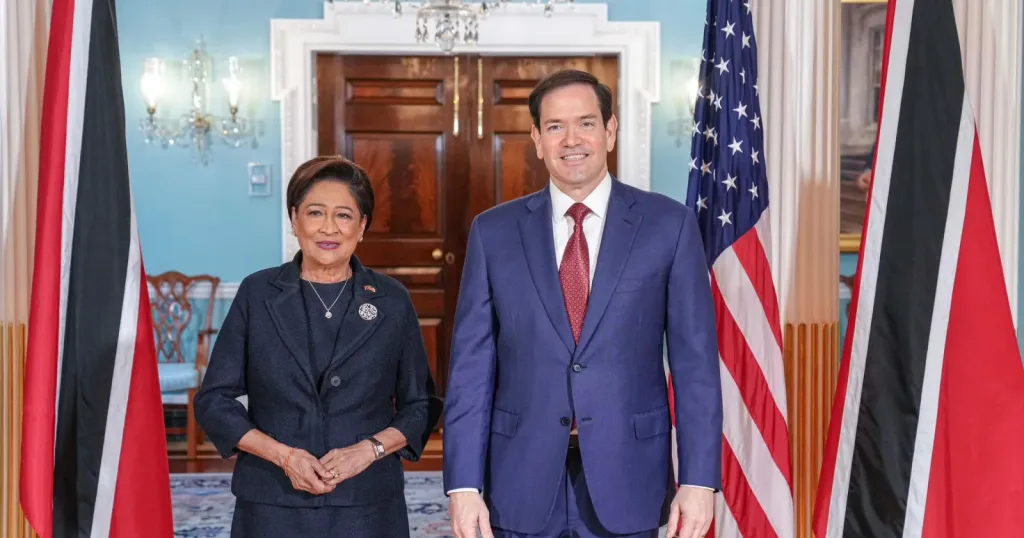
US Secretary of State Marco Rubio alongside Trinidadian Prime Minister Kamla Persad-Bissessar on Sept. 30, 2025. Photo: US Department of State/file photo.

Orinoco Tribune – News and opinion pieces about Venezuela and beyond
From Venezuela and made by Venezuelan Chavistas
US Secretary of State Marco Rubio alongside Trinidadian Prime Minister Kamla Persad-Bissessar on Sept. 30, 2025. Photo: US Department of State/file photo.
Trinidad and Tobago’s Minister of National Security Roger Alexander revealed his government’s intention to propose legislation that would censor social media.
The official justification behind this proposal points to the criticism that various social media platforms have broadcast regarding collaborations between the United States and Trinidad and Tobago. For example, between November 16-21, Trinidad and Tobago carried out joint military exercises with the US despite the fact that the US regime has been accused of carrying out extrajudicial killings in the Caribbean, including killings of civilians of Trinidad and Tobago, in an attempt to bring about regime change in Venezuela.
Understandably, many citizens of Trinidad and Tobago have taken to social media to express their frustration and condemnation of their nation’s collaboration with the criminal acts of the US regime.
The proposal sparked immediate condemnation. The opposition People’s National Movement (PNM) called it “unacceptable, anti-democratic, and hostile to the principle of freedom of expression.” Opposition leader Pennelope Beckles signed a statement repudiating the attempt to use “the power of the state against private citizens exercising their constitutional rights.”
“Any government that fears criticism has abandoned its commitment to democratic values,” the politician said, urging Minister Alexander to retract his threats and focus on the nation’s real problems, “which cannot be solved by silencing critics.”
Enough is Enough
It is reprehensible that this UNC government is seeking to weaponize the issue of visas and the residency status of Trinbagonians overseas as a means of suppressing public discontent and for the muting of questions and lawful expression. pic.twitter.com/fPTjvXcHTc
— Pennelope Beckles MP🌐 (@pennybeckles) November 24, 2025
The PNM argued that misuse of social media can be prosecuted under existing criminal and civil laws and that invoking emergency powers or introducing new laws to suppress dissent “is a blatant attack on our democracy.”
Intimidation and lack of transparency
The PNM also denounced the government’s intention to intimidate people and stifle transparency. The minister’s threats to silence dissenting voices under the pretext of threats to national security “attack the very foundation of a free and open society.”
The opposition described as “reprehensible” the government’s attempt to “weaponize” the issue of visas and the residency status of Trinidadians abroad to suppress public discontent.
Beckles emphasized the crucial role of bloggers, influencers, and online journalists in exposing state misconduct and keeping citizens informed, especially against abuses of power. She lamented that government ministers, who evade accountability in Parliament, are now seeking to punish influencers under the pretext of “threats to national security.”
Authoritarian behavior
The opposition warned that this development is part of a “very dangerous pattern of behavior” by the government. Among the examples cited were the cancellation of Independence Day celebrations under the pretext of “threats to public officials,” the declaration and extension of a State of Emergency under the same justification, the crackdown on Carnival activities due to “noise pollution,” and mass layoffs.
“A government that suppresses freedom of expression is not protecting security; it is undermining it,” Beckles stated.
Stuart Young, former minister of homeland security of Trinidad and Tobago, expressed alarm at Alexander’s positions. Young noted that these maneuvers, along with the use of a Preventive Detention Order under the state of emergency to detain a social media blogger—instead of criminal law allowing bail and respecting the principle of “innocent until proven guilty”—represent “a living and growing threat to democracy.”
“These are very dangerous developments. Is it this government’s policy to use dictatorial actions to silence people who hold different opinions?” Young asked. He added that they cannot ignore “these clear and present threats to our constitutional rights and freedoms.”
Young emphasized that while social media posts should not violate laws—such as those against defamation or harassment— “this government is crossing a line and this is a dangerous path.”
David Abdulah, leader of the Movement for Social Justice (MSJ), deemed Minister Alexander’s statements as “completely unacceptable.” He pointed out that laws already exist to address defamatory or slanderous statements, as well as anti-terrorism and treason legislation.
“There is absolutely no need to strengthen repressive legislation at this time,” he stated.
Abdulah noted that it is not the role of a minister to discuss potential violations but, rather, that the police should investigate and, if there is evidence, prosecute individuals based on existing laws. He also criticized the use of arrest warrants under the State of Emergency to address these situations.
Report: Trinidad & Tobago Army Kept in Dark on US Southern Command Drill
In recent months, the government of Prime Minister Kamla Persad-Bissessar has been under intense scrutiny for her anti-Venezuelan migrant xenophobic stands, her full support for US extrajudicial killings in the region even after Trinidadian nationals were assassinated, military drills conducted with US military forces, and for maintaining an anti-Venezuela rhetoric that is clearly aligned with US imperial designs for Venezuela.
The level of belligerence against Venezuela, Venezuelans, and Venezuelan authorities reached a peak in late October, when Venezuela halted its energy cooperation with the country in response to the island nation’s complicity with the illegal US actions and killings in the region.
(Telesur) with Orinoco Tribune content
Translation: Orinoco Tribune
OT/JRE/SL