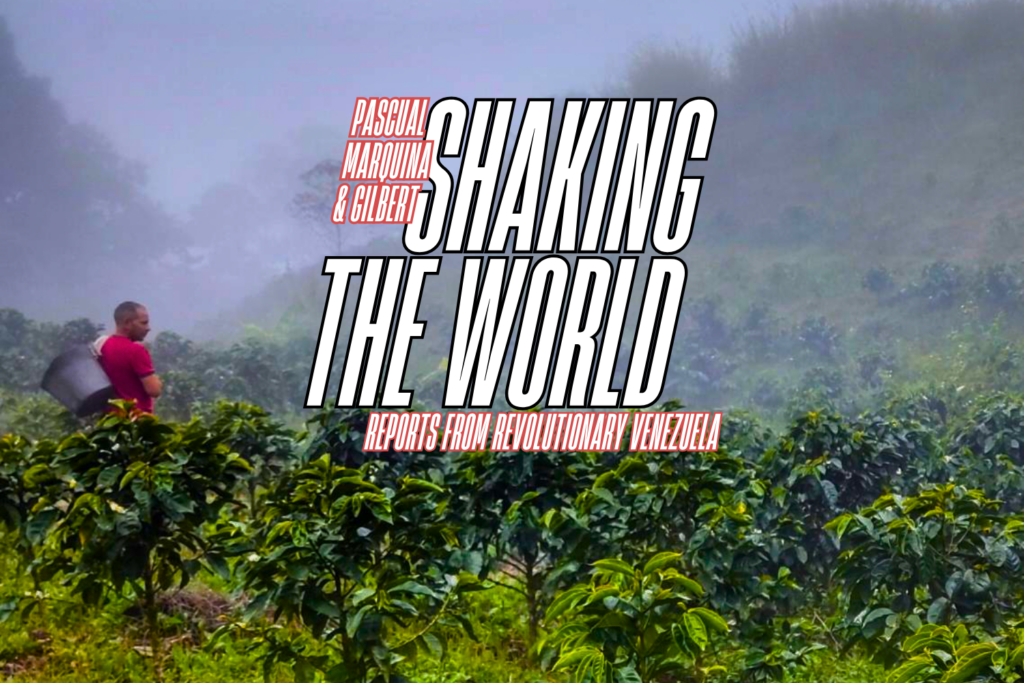
An agricultural worker in a mountainous coffee-growing region. Photo: Rome Arrieche/Voces Urgentes.

Orinoco Tribune – News and opinion pieces about Venezuela and beyond
From Venezuela and made by Venezuelan Chavistas
An agricultural worker in a mountainous coffee-growing region. Photo: Rome Arrieche/Voces Urgentes.
In the mountainous coffee-growing region of Morán municipality, in Lara state, generations of campesino families have built their lives growing coffee. Steep slopes, misty mornings, and hard physical labor are part of daily life in this territory, where coffee is not only a crop but a way of organizing time, work, and community. In recent years, this long history of cooperation has taken a new form through the Vida Café Communal Economic Circuit, an initiative that brings together seven coffee-growing communes in a joint effort to sustain production, life, and collective organization under adverse conditions.
Communal economic circuits are initiatives promoted by the Bolivarian government to organize production, processing, commercialization, and reinvestment at the territorial level, seeking to operate outside the logic of the capitalist market. Vida Café is one such circuit: a relatively recent but robust project that brings together freely-associated producers organized within their communes, while also addressing broader community needs such as infrastructure, communications, and access to healthcare and services. Coffee remains its productive backbone, but the circuit’s horizon is wider: the reproduction of life and dignity in the territory.
This testimonial work explores the origins, functioning, and meaning of Vida Café through the voices of the people who built it. In this first installment, communards reflect on the history of the territory and its long-standing practices of cooperation. Future installments will delve into the organizational efforts behind the Communal Economic Circuit, which was forged during some of the most difficult years of the US blockade. What emerges is not only a story about growing coffee, but, more importantly, about commune-building, collective resistance, and the ongoing effort to build economic sovereignty.

Rooting a territory
Norkys Ramos: Before our grandparents and great-grandparents moved into this territory, Indigenous peoples lived in these mountains: we must never forget that. Later, and particularly in the 20th century, the area was settled again. People arrived little by little to these mountains. Once they came, they stayed for good.
They built their lives here. They planted coffee, but they also grew other crops and raised cattle. It wasn’t only coffee at first. Over time, coffee became the main crop, because this land is very good for it, because it makes sense economically, and also because government plans encouraged coffee production here many decades ago.
We are blessed with a generous land and a climate that produces one of the best coffees in the country. That’s why people stayed here, and that’s why coffee ended up shaping Villanueva.
Enrique Guédez: I was born in 1960. Everything I know about coffee, I learned from my grandparents, who were coffee growers. At that time, the coffee was the criollo variety. We didn’t call it organic; it simply was. We used no agrochemicals and no formulas, and we had no dependence on companies that impose their practices of dispossession by pushing products that burn the land and create dependency. The coffee was cultivated with what the land itself offered and with knowledge forged through practice, not imposed from outside.
In the cup, that coffee was unmatched for the depth of its flavor. Many decades later, I strive to preserve the knowledge and practices of my ancestors.
People settled in this territory mostly to grow coffee. They arrived, they cleared land, they opened paths, and they built their houses little by little. This wasn’t fast. It took decades. But those people stayed. They didn’t come to try something and leave; they rooted themselves here. That’s how it was with my family.
Coffee organizes life. We all know when it’s time to plant, when it’s time to prune, when we have to prepare for the harvest. The year is divided according to the coffee cycle. Families and the community plan around that.
Johnny Valera: My elders were coffee growers, and I grew up here on this mountainside, among the coffee bushes. Every morning I walked a long way to school, in the damp cold and through the thick mist that settles on the trees at night. But I didn’t learn my trade in school. I learned it from my elders, working every day from a very young age—being on the land, watching how the cafetos [coffee bushes] grow, how to keep pests away using natural methods, and learning what conditions help them produce better harvests.
Between my family and me, we have ten hectares of coffee.
That land feeds us, but not by itself. It feeds us because we work very hard and because we never work alone. Here, if a neighbor needs help, I help them. If someone needs work, I try to give it to them. That’s how people survive up here.
But this territory is more than just work. The guerrilleros—those from the armed struggles of the 1960s and 1970s—passed through here. People don’t talk about it much, but they did. They moved through these mountains and left behind stories and lessons, too, that are still with us today. We carry them as we continue to defend our sovereignty and the Bolivarian Revolution, as part of a much longer history: from the struggle for independence, to the anti-oligarchical campesino wars led by General Ezequiel Zamora in the nineteenth century; from the guerrilla struggles to the popular uprising of 1998 [Caracazo].
Coffee, the land, our hard work, and a bit of that history—that’s how we got here! Ah, and working together. You cannot grow coffee alone!
Guédez: In the 1960s, the Ministry of Agriculture and Livestock arrived in Morán with programs aimed at modernizing production. They brought technical guidance and standardized ways of working. We were trained in new coffee varieties, new cultivation methods, and new production practices. Back then, we understood all of that as progress.
We replaced the criollo variety coffee, which was very robust. We introduced chemicals. We began depending on inputs that came from abroad. With time, the soil changed. The acidity increased. The land suffered. People started getting sick. That process marked us deeply.
And in some ways, it was progress. But we also didn’t understand everything we were changing.

Previous forms of cooperation
Ramos: Before the Economic Circuit existed, in the 1960s and 1970s and extending into the 1980s, there was PACCA [Productores Asociados de Café, Compañía Anónima]. PACCA offered plans and programs to coffee producers, and for a time, it played an important role. But little by little it declined, because it was not able to deliver what it promised.
It was in that context that COPALAR [Cooperativa de Productores Agrícolas de Lara, promoted with the support of Centro Gumilla, a Jesuit organization] entered the scene. COPALAR was founded in the early 1990s, at a moment when coffee growers were increasingly exposed to market pressures. Intermediaries paid very little, transport was difficult, and access to credit was almost impossible for small producers on their own.
COPALAR emerged from that need. It was an effort by producers themselves to organize in order to defend their work and their production.
Guédez: COPALAR was an attempt to give direct structure to cooperation, unlike earlier experiences that were not truly cooperative and were mediated by private interests. The idea was to move away from schemes where producers had little say, and toward an organization where decisions were made collectively.
The objective was not only to help one another during the harvest—which we already knew how to do—but to organize commercialization, access to credit, and inputs in a genuinely cooperative way.
For many of us, it was the first time we tried to confront the market as a group rather than as isolated producers. In Morán, COPALAR was a key player at the time, and it was very important in our ongoing struggle to overcome the scourge of the intermediaries.
Valera: Individually, we were very vulnerable. We worked all year, and then we had to accept whatever price they offered us. There was no room to negotiate. COPALAR was a way of trying to change that situation.
It was about selling together, buying together, and not being alone when dealing with buyers and intermediaries.
Kennedy Linares: COPALAR also brought new challenges. Cooperation in work is one thing; organization brings other responsibilities. There were decisions to make, accounts to keep, and disagreements to resolve. Not everyone saw things the same way. That was part of the learning.
Guédez: Through COPALAR, coffee growers were able to access collective credit, organize commercialization, and improve some productive processes. It allowed us to take steps that were impossible individually.
But there were also limits. The infrastructure was weak [e.g., roads]. Credit conditions were difficult. External pressures were strong. And we didn’t yet have the level of institutional support that would come later, with the Communal Economic Circuit.
Ramos: COPALAR eventually collapsed, but even so, it left something very important behind. It showed that collective economic organization was possible. When COPALAR stopped working as it had at the beginning, the experience didn’t disappear. The learning stayed in the territory, and people understood better than ever what was needed to sustain cooperation over time.
Valera: COPALAR wasn’t the end of the road. It was part of the process. We learned by doing, and sometimes by making mistakes. But we didn’t go back to working as isolated individuals. Once you’ve organized collectively, you won’t forget how to do it.
Guédez: In that sense, COPALAR prefigured what would come later. It showed the need for a stronger organization, better infrastructure, and a different relationship—one of cooperation—with the state. Those lessons would become fundamental with the creation of the Communal Economic Circuit.

Working together
Guédez: Even with the introduction of new coffee-growing methods, our own coffee culture has never stopped being the center of life. The harvest still brings people together. If someone can’t finish harvesting, others step in to help. If a neighbor is struggling, someone else will lend a hand. That’s how things still work today. That’s how our culture was built.
Mauro Jiménez: Coffee organizes the year. It tells you when to prepare the land, when to prune, when to harvest. Life moves with that rhythm. And because of that, you’re never working only for yourself. You’re always working alongside others.
If you don’t understand that, coffee will defeat you.
Linares: That’s how we learned to work here. By helping. By exchanging workdays. By being present when someone needed support.
No one wrote that down. It was learned by doing.
This has fed into commune-building in the territory. While coffee-growing is taken to be a family enterprise, it really builds a social fabric of collaboration. Without that fabric of collaboration, you cannot have a working commune, and even less an economic circuit joining seven communes.
Valera: Everyone has their own parcela [plot of land], but nobody is isolated. If a neighbor needs work, you give them work. If someone has a problem, you look for a way to solve it together.
That’s how people raised their families here. That’s how people survived.
Of course, I’m talking about small producers, which is most of us. There are also a few larger-scale fincas [estates] that work under a very different logic. They are not based on cooperation, but on hired labor and extraction. It’s a more exploitative model, and it has little to do with how most of us live and work here.
Guédez: Coffee makes you think beyond your own parcela. We all have to care for the water sources, for the roads, we all depend on others for the harvest, for transport, for knowledge. Over time, that creates bonds.
Those bonds are what allowed life to continue here, even when conditions became more difficult because of the US blockade. Those bonds are also very important for making the commune work.
Ramos: Those ways of working together existed long before there was talk of communes. People already knew how to cooperate before. What came later was the challenge of giving that cooperation a form, a structure, and a political meaning.
But the base was already there.
Vicente Paul Colmenares: Culture isn’t something separate from work. It’s how people relate to one another, how they respect the land, how they care for life. Our traditions, our songs, and our décimas [popular poetry] come from working together.
Shaking the World: Reports from Revolutionary Venezuela is a biweekly column by Cira Pascual Marquina for MR Online, offering frontline analysis of imperialism, popular power, and revolutionary struggle in Venezuela.
This article forms part of a longstanding body of work by Chris Gilbert and Cira Pascual Marquina documenting commune-building in Venezuela. Click here to read earlier installments in the series.
(Monthly Review) by Cira Pascual Marquina and Chris Gilbert

Cira Pascual Marquina is a Political Science professor at the Universidad Bolivariana de Venezuela in Caracas. She is also co‐producer and co‐host (with Chris Gilbert) of the Marxist education program Escuela de Cuadros. She is actively engaged with grassroots organizations in Venezuela and abroad, and is dedicated, both as a militant and as an investigator, to communal initiatives.
Pascual Marquina is co-author of Venezuela, the Present as Struggle: Voices from the Bolivarian Revolution (Monthly Review Press) and co‐compiler of two books: Para qué sirve El Capital: un balance contemporáneo de la obra principal de Karl Marx and ¿Por qué socialismo? Reactivando un debate (both Editorial Trinchera).