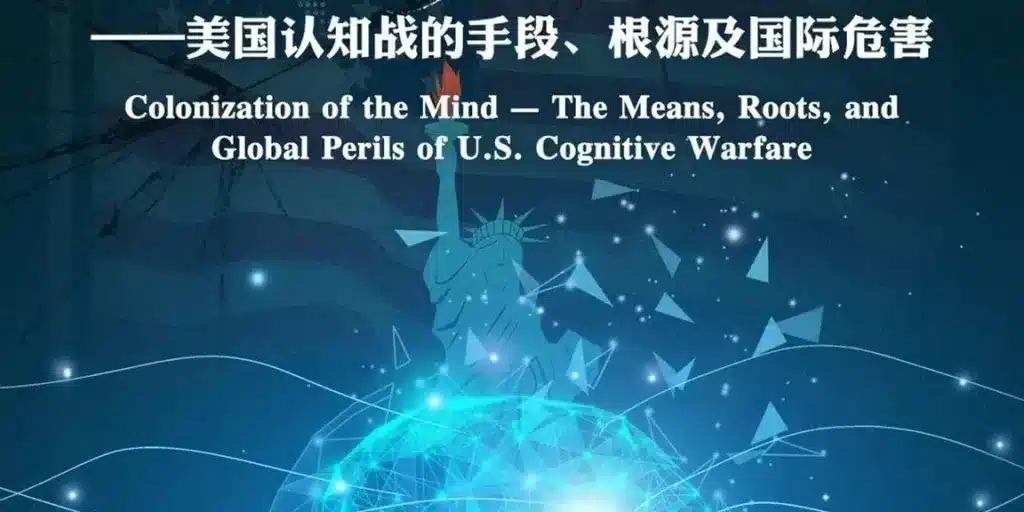
Colonization of the Mind - The Means, Roots, and Global Perils of U.S. Cognitive Warfare. Photo: Substack.

Orinoco Tribune – News and opinion pieces about Venezuela and beyond
From Venezuela and made by Venezuelan Chavistas
Colonization of the Mind - The Means, Roots, and Global Perils of U.S. Cognitive Warfare. Photo: Substack.
By S.L. Kanthan – Sep 14, 2025
The Means, Roots, and Global Perils of U.S. Cognitive Warfare (White Paper from China)
Chinese scholars have recently published an excellent white paper on the colonization of the mind by the US. It’s a long paper — 36 pages. So, I have tried to summarize the paper by copy-pasting some key points here. Here are a three links for the original paper in different formats: Link 1, Link 2, Link 3. Enjoy!

Excerpts from the paper:
Since World War II, particularly after the end of the Cold War, by leveraging its global supremacy in political, economic, military, and technological might, the United States has been exporting its ideology worldwide in an attempt to capture the minds of nations with American values, reshape peoples’ conceptions, and create philosophical dependence on an American-centric worldview.
“The critical question for the United States is not whether it will start the next century as the superpower with the largest supply of resources, but to what extent it will be able to control the political environment and get other countries to do what it wants” — Joseph Nye.
“Reinforcing American culture’s position as the ‘exemplar’ for all nations is an indispensable strategy for maintaining U.S. hegemony” — Zbigniew Brzezinski.
The United States discovered that relying solely on “hard power” in the forms of political domination, economic control, military deterrence, among others, could not establish or sustain a lasting and extensive colonial rule; instead, employing “soft power” such as culture and values would enable it to reap higher colonial rewards at lower costs.
Compelling global “voluntary” compliance and subservience under a sentimental veil — this is the U.S. style of “mind colonization.”
“The Four Freedoms” proposed by President Roosevelt became the theoretical cornerstone of the international human rights system. The United States’ ideological exportation during this period laid the historical groundwork for its wholesale pursuit of mind colonization in the decades that followed.
As one of the primary architects of the post- war international order, the United States has, on the one hand, been exporting its political and economic systems and American values like “democracy” and “freedom”, while on the other hand, purposefully and consciously deconstructing non-American ideologies and suppressing the indigenous cultures of other countries in a bid to foster global philosophical dependence and obedience. By resorting to an incessant stream of double-sided ploys of expansive construction and destructive deconstruction, the U.S. has accomplished much more than any former colonial empire had in attempting to colonize the mind.
The U.S. has leveraged control over new technological platforms and cutting- edge cognitive technologies to tighten its ideological governance of social media. Under pretexts such as “countering disinformation” and “countering foreign influence”, it manipulates information flows on social platforms to dominate global perception-shaping.
If U.S. hegemonic dominance on the world’s political, economic, and military scenes serves as the “hard prerequisites” for its ideological colonization, then the enabling conditions in language and culture, discourse narratives, mass media, and academic research constitute its “soft foundation”.
In carrying out its activities to colonize the mind, the U.S. wears black, white, gray, and other “masks” at different times, flexibly blending different “hues” to camouflage itself according to contextual needs and situations.
White propaganda. This constitutes the most overt dimension of American colonization of the mind, operating through public, transparent, and officially endorsed channels to disseminate publicly verifiable information designed to shape a positive national image and promote its values. (My comment: State Department, Voice of America, scholarships like Fulbright etc.)
Black propaganda represents the most covert, deceptive, and aggressive facet of mind colonization. Typically executed by intelligence and military agencies under strict secrecy, its core characteristic is clandestine operations-including but not limited to disinformation campaigns, intelligence gathering, and cyber-attacks.
Gray propaganda is conducted indirectly by the U.S. government through third-party entities such as corporations and NGOs to evade official accountability while creating the illusion of “non-governmental spontaneity”. Its objective is to covertly influence public opinion, shape political agendas, or support specific groups in target countries-all while allowing the U.S. to maintain plausible deniability.
“The distribution of languages in the world has reflected the distribution of power in the world” — Samuel P. Huntington. Following World War II, the U.S., on the strength of its economic, military, technological, and popular cultural dominance, vigorously promoted English worldwide, further elevating its status as the global lingua franca.
The U.S. systematically glorifies itself while energetically demonizing others, creating artificial binaries like “democracy vs. dictatorship”, “freedom vs. authoritarian- ism”, “market economies vs. non- market economies”, and “counter-terrorism states vs state sponsors of terrorism”.
He who controls the valves of information flows commands the initiative in shaping perceptions.
Today, the U.S. maintains an iron grip on global information and dissemination channels and platforms through its possession of numerous news agencies, powerful multinational media conglomerates, internet- based social media platforms, and a host of new tech giants. In the digital age, by leveraging platforms like Facebook, X (Twitter), and YouTube, the U.S. has achieved a manipulation of public opinions characterized by “wherever algorithms and audience traffic go, there go the agenda and perceptions”.
“The Americanization of knowledge and university education sustains an Americanized global society, which in turn reinforces U.S. dominance in global political economy, cultural life, and military affairs through a mutually reinforcing process” — Oxford University professor Simon Marginson.
The United States’ drive to colonize the mind is designed to consolidate U.S. cultural hegemony, thereby reinforcing its political dominance and preserving its economic privileges.
As a mind colonizer, the U.S. relentlessly glorifies itself, cloaking its values in a guise of “universality” — portraying its national character as something “universal” and repackaging national interests as “international morality”, ultimately disguising cultural colonization as “value leadership”. The U.S. presents itself as the practitioner, spokesperson, and defender of noble values, all to consolidate its central position in the ideological-cultural sphere and cultivate “cognitive dependence” on the U.S.
The fundamental purpose of America’s ideological manipulation and cognitive shaping is to turn rules that serve U.S. interests into a universally accepted international system and order and, in this process, ensure its permanent enjoyment of various privileges.
The U.S. has consistently attempted to turn the UN and the international system it represents into tools for maintaining Western dominance, especially U.S. global hegemony.
In recent years, with the collective rise of the Global South, the U.S. has found this system increasingly restrictive to its privileges. It thus promotes “exceptionalism” and has withdrawn from international agencies to “extricate” itself from common rules that are universally observed by the international community.
Meanwhile, it has come up with the “America First” doctrine to put U.S. interests directly before those of other countries. More over, by extending its practice of “long- arm jurisdiction”, the U.S. is flagrantly placing its domestic laws above international law.
In its history, the U.S. repeatedly used “mind colonization” to pave the way for its aggression and plundering while cloaking these acts in “legitimacy”.
In the late 19th century, the Hearst media group echoed U.S. expansionist ambitions by playing up Spanish “atrocities” in Cuba and creating public opinion in support of the U.S. launching of the Spanish-American War and its subsequent grabbing of Caribbean markets.
During the 1970s, the U.S. used its media to propagate the “Arab oil weapon threat” narrative to help establish the petrodollar system that tied dollar hegemony to global energy trade.
In 2019, U.S.-funded NGOs incited public unrest in Bolivia, wielding the sword of “democracy” to overthrow a leftist government — a move strategically targeting the country’s largest lithium reserves in the world.
Today, the U.S., by continuing to employ this “public opinion first” strategy, has been sup- pressing Chinese enterprises like Huawei and TikTok in the name of “national security”.
All these are none other than moves to clear obstacles for American corporations to grab global markets.
From the two World Wars to the 1960s, the U.S. mainly employed newspapers and radio to “tell the American story to the world”. It established external publicity media mouthpieces such as Voice of America, Radio Free Asia, and Radio Free Europe to launch a long-term propaganda war against the Socialist camp led by the Soviet Union.
Then, the “information control and cognition” paradigm gradually replaced the “propaganda and cognition” model to become the new mainstream communication theory. Theories such as social psychology, game theory, and perceptual phenomenology were introduced into the analysis of international strategic situations and political decision-making processes.
China: US Actions Near Venezuela ‘Threaten Regional Peace and Security’
Cognitive Molding and “Cognition Warfare”
Shaping audiences’ emotions, attitudes, and behaviors has long been an important objective in U.S. journalism, advertising, propaganda, and other related fields. The concept of “cognitive warfare” had emerged as early as the 1990s.
However, it wasn’t until the early 21st century, with breakthroughs in technological research in such fields as psychological science, neuroscience, brain science, and artificial intelligence, and other cutting-edge technologies, that “shaping cognition” became a truly relevant strategic objective.
In 2022, the National Security Strategy report raised cognitive warfare to strategic importance on par with physical combat, which marked the complete independence of the cognitive domain. In 2023, multiple congressional reports re- focused on cognitive security.
Thus, technology-driven cognitive manipulation became a new tactic for mind colonization by the United States.
A series of American values like capitalist democracy, freedom, equality, human rights, along with individualism, egoism, materialism, and hedonism, constitute the crux of the U.S. drive to colonize the mind.
Backed by immense financial power, American media conglomerates have gained end-to-end control over
the entire chain-from news gathering, content production, and distribution to advertising and marketing. Their holdings of media resources span television, newspapers, radio, print, film, videos, and streaming platforms, enjoying access to a huge group of global users.
The U.S. advantage in dissemination is further embodied in its control over internet- based media, platforms, and companies. By controlling critical resources such as global internet root servers and domain names, the U.S. dominates the overall operation of the World Wide Web. Through legislative and many other means, the U.S. government keeps a tight grip on domestic internet tech giants and wields unchecked power over a huge amount of online information. Platforms like Facebook, X, YouTube, and Instagram — the world’s most popular social media platforms — provide new space and facility for the U.S. to construct information cocoons and shape user perceptions through algorithms and lies.
“The easiest way to inject a propaganda idea into most people’s minds is to let it go through the medium of an entertainment” — Elmer Davis, head of the U.S. Office of War Information during WWII.
In Allied victors like France and Britain, the US forced open local film markets as a condition for financial aid, helping Hollywood films to dominate these markets. For as long as several decades thereafter, American films- commanding over 70% of the global market-served as an important means to colonize the mind.
Countless films centering on “heroism” crafted an image of the U.S. as the “righteous defender of the world order” and cultivated awe for American military power.
After 9/11, Hollywood once again became a powerful propaganda tool for the U.S. war on terror, with the industry and military forming a mutually beneficial military-entertainment complex and each party partaking of what it needs.
With the advancement of digital technology, video games have also become an important tool for manipulating the mind. The America’s Army game series, developed under the guidance of the U.S. military with over $30 million of funding, simulates realistic combat as the core game and has attracted about 20 million players worldwide.
To entrench American ideology worldwide, the United States leverages its leading position across academic disciplines to propagate Western knowledge systems and cultural values among intellectual elites in various countries and regions through education, training, academic exchanges, research funding, and faculty deployments.
It aims to cultivate a vast, globally dispersed “pro-American” contingent among elite circles globally.
Early on, the U.S. had positioned cultural exchange as the “fourth dimension of foreign policy”. Since 1948, the U.S. government has invested heavily in the Fulbright Program — viewed as a “model investment in long-term U.S. national interests” — sponsoring college students, scholars, cultural elites, and academic groups worldwide to study, visit, and research in America. By the late 20th century, the program had provided financial support to over 250,000 scholars from 140+ countries and regions.
Self-glorification and the vilification of others are the two most commonly seen sets of narratives in the U.S. efforts to colonize the mind.
Applying “double standards” to interpret and address international issues represents one of the most quintessential U.S. political strategies and serves as the most important narrative logic in its mind colonization endeavor.
From the use of radio waves and analog signals to the digital internet and now a new round of communication revolution led by artificial intelligence, the United States has consistently leveraged its monopoly over advanced communication technologies to rein- force its “soft power” with “hard power,” using its technological hegemony to advance its attempt to colonize the mind.
Riding on its monopoly in infrastructure, the U.S. selectively cuts or disrupts target countries’ channels of communication with the international community, creating a one- sided narrative environment in its favor, one that silences dissenting voices.
Faced with future competition, the U.S. is actively integrating cutting-edge cognitive science and technologies-such as artificial intelligence and biotechnology-into its strategic architecture for mind colonization.
In addition, the U.S. has frequently politicized, weaponized, and ideologized techno- logical issues, using “Chip Alliance”, “Clean Network Program”, etc. to construct exclusive technological “clubs” and entrench a new form of tech hegemony.
As American writer William Blum observes in Democracy: America’s Deadliest Export, since the end of World War II the United States has sought to overthrow more than 50 foreign governments and has brazenly interfered in the elections of at least 30 countries.
Out of its geopolitical and diplomatic needs, the United States often spreads political falsehoods and drives “cognitive wedges” between different interest groups — stirring up antagonism, inciting division, or engineering conflict to reap benefits, and even intervening directly to “discipline” those adversaries that refuse to fall in line.
Cultural Aphasia
Colonization of the mind means instilling blind confidence in U.S. culture around the globe, dismantling confidence in local cultures, dissolving the subjective cultures of target countries, eroding global civilization diversity, and exacerbating the antagonism and clash among civilizations.
Perennially impacted by American-style civilization, some developing countries have lost their national subjectivity and pride, suffering from rampant national nihilism. From the elite class to the general public, they imitate and even subsequently follow the U.S. and the West in every way, from thinking and ideas to food, clothing, housing, and transportation. This is the phenomenon of “post-colonial aphasia” as described by many scholars.
Conclusion: Breaking the Shackles of Mind Colonization and Promoting Inter-Civilization Exchanges and Mutual Learning
(Substack)
Support Groundbreaking Anti-Imperialist Journalism: Stand with Orinoco Tribune!
For 7 years, we’ve delivered unwavering truth from the Global South frontline – no corporate filters, no hidden agenda.
Last year’s impact:
• More than 250K active users demanding bold perspectives
• 280 original pieces published in 2025 alone
Fuel our truth-telling: Every contribution strengthens independent media that challenges imperialism.
Be the difference: DONATE now to keep radical journalism alive!