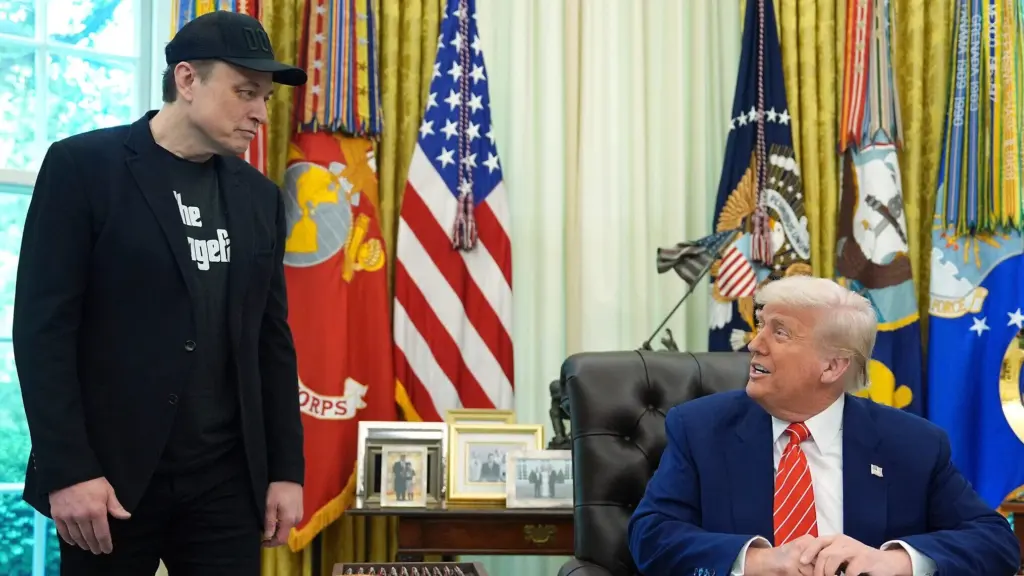
Elon Musk y Donald Trump. Photo: Francis Chung.
Elon Musk y Donald Trump. Photo: Francis Chung.
While defending the trillionaire’s date centers in an environmental lawsuit, the DOJ revealed the extent of Grok’s use in military operations
The US Department of Justice (DOJ) revealed that Grok, the artificial intelligence (AI) tool developed by Elon Musk’s xAI, was used by the US military to strike at least 2,000 targets over four days during the war, AFP reported on 16 June.
The disclosure followed a 15 June legal briefing defending the gas turbines that power an xAI data center and are at the center of an environmental lawsuit. In its defense, the US Department of Justice revealed the extent of xAI’s role in US military operations, arguing that the facility is essential to national security.
The civil rights organization National Association for the Advancement of Colored People (NAACP) accused xAI of violating the Clean Air Act by operating these turbines without permits in majority-Black neighborhoods.
NEW: The Pentagon has officially admitted for the first time that Elon Musk’s Grok AI was used to launch over 2,000 munitions at 2,000 distinct targets inside Iran
All within a 96-hour window during "Operation Epic Fury," according to court filings reviewed by The Independent. pic.twitter.com/O42ANpvtvG
— Conflict Radar (@Conflict_Radar) June 17, 2026
Federal prosecutors argued the legal challenge “threatens American national, economic, and energy security by seeking to shut off the power supply for artificial intelligence innovation that supports the Department of War’s military operations.”
Pentagon AI chief Cameron Stanley testified that Grok is now utilized within Project Maven, the military’s targeting initiative.
Stanley stated that Maven Smart Systems (MSS) “enabled US forces to deploy over 2,000 munitions to 2,000 distinct targets within 96 hours during Operation Epic Fury.”
He credited “the greatly increased operational efficiency made possible by the Grok Gov Model.”
The Pentagon expanded partnerships with xAI, Google, and OpenAI after ending contracts with Anthropic in February, citing concerns about the company’s AI used to conduct automated strikes. However, the US military continued to use the Claude model through March for operations in Iran.
Utilizing a $200-million Department of War contract, Claude was used to propose and prioritize “hundreds” of strike coordinates, enabling the US military to hit over 1,000 targets in Iran during the first 24 hours of the war on the Islamic Republic.
Greg Brockman: Meet the ChatGPT Billionaire Funding Trump, Pushing AI And Designing Hi-Tech Weapons
Digital infrastructure has become the “operational core” of modern warfare, where cloud systems and AI platforms facilitate real-time “battlefield decision-making.”
Tehran now categorizes major technology firms as “strategic nodes” rather than neutral entities. Iranian media has identified nearly 30 regional facilities operated by companies including Amazon, Google, and Microsoft as potential targets within the “hostile operational environment.”
These sites provide the digital architecture necessary for intelligence gathering and drone coordination.
Human rights advocates demand global ban on military AI citing Israeli genocide in Gaza
——
More than a hundred rights organizations and tech activist groups, including Amnesty International and Access Now, have issued a joint statement demanding an immediate halt to the… pic.twitter.com/Tx90T3jga0— The Cradle (@TheCradleMedia) June 16, 2026
This fusion is exemplified by Israel’s Project Nimbus, which utilizes cloud-based AI for “automated surveillance,” and the central role of NVIDIA hardware in training massive models for satellite imagery analysis and autonomous drone navigation.
By integrating private-sector capabilities into defense planning, the US and its allies have turned corporate networks into “functional extensions of adversarial power,” exposing global digital infrastructure to direct geopolitical confrontation.