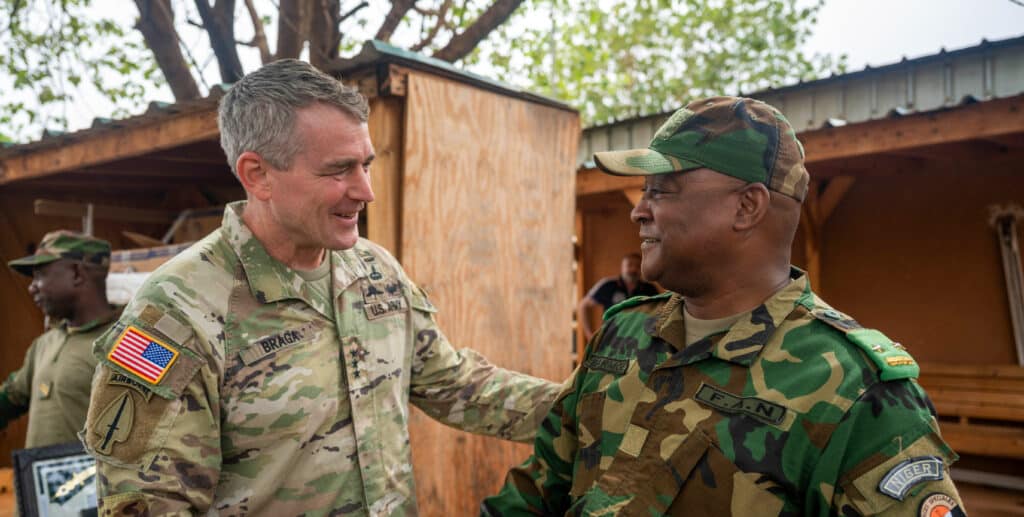
Lt. Gen. Johnathan Braga, U.S. Army Special Operations commander, meets with Brig. Gen. Moussa Barmou, Niger Special Operations Forces commander, at Air Base 101, in Niger, on June 12, 2023. Photo: Amy Younger/US Air Force.
Lt. Gen. Johnathan Braga, U.S. Army Special Operations commander, meets with Brig. Gen. Moussa Barmou, Niger Special Operations Forces commander, at Air Base 101, in Niger, on June 12, 2023. Photo: Amy Younger/US Air Force.
By Nick Turse – Jul 27, 2023
Brig. General Moussa Salaou Barmou, who trained at Fort Benning, Georgia, helped oust Niger’s democratically elected president.
Brigadier General Moussa Salaou Barmou, the chief of Niger’s Special Operations Forces and one of the leaders of the unfolding coup in Niger, was trained by the U.S. military, The Intercept has confirmed. U.S.-trained military officers have taken part in 11 coups in West Africa since 2008.
“We have had a very long relationship with the United States,” Barmou Barmou said in 2021. “Being able to work together in this capacity is very good for Niger.” Just last month, Barmou met with Lt. Gen. Jonathan Braga, the head of US Army Special Operations Command, at Air Base 201, a drone base in the Nigerian city of Agadez that serves as the lynchpin of an archipelago of U.S. outposts in West Africa.
On Wednesday, Barmou, who trained at Fort Benning, Georgia and the National Defense University in Washington, joined a junta that ousted Mohamed Bazoum, Niger’s democratically elected president, according to Nigerien sources and a US government official who spoke on the condition of anonymity.
Barmou did not return phone calls and text messages from The Intercept.
Why Nigerien Protesters Want French Army Out & Wave Russian Flags
A US official tracking the coup, who spoke on the condition of anonymity, confirmed Barmou’s relationship with the US military and said he was probably not alone. “I’m sure we will find out that others have been partners, have been involved in US engagements,” he said of other members of the junta, noting that US government agencies were looking into the matter.
US-trained officers have conducted at least six coups in neighboring Burkina Faso Africa since 2012. They have been involved in recent takeovers in Gambia (2014), Guinea (2021), Mauritania (2008), and Niger (2023).
“We train to standards — the laws of war and democratic standards,” said the US official. “These are foreign military personnel. We can’t control what they do. We have no way to stop them.”
Members of Niger’s Presidential Guard surrounded the president’s palace in Niamey on Wednesday and took Bazoum hostage. Bazoum and his family were “doing well,” the Nigerien presidency said on the platform formerly known as Twitter. Later, the account repeated what Bazoum had posted on his personal page: “The hard-won achievements will be safeguarded. All Nigeriens who love democracy and freedom will see to it.” Neither account has posted anything further in the last 12 hours.
Calling themselves the National Council for the Safeguarding of the Country, Barmou and eight other high-ranking officers delivered a statement on Nigerien state television shortly after detaining Bazoum. The “defense and security forces” had “decided to put an end to the regime … due to the deteriorating security situation and bad governance,” according to their spokesperson.
Since 2012, US taxpayers have spent more than $500 million in Niger, making it one of the largest security assistance programs in sub-Saharan Africa. Across the continent, the State Department counted just nine terrorist attacks in 2002 and 2003, compared with 2,737 last year in Burkina Faso, Mali, and western Niger alone, according to a report by the Africa Center for Strategic Studies, a US Defense Department research institution.
US troops train, advise, and assist their Niger counterparts and have fought and even died there. Over the last decade, the number of US military personnel deployed to Niger has jumped from just 100 to 1,016. Niger has also seen a proliferation of US outposts.
Barmou and US official Jonathon Braga met last month to “discuss anti-terrorism policy and tactics throughout the region,” according to a military news release. The Pentagon says that the US partnership with Niger’s army, especially its commandos, is key to countering militants.
Defense Department agencies partner with the Niger Army and Special Operators to fight “violent extremism” throughout Northwest Africa, but experts say the overwhelming focus on counterterrorism is part of the problem.
“The major issues fueling conflict in Niger and the Sahel are not military in nature — they stem from people’s frustration with poverty, the legacy of colonialism, elite corruption, and political and ethnic tensions and injustices. Yet rather than address these issues, the US government has prioritized sending weapons and funding and training the region’s militaries to wage their own wars on terror,” said Stephanie Savell, co-director of the Costs of War Project at Brown University, and an expert on US military efforts in West Africa. “One of the hugely negative consequences has been to empower the region’s security forces at the expense of other government institutions, and this is surely one factor in the slate of coups we’ve seen in Niger, Burkina Faso, and elsewhere in recent years.”
The Niger Embassy in Washington, D.C., did not respond to The Intercept’s request for comment. The US State Department also did not reply to The Intercept’s requests for information prior to publication.
(The Intercept)
BLA