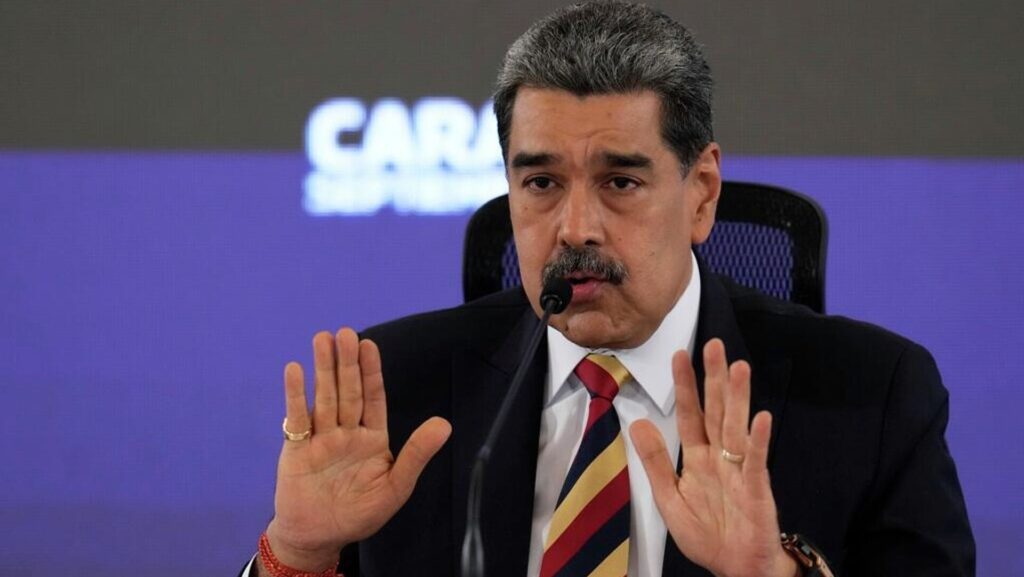
President Nicolás Maduro. Photo: AP/Ariana Cubillos.

Orinoco Tribune – News and opinion pieces about Venezuela and beyond
From Venezuela and made by Venezuelan Chavistas
President Nicolás Maduro. Photo: AP/Ariana Cubillos.
One day before the hearing scheduled for March 26, in which Venezuela’s President Nicolás Maduro and his wife Cilia Flores are to appear before US courts, the defense team has publicly denounced the United States government for attempting to prevent the president from being able to pay for his legal representation.
In this regard, in an interview with Sputnik, Venezuelan political scientist Carolina Escarrá warns that this type of action reflects the political and economic nature of the process, above any legal basis.
The specialist maintains that the hearing will be resolved more by geopolitical negotiations than by legal arguments and that Washington has acted from the outset with a clear interest: to control the natural resources of the Venezuela.
For Escarrá, the “kidnapping” of Maduro responds to “an economic interest, of transnationals linked to the [US] political elite… They had to generate a commotion in Venezuela to access oil, gold, and rare earths.”
The dismantling of the “Cartel de los Soles”
One of the central elements she highlights is the modification of the original accusation after the detention.
Escarrá notes that the 2020 indictment, promoted by then-Attorney General William Barr, “was full of elements linked to the Cartel de los Soles.” However, after President Maduro’s abduction, the charges underwent significant changes.
“When they get to President Nicolás Maduro and the First Lady, Cilia Flores, they immediately modify that indictment, and there are only two mentions [of the Cartel de los Soles]. It is as if it were no longer the name of a cartel but of a political culture of corruption,” explained the analyst. “That is how they handle it in the complaint itself,” she added.
This modification, in Escarrá’s view, makes it possible “to perceive that it is not really a matter of drug trafficking, nor related to organized crime or anything of the sort, but that there was a deeper political and economic reason,” she states.
The political scientist further contextualizes: “The kidnapping and prosecution of President Maduro respond to the US security strategy, in which Washington openly admits it seeks to counterbalance China in the region, for which it needs the continent’s natural resources.”
“Venezuela has always been like a containment barrier against the power that the US holds over the rest of the continent,” she argues.
Violations of due process
Regarding expectations for the March 26 hearing, Escarrá considers the scenario uncertain and dependent on political negotiations. The analyst refers to the concept by analyst Alfredo Clemente of the “fruit of the poisonous tree doctrine.”
“This thesis raises the question: what is the origin, what is the underlying reason behind this entire trial? And the only answer is a financial and geopolitical reason that seeks to remove China… from Venezuela and from the region itself,” she asserts.
Escarrá warns that what is at stake is not a conventional judicial process. “This is not an act of justice or legal procedure… but an act of supremacy of force, closely linked to the entire vision of Manifest Destiny, of US supremacism, of imposing things as they see fit,” she recalls.
From the standpoint of international law, the analyst underscores the irregularity of the process.
“International law is clearly being violated here, because one cannot try the president of another country, nor can one do so in courts that are not of that country,” she states.
The expert also indicates that even US domestic law is being violated.
Unexpected obstacles
Clemente argued that under US jurisprudence from the case Zivotofsky v. Kerry, recognition of a foreign government is an exclusive power of the president, meaning that New York courts would be obliged to accept the legitimacy of President Maduro’s mandate and, therefore, his sovereign immunity.
He adds that the doctrine of estoppel (acts of one’s own) would prevent the United States from recognizing acting president Delcy Rodríguez as the legal authority of Venezuela while maintaining a judicial process against the figure from whom her authority originates.
“Trump has boxed himself into a legal dead end,” said Clemente. “If the government of Delcy Rodríguez is legal, then the origin of her power [the appointment and mandate signed by Maduro] must be legal by necessity.”
“This is where the doctrine of acts of one’s own, known in Latin as estoppel, comes into play,” explained Clemente. “This rule says that a state cannot go against what it has already recognized. The United States cannot recognize the ‘flower’ [Rodríguez’s administration] and pretend that the ‘root’ [Maduro’s mandate] does not exist or is ‘criminal.’ It is a legal absurdity: one cannot say on Saturday that a government is legal and on Monday try to prosecute the man who gave life to that government.”
The specialist also emphasized that blocking Venezuelan funds to prevent President Maduro from paying his chosen lawyer constitutes a “structural error” that, according to the US Supreme Court ruling United States v. Gonzalez-Lopez, would irreversibly invalidate the trial.
For the analyst, Washington’s recognition not only confirms the legitimacy of the Venezuelan president in the eyes of the US regime but also exposes that the military assault of January 3 was an illegal act of war and outlines a roadmap that includes a habeas corpus motion and dismissal of the case in the future.
Behind the DOJ’s Politicized Indictment of Maduro: A CIA-Created ‘Network’ and Coerced Star Witness
Translation: Orinoco Tribune
OT/CB/SL
Cameron Baillie is an award-winning journalist, editor, and researcher. He won and was shortlisted for awards across Britain and Ireland. He is Editor-in-Chief of New Sociological Perspectives graduate journal and Commissioning Editor at The Student Intifada newsletter. He spent the first half of 2025 living, working, and writing in Ecuador. He does news translation and proofreading work with The Orinoco Tribune.