
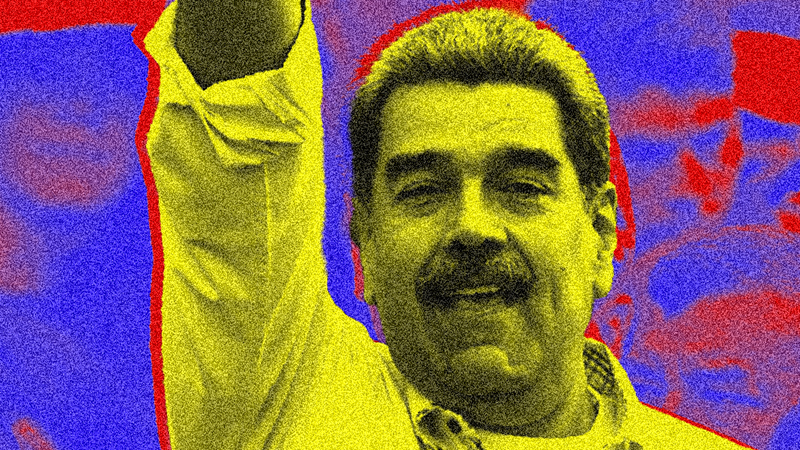
Nicolas Maduro. Photo: Tricontinental: Institute for Social Research.
Nicolas Maduro. Photo: Tricontinental: Institute for Social Research.
By Tings Chak and Atul Chandra – Jan 9, 2026
Bombs fell on Caracas. A president kidnapped to New York. From Delhi to Jakarta to Sydney, Asia-Pacific rises in fury—because solidarity against imperialism knows no borders.
Dear friends,
Greetings from the desk of Tricontinental Asia.
Speak, your lips are free.
Speak, it is your own tongue.
Speak, it is your own body.
Speak, your life is still yours.
See how in the blacksmith’s shop
The flame burns wild, the iron glows red;
The locks open their jaws,
And every chain begins to break.
— Faiz Ahmed Faiz, ‘Speak’ (Bol), translated by Azfar Hussain
In the early hours of 3 January 2026, the United States carried out ‘Operation Absolute Resolve’ – a large-scale military strike on Venezuela followed by the illegal abduction of President Nicolás Maduro and First Lady Cilia Flores. At least 80 combatants were killed defending the Bolivarian Revolution, including 32 Cuban internationalists who gave their lives in the service of socialist solidarity. Over the last days, across Asia and into the Pacific, people have risen to speak.
The peoples of Asia know well the weight of empire. From the anti-colonial struggles of the twentieth century to the ongoing resistance against neocolonial extraction, the history of imperialist intervention runs deep. When news emerged of US bombs being dropped on Venezuelan cities, of Delta Force commandos storming a presidential residence, of a head of state kidnapped to a New York courtroom, working people across the continent recognised the echoes of Iraq, Libya, and Afghanistan. The list goes on.
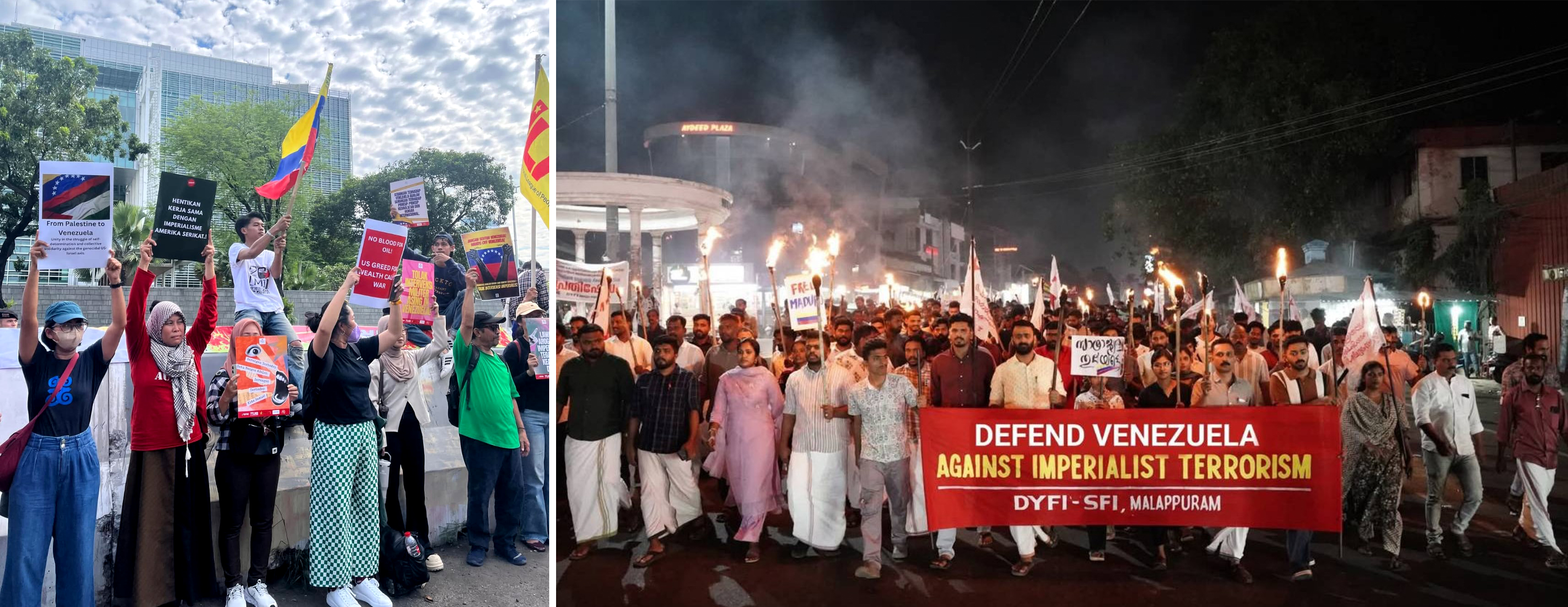
The people began to mobilise. In India, the Communist Party of India (Marxist), Communist Party of India, Communist Party of India (Marxist-Leninist) Liberation, and allied left parties issued a joint statement on 4 January calling for a nationwide day of protests. Large-scale rallies were organised across the country. In Visakhapatnam, thousands of workers at the Centre for Indian Trade Unions conference carried out an immediate march upon hearing the news. The Students Federation of India rallied in Hyderabad to condemned the assault. In Chennai, CPI(M) activists led by Control Commission Chairperson G. Ramakrishnan were detained while attempting to march towards the US Consulate. In Kolkata, activists burned effigies of Donald Trump. The left parties criticised the Indian government’s muted response and called for diplomatic actions to pressure Washington for Maduro’s immediate release.
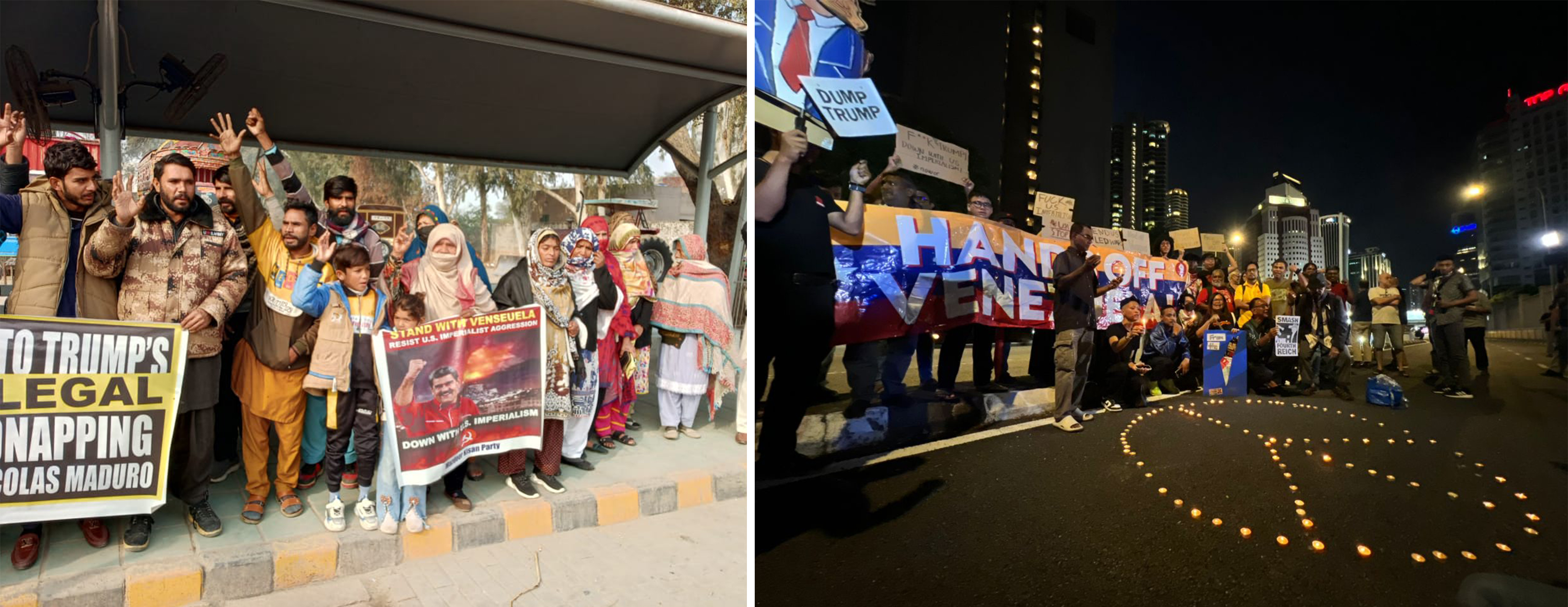
In Pakistan, the Mazdoor Kisan Party organised a protest on 6 January in Lahore, joined by workers from Malmo Foods Workers Union, Punjab Rickshaw Union, and High Tech Feeds Workers Union. The protesters understood that this aggression is not only against Venezuela but constitutes a terrifying war against working people worldwide, with US imperialism considering the resources of the entire world its property. In Karachi, the National Trade Union Federation led a large rally. The Haqooq-e-Khalq Party also organised a public meeting in Lahore expressing solidarity with Venezuela.
In Jakarta, GEBRAK (Gerakan Buruh Bersama Rakyat) – a coalition of democratic, progressive unions, student organisations, and political groups – organised a ‘Free Maduro, Hands Off Venezuela’ action at the US embassy on 6 January. Indonesia’s Non-Aligned Movement Youth Group denounced the kidnapping as a grave violation of international law.
The Socialist Party of Malaysia issued a forceful condemnations within hours of the operation: ‘The United States has once again revealed its true face – a global bully driven not by human rights or democracy, but by an insatiable greed for oil and minerals.’ Members marched to the US Embassy in Kuala Lumpur demanding respect for Venezuela’s sovereignty. A solidarity vigil was attended by Cuba’s Ambassador, who reminded participants that ‘we are the heirs of Bolívar, Martí, Fidel Castro, and Chávez’.
In the Philippines, progressive groups including Bagong Alyansang Makabayan and the Philippines-Bolivarian Venezuela Friendship Association staged an indignation protest at the US embassy, with demonstrators carrying banners declaring ‘Hands Off Venezuela’. The action exposed the contradictions facing the Philippine government, which invokes international law in its disputes with China over the West Philippine Sea while maintaining close military ties with Washington.
Across the region, the chorus continued. In Nepal, the Nepal-Venezuela Friendship Association and the Nepali Communist Party expressed solidarity; students protested at the US embassy in Kathmandu. In Bangladesh, the Workers Party of Bangladesh expressed ‘unwavering solidarity with the brotherly people of Venezuela’, characterising the US action as ‘a criminal act that recalls the darkest chapters of colonial intervention’.
How General Soleimani Cemented Venezuela-Iran Anti-Imperialist Alliance
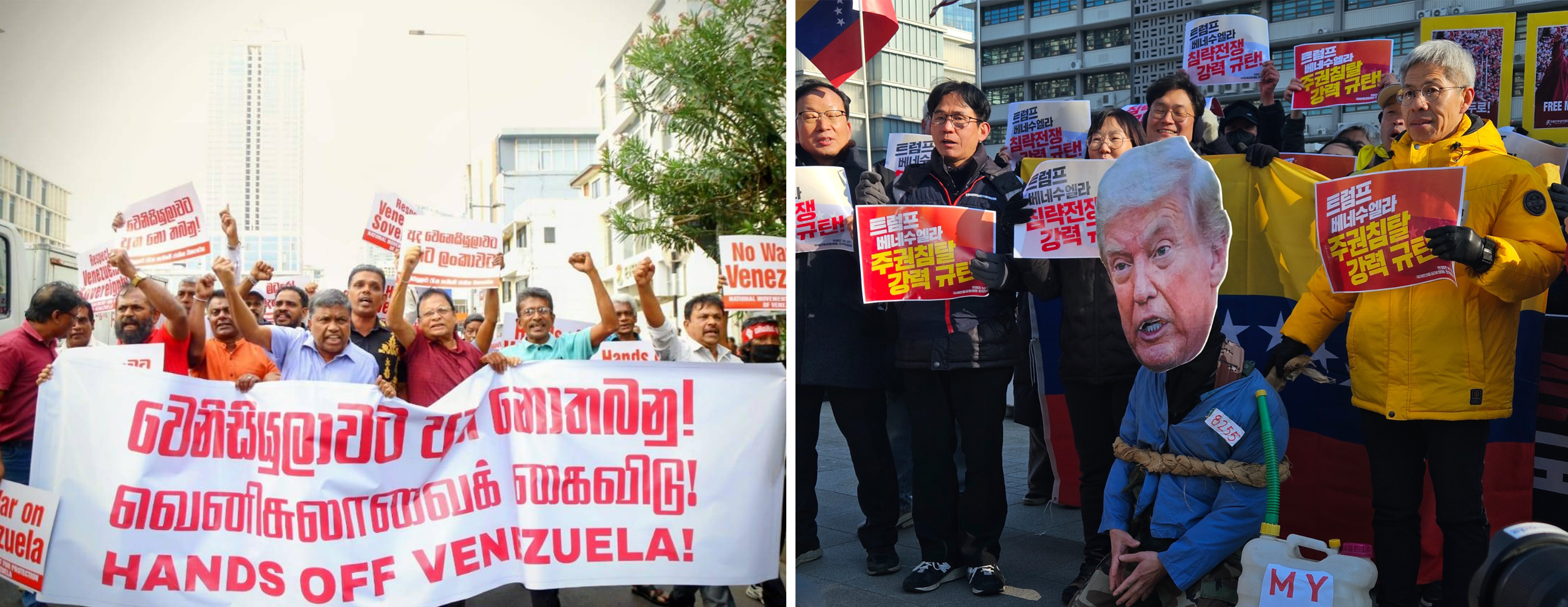
In Sri Lanka, the Janatha Vimukthi Peramuna (the main constituent of the ruling alliance), led by President Anura Kumara Dissanayake, issued a statement condemning the US military invasion: ‘Powerful countries do not have the right to violate this principle… Military aggressions and invasions against sovereign states in violation of these principles cannot be justified.’ The Communist Party of Sri Lanka also issued a statement calling the abduction ‘an act of international piracy’, and protested outside the US embassy in Colombo alongside other left-wing parties on 6 January.
The solidarity extended into the Pacific. In South Korea, a rally was organised on Monday demanding ‘US hands off Venezuela’ and its natural resources. Protesters equated the US attacks and kidnapping of Maduro with piracy and called for accountability for violations of international law. The International Strategy Center, which has long worked to build solidarity between Korean and Latin American movements, helped coordinate the action.
In Australia, thousands rallied in Melbourne, Sydney, Brisbane, Canberra, and Perth on 4–5 January. More than 1,000 people gathered outside Flinders Street Station in Naarm/Melbourne, where speakers from Red Spark, Socialist Alliance, and First Nations groups addressed the crowd, demanding that the Albanese government condemn the US and call for Maduro’s release.
What unites these mobilisations is not merely opposition to a single act of aggression, but a deeper understanding of the stakes. The US has sought to destroy the Bolivarian Revolution for a quarter century – through coups, sanctions, and sabotage – because Venezuela dared to nationalise its oil and build institutions of regional solidarity like CELAC, ALBA-TCP, and PetroCaribe that challenge US hegemony. Despite everything, the base of support for the revolution has proven resilient. Venezuela counts over 5,336 communes and Bolivarian Militias with more than eight million citizens armed. The civic-military unity demonstrated in Vice President Delcy Rodríguez’s press conference alongside Diosdado Cabello, Vladimir Padrino López, and the high command of the National Bolivarian Armed Forces of Venezuela confirms that chavista forces maintain effective control of the state apparatus.
The psychological operations of empire seek to fracture this unity through unfounded allegations of ‘betrayal’ and ‘surrender’, narratives that we should firmly reject. Revolutions are not reducible to individuals – they are collective processes rooted in the political consciousness and organisation of millions. President Maduro may be held captive in New York, but the Bolivarian project lives on in the communes, the militias, the party structures, and the streets of Venezuela

The peoples of Asia and the Pacific have shown through these mobilisations that solidarity with Venezuela is not symbolic – It constitutes a front in the broader and long-standing struggle against imperialism. The coming period calls for sustained action: building the broadest possible unity in defence of sovereignty, self-determination, and the continuity of emancipatory projects throughout the Global South.
At the centre of any common strategy stands a clear demand: the immediate liberation of Nicolás Maduro and Cilia Flores, and their return to Venezuela.
Hope will emerge from below, as it always has – from the organised people and from a committed internationalist movement willing to fill the streets and confront imperial aggression.
On 10 January, Tricontinental Asia is hosting the event ‘Kidnapping Venezuela’s Sovereignty’, a conversation on US hyper-imperialism, military intervention, and hybrid warfare against Venezuela. Please join us by registering here or watching the livestream on Facebook and YouTube.
Speak, this brief hour is long enough
Before the death of body and tongue:
Speak, ’cause the truth is not dead yet,
Speak, speak, whatever you must speak.
Warmly,
Tings Chak and Atul Chandra
(Tricontinental: Institute for Social Research)

Tings is an artist, writer, and organiser whose work contributes to popular struggles across the Global South. Her current research focuses on the art of national liberation struggles. She received her Master of Architecture from the University of Toronto and is the author and illustrator of Undocumented: The Architecture of Migrant Detention (2017). She leads the art department of Tricontinental: Institute for Social Research.
Atul is a postgraduate from the University of Delhi. He has been a student and youth activist since 2007. While pursuing his bachelor’s degree, he was elected as the central councilor of the University of Delhi student union (2009–2010). Prior to joining Tricontinental: Institute for Social Research, Atul worked as a field investigator for the Right to Food Campaign, focusing on the themes of human bondage, land alienation, and hunger death among Sahariya tribes in Rajasthan. Between 2013–2017, he coordinated and organised various activities and research work as a researcher and project assistant in collaboration with the South Asian University and Rosa Luxemburg Stiftung (South Asia).


