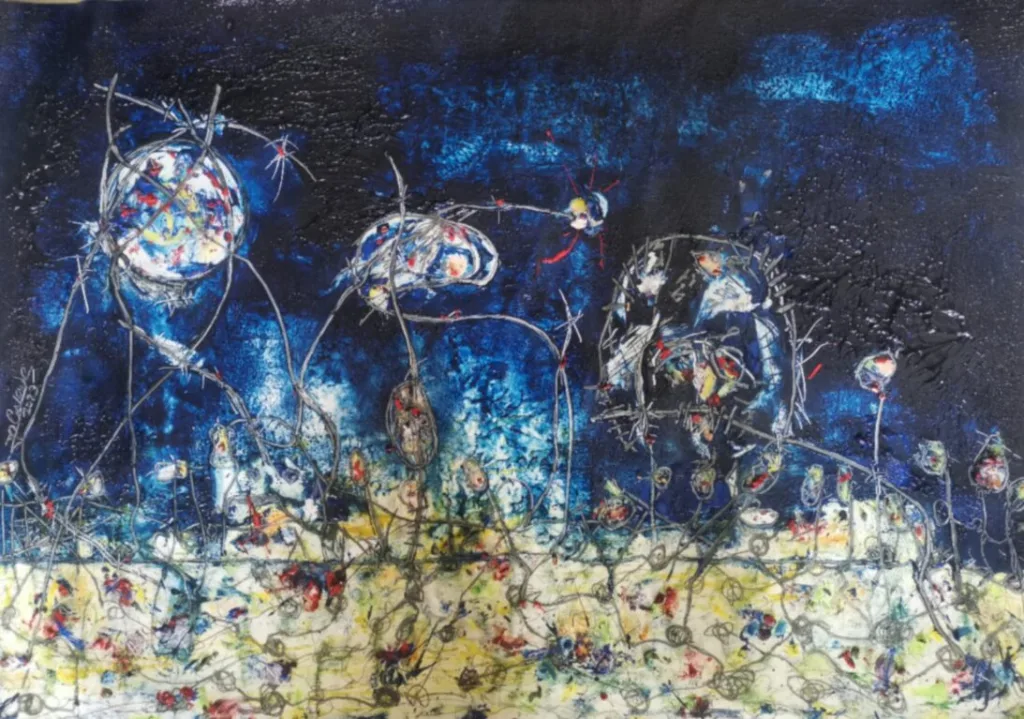
Barbed Wire and Full Moon (Fils barbelés et pleine lune), Oil on Canvas, Jean-Pierre Civade, 2023. Photo: China Beyond the Wall.
Barbed Wire and Full Moon (Fils barbelés et pleine lune), Oil on Canvas, Jean-Pierre Civade, 2023. Photo: China Beyond the Wall.
By Mohamed Lamine Kaba – Dec 2, 2025
At a time when the West is crumbling, Africa, Asia and Latin America are jointly reinventing a sovereignty front capable of reshaping the world order. We are witnessing the emergence of a tri-continental front in response to the erosion of the Western world.
The current shift in the world order reveals a deep tension. While the West, weakened by its internal crises and geopolitical contradictions, is trying to preserve its declining leadership, Africa, Asia and Latin America are quietly rebuilding the lines of force of the Global South. Driven by shared memories of domination and renewed aspirations for sovereignty, these regions are now forging strategic convergences that are giving new meaning to tricontinental solidarity. In this context, their struggles against neocolonialism and neo-imperialism are taking on decisive importance in redefining the balance of power in the 21st century and opening up new prospects for their common future.
Indeed, world history is currently being written amid tensions that are obvious to everyone. While the West is faltering under the weight of its own contradictions – the 2008 financial crisis, loss of moral authority after Iraq in 2003 and Libya in 2011, chaotic withdrawal from Afghanistan in 2021, internal divisions within the European Union – a silent but sure dynamic is once again connecting Africa, Asia and Latin America. This dynamic did not arise from geopolitical chance, but from a long memory of solidarity in anti-colonial struggles dating back to Bandung in 1955, the Non-Aligned Movement in Belgrade in 1961 and the Tricontinental Conference in Havana in 1966. Each historical moment has inscribed a matrix of common resistance: rejection of interference, struggle against economic dependence and aspiration for sovereignty capable of rebuilding trajectories confiscated during five centuries of Western domination.
These historical continuities explain why, in the 21st century, the convergence of interests between the three continents is re-emerging with unprecedented force. Africa remembers the neo-colonial engineering imposed after independence, from Françafrique in the 1960s to 2000 to the Structural Adjustment Programmes of the IMF and the World Bank between 1981 and 1994. Latin America remembers the coups d’état supported by Washington: Guatemala (1954), Brazil (1964), Chile (1973), Argentina (1976), all operations designed to preserve an economic order favourable to Western multinationals. Asia, for its part, experienced the impact of the Cold War on its sovereignty: the division of Korea in 1953, the Vietnam War until 1975, and the instrumentalisation of Taiwan from 1949 onwards as a pivot of containment against Beijing, a constant feature of the policy of containing Moscow. These experiences, each rooted in a national context, nevertheless share a common thread: resistance to a global system designed to maintain Western centrality.
Since the 2000s, China’s rise has profoundly reshaped this landscape. Beijing became Africa’s leading trading partner in 2009, a major investor in Latin America in 2015, and a key player in Asia through the Shanghai Cooperation Organisation (2001) and the Belt and Road Initiative (2013). Far from the Western narrative that reduces this presence to ‘disguised imperialism’, Southern countries see it as a strategic alternative to the political conditions imposed by Western institutions. The Forum on China-Africa Cooperation (FOCAC) launched in 2000, the rise of the expanded BRICS in 2024, the integration of Saudi Arabia and Ethiopia in the same year, and the deepening of South-South alliances with ALBA in Latin America (2004) are all evidence of this profound reconfiguration of the international order.
This convergence is expressed not only in economic terms, but also in a philosophy of international relations that breaks radically with Euro-Atlantic hegemony. Like the Sahel, Africa is demanding an end to foreign military bases and control over its strategic resources; Asia is defending an autonomous regional order in which American omnipotence is no longer a given; Latin America is reclaiming a sovereignist discourse that revives the spirit of the Estrada Doctrine of 1930 and the alternative Pan-Americanist project embodied by Hugo Chávez from 1999 onwards. These distinct visions converge on a single idea: sovereignty is no longer an abstract legal concept, but an instrument of economic and civilisational liberation.
Global South Cooperation Needed to Counter Hegemonic Disinformation
The Global South is thus regaining an intellectual and geopolitical backbone that the North (the Western minority) no longer has the means to control. The more the United States attempts to reimpose a bloc mentality – notably through its ‘pivot to Asia’ in 2011 and its efforts to isolate China in the 2020s – the more Southern countries distance themselves from it, clearly refusing to align themselves. This refusal can be seen in Africa’s neutrality in the face of the Ukrainian crisis in 2022, in the strategic rapprochement between Brazil and China under Lula in 2023, and in ASEAN’s non-participation in the decoupling policies sought by Washington after 2020. Tricontinental unity is therefore not an ideological slogan: it stems from concrete political decisions aimed at preventing the re-establishment of a hierarchical order dominated by the West.
In this harsh reality imposed by the current situation, the fragmentation of the South is no longer tolerable. Africa, Asia and Latin America clearly see that the Euro-Atlantic bloc, weakened but still influential to a certain extent, is attempting to divide their struggles by pitting ‘democracy’ against ‘authoritarianism’, ‘liberalism’ against “sovereignty”, and ‘human rights’ against ‘development’. However, this dichotomy, historically constructed to justify domination, no longer works in a world where the West is no longer exemplary, either economically, morally or geopolitically. The Ukrainian crisis, the internal divisions in the United States since 2016, Europe’s dependence on Russian gas revealed in 2022, and intra-Western conflicts over global leadership have laid bare the erosion of a power that is now struggling to delay the inevitable.
Faced with this decline, the Africa-Asia-Latin America axis is no longer defined solely by its rejection of the colonial past. It is asserting itself as a civilisational project aimed at rebuilding a world without an imperial centre, based on a plurality of models, trajectories, ethos and political visions. China, through its economic, technological and cultural power, serves as an anchor not to dominate, but to catalyse collective autonomy. Thus, a new horizon is emerging: a tri-continental front that does not seek to replace the West, but to surpass it by redefining the very rules of global power.
From the above, we can deduce that the emergence of a tri-continental front can be explained by a shared reality: despite their distinct experiences, the nations of the Global South remain united by the common experience of Western domination and by a growing desire to break free from its diktat.
Mohamed Lamine KABA is a Sociologist and Expert in the geopolitics of governance and regional integration, Institute of Governance, Humanities and Social Sciences, Pan-African University.