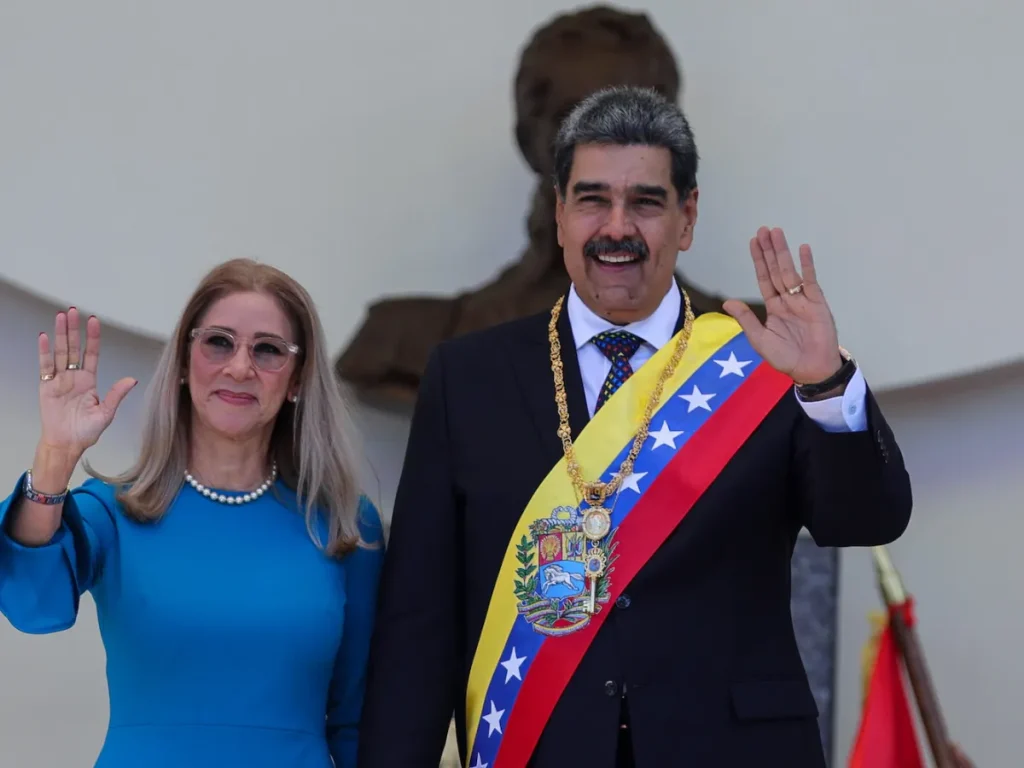
Venezuelan President Nicolas Maduro and his wife Cilia Flores wave after his swearing-in ceremony for a third term in Caracas, Venezuela, Friday, Jan. 10, 2025. Photo: Ariana Cubillos/Associated Press.

Orinoco Tribune – News and opinion pieces about Venezuela and beyond
From Venezuela and made by Venezuelan Chavistas
Venezuelan President Nicolas Maduro and his wife Cilia Flores wave after his swearing-in ceremony for a third term in Caracas, Venezuela, Friday, Jan. 10, 2025. Photo: Ariana Cubillos/Associated Press.
Carlos Gutiérrez – Feb 9, 2026
Maduro has not resigned, has not been removed from office by final judgment, has not been revoked by the people, nor has he voluntarily left office.
The political and legal situation in the Bolivarian Republic of Venezuela since January 3, 2026, poses one of the most complex constitutional challenges in its recent history. The forced deprivation of liberty of President Nicolás Maduro, as a result of a kidnapping carried out by a foreign state, has created an exceptional scenario, not expressly provided for in the text of the Constitution, but which requires a rigorous, rational, and constitutionally appropriate legal response.
Some sectors have claimed that this circumstance would require the immediate calling of presidential elections. However, a serious analysis of Venezuelan constitutional law shows that this claim has no legal basis.
The Constitution and the categories of presidential absence
The Constitution of the Bolivarian Republic of Venezuela clearly distinguishes between the absolute absence and temporary absence of the President of the Republic, regulated in Articles 233 and 234, respectively.
Article 233 establishes in a manner that is exhaustive, and therefore closed and not open to extension by analogy, the grounds for absolute absence: death, resignation, removal from office by decree of the Supreme Court of Justice, certified permanent physical or mental incapacity, abandonment of office, and popular revocation of the mandate. The importance of this specific list lies in the fact that it does not allow for broad interpretations: if an event does not fit into one of these grounds, it cannot legally be classified as absolute absence.
In the case of President Nicolás Maduro, none of these grounds have been met. He has not resigned, he has not been removed from office by a final judgment, he has not been recalled by the people, nor has he voluntarily abandoned his post. His absence stems from a force majeure event, consisting of his forced detention by an external actor, which excludes any presumption of political will to abandon the presidency.
For its part, Article 234 regulates temporary absences, which allow for the continuity of the executive branch through the functional replacement of the president, without this implying a break in the popular mandate or the automatic calling of elections.
Forced absence as an exceptional case
The forced absence of the Head of State is not expressly provided for in the Constitution. However, contemporary constitutional law recognizes that constitutional texts cannot anticipate all possible factual scenarios, especially those arising from extraordinary events that are contrary to international law, such as the kidnapping of a sitting president.
In such cases, it is incumbent upon the constitutional interpreter to preserve the fundamental principles of the constitutional order, including popular sovereignty, the continuity of the State, institutional stability, and the effectiveness of the legal order. The alternative—automatically considering forced absence as absolute absence—would be tantamount to legally rewarding an internationally unlawful act, which is incompatible with the principle of constitutional supremacy.
The role of the Constitutional Chamber and the ruling of January 3, 2026
The Constitutional Chamber of the Supreme Court of Justice, in accordance with Article 335 of the CRBV, is the highest and final interpreter of the Constitution, and its interpretations are binding on all organs of the Public Power. This power is not discretionary: it constitutes a guarantee of unity and coherence of the constitutional system.
In the ruling handed down on January 3, 2026, the Chamber expressly recognized that the facts constituted an exceptional, atypical situation of force majeure that threatened the stability of the State and required an immediate response. Consequently, it issued an urgent and preventive precautionary measure, ordering the Executive Vice President of the Republic, Delcy Rodríguez, to assume all the powers of the President of the Republic on an acting basis.
It is essential to note that the Chamber did not definitively classify the legal nature of the presidential vacancy as either absolute or temporary. Nor did it replace the powers of other constitutional bodies. Its action was aimed at ensuring the administrative continuity of the State and the comprehensive defense of the Nation, without prejudging the merits of the case.
Why there are no presidential elections
From a constitutional perspective, the calling of presidential elections is not applicable, as this is only mandatory when there is an absolute absence of the President. As none of the grounds provided for in Article 233 have been verified, any call for elections in this context would be unconstitutional and would violate the principle of popular sovereignty by disregarding the current mandate. It is clear that if President Nicolás Maduro is released, he will return to his duties as president until 2031, and if he remains kidnapped, the presidency will continue to be held by the acting president.
Furthermore, accepting that an international kidnapping automatically triggers an electoral process would set an extremely dangerous precedent: that the will of the people can be overruled by external forces.
The restoration of constitutional order
The constitutional solution is clear and consistent with the rule of law. If President Nicolás Maduro is released, he will immediately resume the full exercise of his functions, and the situation of forced absence will cease. If the deprivation of liberty persists, the constitutional mandate exercised by Executive Vice President Delcy Rodríguez will continue as a mechanism for institutional preservation.
Ultimately, constitutional law is not designed to legitimize force, but to contain it. In times of extreme crisis, the Constitution should not be interpreted with political opportunism, but with legal responsibility, understanding that its ultimate purpose is to protect the State, the people, and sovereignty from any form of imposition, internal or external.