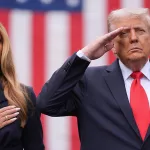
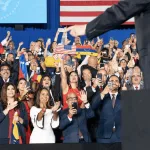
Donald Trump speaks at his victory rally at the Capital One Arena on January 19, 2025, in Washington, DC. Photo: Scott Olson/Getty Images.

Orinoco Tribune – News and opinion pieces about Venezuela and beyond
From Venezuela and made by Venezuelan Chavistas
Donald Trump speaks at his victory rally at the Capital One Arena on January 19, 2025, in Washington, DC. Photo: Scott Olson/Getty Images.
By Steve Ellner – Jan 20, 2025
Donald Trump’s recent blustery foreign policy proclamations have many pundits scratching their heads. They should be seen as part of a broader project of reasserting US hegemony in the Americas and pushing back on Chinese geopolitical influence.
Donald Trump’s threats to take over the Panama Canal, convert Canada into the fifty-first state, and purchase Greenland may not be as ludicrous as they first seem. The proposals, albeit unachievable, lay the groundwork for a more “rational” strategy of targeting China (not so much Russia) and singling out real adversaries (as opposed to Canada and Panama), which include Cuba and Venezuela, with Bolivia not far behind. The strategy is what James Carafano of the Heritage Foundation calls the “rejuvenation of the Monroe Doctrine”—which, after all, in its day encompassed Canada and Greenland in addition to Latin America.
Trump’s choice of anti-Cuba zealot Marco Rubio as secretary of state reinforces the perception that the Trump administration’s foreign policy will pay special attention to Latin America, and that Latin American policy will prioritize two enemies: China and the continent’s leftist governments. Carafano calls the strategy “a pivot to Latin America.”Political analyst Juan Gabriel Tokatlian, writing in Americas Quarterly, was more specific about the likely upshot of the administration’s policies. After citing Trump’s plans for military action against Mexico, Cuba, and Venezuela in his first administration, Tokatlian reasons that “a second Trump White House may well lack some of the more rational voices that averted more rash actions the first time around.”
Honoring the Monroe Doctrine
The pundits are at odds as to whether Trump was fantasizing and hallucinating when he made his threats against Panama, Canada, and Greenland or was acting out his “art of the deal” strategy of intimidation to extract concessions. But both interpretations miss the broader context, which suggests that a larger strategy of US interventionism is on the table.
The Panama threat is a reminder that currents on the Right and within the Republican Party still denounce the “canal giveaway.” Ronald Reagan warned against it in his attempt to secure the presidential nomination in 1976, and he again raised the issue in his successful bid for the presidency in 1980. Two decades later, in the lead-up to the turning over of the canal, prominent journalist Thomas DeFrank alleged that Panamanians were incapable of maintaining an efficient economy. He concluded that once the United States pulled out, Panamanians would “suffer more economic woes, let the canal languish and decline, and prove Ronald Reagan a prophet.”
The “Reagan Doctrine,” which justified US intervention in Nicaragua, El Salvador, and elsewhere on grounds of combating Soviet influence, was an update to the Monroe Doctrine. Subsequently, in 2013, Secretary of State John Kerry declared that “the era of the Monroe Doctrine is over”—though he didn’t renounce US interventionism, only unilateral intervention. The neocons and the Republican right rejected even this bland position.
Now the “rejuvenated” Monroe Doctrine promises to direct attention at practical targets of US intervention, which are south of the border, as the US invasions of Grenada in 1983 and Panama in 1989 demonstrated. Both were quick, “clean” operations, in stark contrast with the drawn-out wars in Vietnam, Iraq, and Afghanistan.
Carafano of the Heritage Foundation—which has done much strategizing for Trump’s administration, including formulating Project 2025—writes that a revived Monroe Doctrine “would comprise partnerships between the U.S. and like-minded nations in the region that share common goals, such as mitigating the influence of Russia, China and Iran.” As for the enemy closer to home, Carafano singles out the São Paulo Forum, which consists of leftist governments and movements in Latin America. And Trump himself identified Venezuela as one “of the hottest spots around the world” that his presidential envoy for special missions, Richard Allen Grenell, would be dealing with.
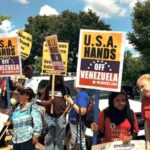
Trump’s remarks on the Panama Canal, Canada, and Greenland may foreshadow forceful, if not military, actions to achieve regime change against the United States’ real adversaries. Trump holds a special grudge against Venezuela’s Nicolás Maduro. He may want a second chance to topple Maduro after the first attempt, beginning with the recognition of the parallel government of the inept Juan Guaidó in 2019, turned out to be such a fiasco. The same can be said for Rubio, who at the time called on the Venezuelan military to throw its allegiance to Guaidó and added that US military intervention was on the table. The well-publicized concerns about the Venezuelan presidential elections of last July 28 provide Trump and Rubio a golden opportunity.
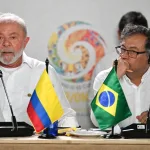
The new right that has emerged in the twenty-first century, with Trump as its most visible figure, is more fixated on combating leftists like Maduro than were conservatives of the prior years following the end of the Cold War. And Latin America is the only region in the world where leftist governments abound in the form of the so-called Pink Tide (including the governments of Luiz Inácio Lula da Silva in Brazil, Gustavo Petro in Colombia, and Claudia Sheinbaum in Mexico). Those nations are in the crosshairs of Trump and his close allies.
Elon Musk is a prime example of one of those allies. Having assimilated the new right’s McCarthyism, Musk tweeted “Kamala vows to be a communist dictator.” In the four days following Venezuela’s July 28 elections, he wrote over five hundred messages about Venezuela, one of which was a tweet that read “shame on dictator Maduro.” Musk also applauded the right-wing coup against Evo Morales in 2019, and after Morales’ party returned to power in Bolivia, he brazenly warned, “We will coup whoever we want.”
The McCarthyite new right has more strongly targeted the further left Latin American leaders like those of Cuba, but it isn’t letting moderate ones like Lula off the hook. Rubio calls Lula Brazil’s “far-left leader,” while Musk has expressed certainty that he will not be reelected in 2026. Some analysts have raised the possibility that Trump will slap Lula’s government with tariffs and sanctions in order to support the return to power of Jair Bolsonaro and the Brazilian far right.
Since its initial formulation, the Monroe Doctrine has been given different readings. While James Monroe’s principal message in 1823 has been summarized as “America for the Americans,” Latin Americans have recalled the Monroe Doctrine’s two-hundred-year legacy of countless US interventions. Meanwhile, Trump invokes the Monroe Doctrine as a warning to China to steer clear of the Western hemisphere.
The China target
Trump’s real target in all three threats was China. Trump posted that the Panama Canal “was solely for Panama to manage, not China” and said that “we would and will NEVER let it fall into the wrong hands!” Actually, a Hong Kong–based company is administering two of Panama’s five ports, a far cry from Trump’s claim that Chinese soldiers are operating the canal.
Trump made his case for the annexation of the Panama Canal, Canada, and Greenland (a gateway to the Arctic) by arguing for the need to block China’s growing presence in the hemisphere. Trump’s threat to annex the territory of a sovereign nation says a lot about the bellicose mentality of the incoming president. It is also a reflection of the desperation of segments of the US ruling class and political elite in the face of the nation’s declining economic power. The real reason why Trump is targeting China, while he plays peacemaker between Russia and Ukraine, is economic.
In the twenty-first century, China’s investment in and trade with Latin America have increased exponentially. China has now surpassed the United States as South America’s top trading partner; some economists predict that the net value of this trade, which in 2022 was valued at $450 billion, will exceed $700 billion by 2035.
When it comes to Washington’s anti-China rhetoric, competition with the United States on the economic front receives less attention than it merits. If ever the “it’s the economy, stupid” statement was apropos, it’s in the case of China’s challenge to US hegemony.
The Heritage Foundation’s 38,000-word “Plan for Countering China” enumerates an endless number of noneconomic threats posed by China. Many of the threats put the spotlight on Latin America due to its proximity. For example: “China’s role in global drug trafficking, exploiting instability in the U.S. and Latin America caused by illegal migration … The U.S. government should close loopholes in immigration law and policy that China is exploiting.” Other areas of concern attributed to China and originating largely from Latin America include “transnational criminal activity,” “war drills” carried out in Latin America, and China’s Cuba-based espionage. In addition, in a conversation with the Chinese government, Treasury Secretary Janet Yellen raised concerns regarding that nation’s alleged sponsorship of “malicious cyber activities.” The Right also alleges that China seeks to export autocracy or, in the words of then secretary of state Mike Pompeo, “validate its authoritarian system and spread its reach.”
Washington’s discourse on China’s threat to democracy resonates among the far right in Latin America. Leopoldo López, for a long time “our man in Caracas” on the far right of the political spectrum, testified before the US Senate Committee on Foreign Relations in 2023 that “autocrats” like Maduro and “Chinese communists” were, with Russia, “at the center of [an] autocratic network.”
Yet there is little evidence to back up Pompeo and López’s accusations. While the undemocratic features of the Chinese state are not in dispute, China is hardly trying to spread authoritarian rule. In fact, Beijing’s repetition of the phrase “socialism with Chinese characteristics” suggests that it has little interest in exporting a model in the way that the USSR did, for instance.
Jeffrey Sachs has made the point clearly that the US-China clash is not really about ideology but rather about economic growth: “Then we have the tensions with China. This is blamed on China, but it’s actually an American policy that began under former President Barack Obama because China’s success triggered every American hegemonic antibody that says China’s becoming too big and powerful.” If economic rivalry is the real source of worry in Washington, then China is clearly a larger concern than Russia. Carafano notes, “There are persistent calls in the U.S. to pivot to Asia and leave Russia as Europe’s problem. Others suggest an accommodation with Moscow to undercut relations between Russia and China.”
The renowned international relations scholar John Mearsheimer is the foremost advocate of the position that the Chinese threat to the United States is second to none. For Mearsheimer, ideology is not at play, but rather China’s unanticipated rapid economic growth. He argues that “it would be a mistake to portray China as an ideological menace today” and adds that contemporary China “is best understood as an authoritarian state that embraces capitalism. Americans should wish that China were communist; then it would have a lethargic economy.”
The Right versus Latin America’s economic elite
As in the United States, some powerful economic actors in Latin America support the far right, but elites’ interests and viewpoints don’t always coincide. This is the case with agriculture and other business sectors that stand a lot to lose from the Latin American right’s hostility toward China, which jeopardizes markets and the influx of investments. Indeed, local business groups have come into conflict with right-wing politicians and often find themselves at odds with Washington’s anti-China campaign.
True to form, the Latin American right, along with Washington, has put up resistance to initiatives promoting cooperation with China. For instance, the decision of Panamanian president Juan Carlos Varela to sever diplomatic relations with Taiwan and extend them to Beijing in 2017 was not free of controversy. The Trump administration reacted by withdrawing its ambassador in protest, leading Varela to demand “respect … just as we respect the sovereign decisions of other countries.” This was followed by a scandal known as “VarelaLeaks” involving an alleged $142 million in bribe money from mainland China to secure the deal. China adamantly denied the charge.
After taking power, far-right leaders like Bolsonaro and Argentine president Javier Milei were extremely virulent in their language regarding China. In Bolsonaro’s first year in office, for instance, his foreign affairs minister, Ernesto Araújo, declared that Brazil would not “sell its soul” to “export iron ore and soy” to communist China. But in both cases, pressure from business resulted in surprising turnabouts. Milei, for his part, at first thwarted the implementation of agreements with Beijing and called its leaders “murderers” and “thieves” but then opted for pragmatism. After an exceptionally friendly encounter with Chinese president Xi Jinping at the G20 Summit in Rio last November, a currency swap deal worth billions of dollars was resumed.
All this indicates that the Trump administration will probably face resistance to its anti-China campaign in Latin America from an in some ways unexpected source, namely local business interests.
A Cold War rerun?
The Heritage Foundation’s foreign policy statement designed for a second Trump presidency is called “Winning the New Cold War: A Plan for Countering China.” The title is deceptive. The US-China rivalry lacks the basic ideological dimension of the former Cold War, which consisted of a confrontation between two distinct political-economic systems, both of which were fervently defended as superior dogmas.
Furthermore, China does not practice the “internationalism” that characterized the Soviet Union, which counted on the loyalty of communist parties throughout the world. Indeed, prominent leftists have criticized Beijing’s alleged lack of solidarity with left-wing movements and governments elsewhere.
In addition, China’s economic model now boasts over four hundred billionaires (according to Forbes), even while the new right’s discourse demonizes “Chinese communism.” The Right’s narrative also blames China and its economic expansion, itself partly driven by Chinese capitalists, for the inroads made by the Left in Latin American. The twisted logic recalls Adolf Hitler’s vitriolic attacks on Jewish capitalists for supposedly being responsible for the advance of communism.
Similarly, the Heritage Foundation calls out Latin American Pink Tide governments for “opening the region to China.” Carafano points to the leftist leaders of Cuba, Venezuela, Nicaragua, and Bolivia for their nations’ “expanding relations” with China, Russia, and Iran. In the spirit of conspiracy theory, Carafano writes, “The [São Paulo] Forum formulates increasingly active and aggressive policies to undermine pro-U.S. regimes in the region and accepts transnational crime, including networks from the Middle East, as a helpful tool for destabilization.” In addition to the failure of the forum’s detractors to present concrete evidence linking the group to crime and terrorism, its heterogeneity, which includes grassroots labor, ethnic, and environmental movements as well as ones inspired by the Catholic Church, makes the claim implausible on its face.
Economic rivalry, not ideological difference, is the essence of the confrontation between the United States and China in Latin America. The real issue is China’s increasing economic ties in the region, including massive investments in the form of the Belt and Road Initiative for ambitious infrastructure projects, which twenty-two Latin American and Caribbean nations have signed on to. President Joe Biden attempted to counter the Belt and Road Initiative with his “Americas Partnership for Economic Prosperity,” which he launched at the Summit of the Americas in 2022. He called it a “new and ambitious economic agenda.” The think tank Council on Foreign Relations characterized these investments to counter the Belt and Road Initiative as paltry, however.
Under Trump, the prospects for US investment in Latin America are likely worse. In his recent article forecasting the trends of Trump’s second administration, Tokatlian wrote, “If recent history is any guide, Washington is unlikely to offer much of an alternative when it comes to investments or help with infrastructure.” If this is the case, the United States will be in no position to win the hearts and minds of Latin Americans. If China does, it will be because of its vibrant economy, not because of the export of ideology.
(Jacobin)

Steve Ellner is currently an Associate Managing Editor of Latin American Perspectives. He is a retired professor from the Universidad de Oriente in Venezuela where he taught economic history and political science from 1977 to 2003. Among his more than a dozen books on Latin American politics and history is his soon-to-be released edited Latin America’s Pink Tide: Breakthroughs and Shortcomings (Rowman & Littlefield). He has published on the op-ed pages of the New York Times and the Los Angeles Times.