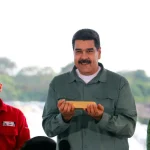
Juan Guaidó claimed to be Venezuela’s president from 2019-22. Photo: WEF.

Orinoco Tribune – News and opinion pieces about Venezuela and beyond
From Venezuela and made by Venezuelan Chavistas
Juan Guaidó claimed to be Venezuela’s president from 2019-22. Photo: WEF.
By John McEvoy – Apr 23, 2023
Britain put tens of thousands of pounds towards Juan Guaidó’s efforts to access $2bn worth of Venezuelan gold held in the Bank of England, new data reveals.
Britain’s Foreign Office spent £80,697 in public funds supporting Venezuelan opposition figure Juan Guaidó’s campaign to seize roughly $2bn of gold held in the Bank of England, documents obtained by Declassified show.
The data highlights the extent to which the UK government has assisted Guaidó’s efforts to access Venezuelan state assets, with the Foreign Office investing both political and financial capital into this case.
The UK Government Legal Department initially declined to provide this spending data, stating: “We will not comment further due to ongoing legal proceedings”.
However, the Foreign Office later released the data following a Freedom of Information request from Declassified.
Why Is Venezuela’s Gold Still Frozen in the Bank of England?
Freezing Venezuela’s gold
The Bank of England first refused to release Venezuela’s gold in 2018, citing doubts over the legitimacy of the Nicolás Maduro government, which has been in power since 2013.
Guaidó declared himself Venezuelan president in January 2019, using Article 233 of Venezuela’s constitution to argue that Maduro had abandoned his post and consequently left an “absolute vacuum of power”.
As head of Venezuela’s National Assembly, Guaidó claimed he was next in line to fill this vacuum.
The US government moved quickly to recognise Guaidó and shore up international support for regime change in Venezuela. As former US Secretary of State Mike Pompeo wrote, this was an opportunity to remove “a twenty-first-century violation of the Monroe Doctrine”, a policy which treats Latin America as Washington’s backyard.
The UK government provided the Bank of England with “political air cover” to keep the gold frozen
With a coup in Venezuela now firmly on the cards, the UK government provided the Bank of England with “political air cover” to keep the gold frozen.
This came in the form of a “robust letter” from the Foreign Office to the Bank “outlining the growing doubts over Maduro’s legitimacy”, according to the recently published diaries of former minister Alan Duncan.
The Trump administration’s hostility to Maduro apparently weighed heavily on Britain’s decision-making process.
According to former US National Security Adviser John Bolton, then UK foreign secretary Jeremy Hunt was “delighted” to help Washington’s destabilisation campaign, “for example freezing Venezuelan gold deposits in the Bank of England”.
Legal battle
On 4 February 2019, the UK government formally recognised Guaidó, triggering a protracted legal battle over who could lay claim to the gold.
The legal process centred on whether the UK’s stated recognition of Guaidó allowed it to transfer Venezuelan state assets to his “interim” government.
Throughout this case, the UK government insisted at every turn that it recognised Guaidó – and not Maduro – as Venezuelan president. In turn, Guaidó’s lawyers argued that he was authorised to represent and control the assets of the Venezuelan Central Bank in London.
In 2021, for instance, the UK government acquired the services of Sir James Eadie QC and Jason Pobjoy (of Blackstone Chambers) and Sir Michael Wood and Belinda McRae (of Twenty Essex) – some of the UK’s top lawyers – to present its case in support of recognition of Guaidó.
At the Supreme Court, these lawyers argued on behalf of the UK foreign secretary that Britain’s recognition of Guaidó was “clear and not ambiguous”.
The implication of this argument was that the UK government could treat Guaidó for all intents and purposes as Venezuela’s president, and that Venezuela’s gold reserves could thus be transferred to Guaidó and his representatives.
Professor Francisco Rodríguez is a leading Venezuelan economist who has advised its national assembly on financial matters and currently teaches at the University of Denver.
He told Declassified: “Despite a long-established legal and diplomatic tradition that recognition is only granted to governments with actual control over a country’s territory, the British government went out of its way to make a convoluted case before courts that it was recognizing the Guaidó interim government even though it was not engaging with it diplomatically.
He added: “In contrast to the United States, the UK maintained an embassy in Caracas and interacted with the Maduro-appointed ambassador, refusing to accept credentials from Guaidó-appointed diplomats. In principle, these decisions would in and of themselves have implied unequivocal recognition of the Maduro government.
“However, the UK insisted before the Supreme Court that it recognized Guaidó as Venezuela’s president, an argument that had as its only practical effect the blocking of the Venezuelan Central Bank’s access to part of its international reserves”.
Dramatic Development in Venezuela’s Fight for Gold Seized by Bank of England
‘Nothing to do with this government’
The Foreign Office’s use of public funds to support Guaidó in court casts serious doubt on the government’s persistent claims that the gold case was not a political affair but a matter for the Bank of England and the courts.
In February 2019, Duncan declared in parliament that the freezing of Venezuela’s gold reserves “is entirely down to the Bank, as an independent Bank of England”.
He added: “It is nothing to do with this Government. We are not empowered to, nor should we in any way attempt to, influence the decision of the Bank of England.”
Shortly after, Treasury minister Robert Jenrick affirmed in a similar vein that: “Holding gold reserves on behalf of any foreign central bank is a matter for the Bank of England.”
However, the politicised nature of this case seems difficult to ignore. Indeed, the UK government’s recognition of Guaidó was a key prerequisite for the Bank of England’s refusal to release Venezuela’s gold.
The UK also has long-standing oil interests in Venezuela. In February 2020, a secretive Foreign Office team named the “Venezuela Reconstruction Unit” met in Caracas to discuss “UK involvement in the energy sector of Venezuela”.
Britain’s decision to freeze Venezuela’s gold thus formed part of a wider effort to remove the Maduro government and reassert Western domination over its key industries.
The data obtained by Declassified will make it increasingly difficult for the UK government to counter claims that the gold case has been political at its core.

Independent journalist @theCanaryUK, @jacobinmag, @ColombiaReports , & International History Review.