AI-generated image showing a illustration symbolizing themes of disruption, justice, and law. It prominently features a set of scales of justice, broken chains, and law books, set in a dimly lit, somber environment.
AI-generated image showing a illustration symbolizing themes of disruption, justice, and law. It prominently features a set of scales of justice, broken chains, and law books, set in a dimly lit, somber environment.
By Misión Verdad – Dec 5, 2025
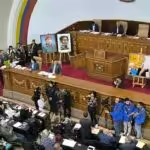
On December 2, the National Assembly (AN) of Venezuela approved the first reading of a bill initiating the formal process to condemn the Rome Statute, the founding treaty of the International Criminal Court (ICC). This would be another step in a series of tensions between the Venezuelan state and the ICC, exacerbated by a pattern of political selectivity, interference, and the application of double standards by international organizations under Western influence.
The measure has immediate precedents, such as the closure of the ICC office in Caracas. There are contrasting approaches within the court in its handling of cases involving not only Venezuela, but also Russia, Palestine, the European Union (EU), and the United States. These reveal the deep geopolitical fractures that run through the architecture of international criminal justice.
Venezuela condemns the legal colonialism of the ICC
The period leading up to the legislative approval was marked by two key events. First, the confirmation that the ICC would close its technical office in Caracas, although it would continue its investigations. Then, more provocatively, came the statements by ICC Deputy Prosecutor Mame Mandiaye Niang, who, during a visit to Argentina at the end of November, made remarks that the Venezuelan government labeled “legal colonialism.” The government accused him of “turning a blind eye and doing nothing, only to later exploit the justice system for political purposes.”
The Venezuelan Foreign Ministry issued a statement on December 1 condemning the prosecutor’s office for “never appointing staff to occupy” the office in Caracas.
The president of the National Assembly, Jorge Rodríguez, was more forceful, stating that “the ICC serves to persecute independent countries that do not submit to the dictates of the hegemon.” This atmosphere of verbal confrontation paved the way for legislative action.
The bill, approved in its first reading, is the legal tool to implement an alternative that has been in place since the ICC prosecutor’s office, under former prosecutor Fatou Bensouda, opened the preliminary examination on Venezuela in 2018. The condemnation of the Rome Statute is a sovereign act provided for in the treaty itself (article 127). However, it does not exempt the state from the jurisdiction of the court for alleged crimes committed during the period in which it was a member.
The parliamentary move should therefore be interpreted as a high-level political protest and a response to what is perceived as a flawed process from its inception.
The double standard against Russia
The most glaring contrast in the ICC’s actions is its diametrically opposed treatment of different powers. On March 17, 2023, the ICC issued an arrest warrant for Russian President Vladimir Putin for alleged war crimes related to the “deportation” of Ukrainian children, which was in reality an evacuation from combat zones to protect them from danger.
The speed and public profile of this decision were remarkable. However, this act stands in stark contrast to the court’s historical paralysis in the face of alleged crimes committed by US citizens or military forces, which are also not part of the Rome Statute.
The hypocrisy is structural, as the United States has been a staunch adversary of the ICC, enacting laws such as the American Servicemembers’ Protection Act (2002)—colloquially known as the “Hague Invasion Act”—which authorizes the president to use “all necessary means” to free US or allied personnel detained by the court.
Furthermore, Washington has imposed direct sanctions on ICC prosecutors when these investigations touched on its interests or those of its close allies, as in the cases of Afghanistan and Israel. The ICC itself criticized the US sanctions against its judges and prosecutors, stating that they undermine its independence.
Documented cases of potential US-linked crimes against humanity or war crimes, such as “Operation Babylift” in Vietnam, stand in stark contrast to the resolve shown against Putin. Similarly, the involvement of NATO generals in killings committed in Serbia, Libya, Western Sahara, Afghanistan, Syria, Yemen, and Palestine is also a stark contrast. Furthermore, those responsible for the horrific torture perpetrated by US forces at Abu Ghraib in Iraq and the occupied Guantanamo Bay Naval Base in Cuba have not been brought to justice.
Analysts assert that the warrant against Putin “exposes the political nature of the ICC and its subordination to the geopolitical interests of the West.” This double standard is a legal and political reality that erodes the court’s legitimacy in the eyes of much of the multipolar world.
Venezuela Takes First Steps in Repealing its Ratification of ICC’s Rome Statute
The case of Palestine, Israel, and the ICC: between hypocrisy and pressure
The Israel-Palestine conflict offers another paradigmatic example of the selectivity and political pressures that the ICC allows. In 2021, then-prosecutor Fatou Bensouda announced the opening of a formal investigation into possible war crimes and crimes against humanity in the Occupied Palestinian Territories, including those committed by Israeli forces and Palestinian armed groups. The reaction from the United States and Israel was one of absolute repudiation and unprecedented pressure.
The US government, under both Democratic and Republican administrations, has labeled the ICC “illegitimate” and “corrupt” when it investigates strategic allies. In 2024, President Joe Biden was accused of “undermining international justice” for opposing an ICC investigation into Israeli war crimes. Donald Trump, for his part, escalated the pressure to the point of imposing personal sanctions on Bensouda and another senior court official in 2020, measures that were only partially lifted later.
The EU, which in theory is a staunch defender of the court and international law, has maintained a deafening silence or issued lukewarm statements when it comes to demanding Israeli cooperation with the ICC. This passivity contrasts sharply with the speed with which the EU supports the court’s decisions when they target geopolitical adversaries such as Russia or, in the past, Serbia.
The pressure against Bensouda until the end of her term in 2021 and the sanctions against her successor, Karim Khan, have raised questions about the continuity and vigor of the investigation into Palestine. In fact, last November, the ICC confirmed that it continues to “examine” the situation in Gaza, language that many observers interpret as excessive caution. This duality of criteria—firmness toward some, extreme caution toward others—is at the heart of the accusation of double standards.
Venezuela Case II: contrasts with Venezuela Case I
Within the Venezuelan case file itself, the asymmetry in the treatment of cases is evident and fuels distrust. The ICC is handling two separate situations:
• Venezuela I: Referring to the situation since April 2017, this case investigates alleged crimes against humanity committed by state authorities and security forces. This case was originally initiated by a group of member states (mostly Latin American) and has received consistent support from the Venezuelan opposition and allied international actors. Last November, the ICC confirmed that this investigation “is ongoing.”
• Venezuela II: Opened in 2023 at the request of the Venezuelan government, this case investigates alleged crimes committed as a consequence of unilateral economic sanctions imposed by the United States and other countries, which Caracas describes as “unilateral coercive measures” with a devastating humanitarian impact. The government alleges that these sanctions constitute crimes against humanity.
The contrast is stark. While the Venezuela I case has progressed through clear procedural phases (preliminary examination, opening of investigation), with frequent public statements from the prosecutor’s office and a physical office in the country (now closed), the Venezuela II case seems to be moving at a glacial pace. Venezuelan authorities have repeatedly complained about the lack of visible progress.
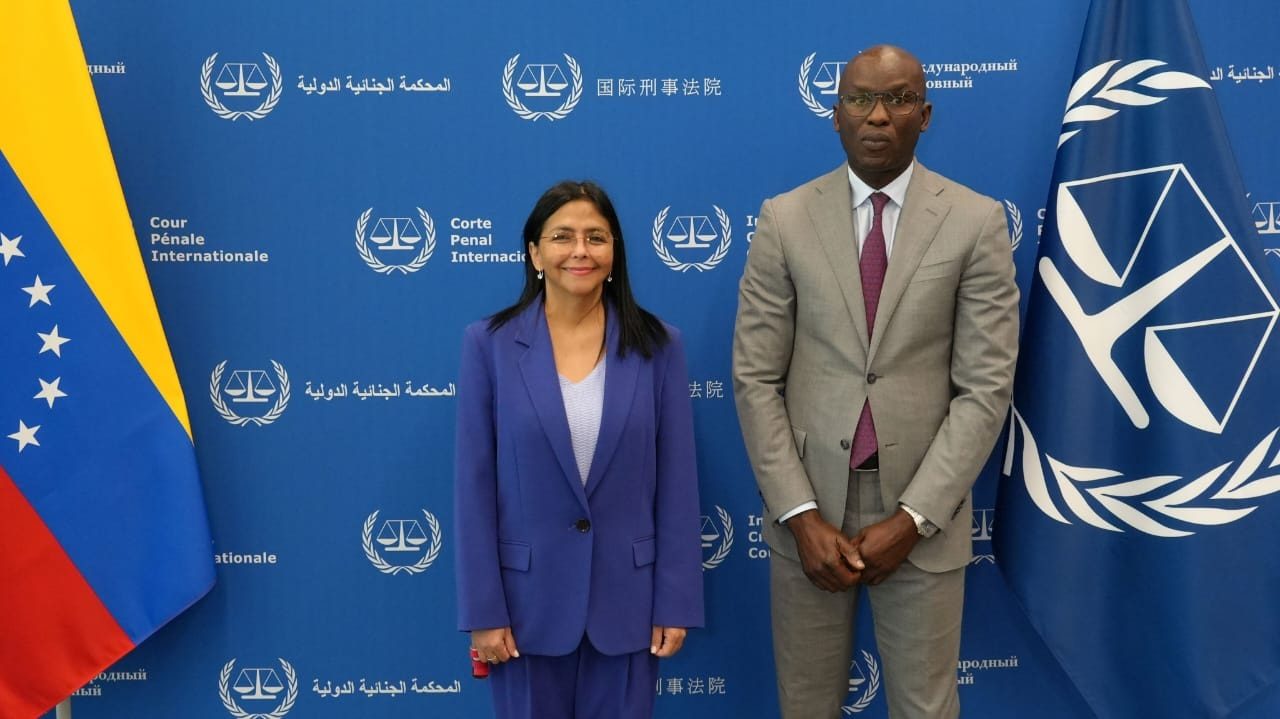
Last August, Venezuelan Executive Vice President Delcy Rodríguez traveled to The Hague to express her concern about the ICC’s slow progress in the case. In a statement from the Foreign Ministry, the Venezuelan state reiterated this demand and affirmed that “the ICC prosecutor’s office showed not the slightest commitment or spirit of cooperation.”
For the Venezuelan government, this disparity confirms that the ICC functions as an instrument of political pressure: it is swift when investigating states not aligned with the West, but slow when the alleged perpetrators are the United States or its allies. The closure of the Caracas office, maintaining only the investigations of Venezuela Case I, is interpreted as the manifestation of this bias.
The approval in the first reading of the law to condemn the Rome Statute is, in essence, an act of political sovereignty against an international justice system that, by all accounts, is profoundly unequal.
The Venezuelan decision comes at a time of global questioning of the impartiality of multilateral institutions. The swift action against Putin, in contrast to the paralysis surrounding cases involving the United States or Israel, the blatant pressure exerted on prosecutors, and the internal contradictions in the handling of the Venezuela I and II cases, provide Caracas with a powerful argument regarding the politicization of the court, even among critical governments.
The complaint symbolizes a direct repudiation of what is considered a system of “victors’ justice,” where universal jurisdiction is applied only to the weakest in the international hierarchy. The backdrop is a broader battle for multipolarity and the questioning of a liberal international order that, for many states, has revealed its most hypocritical and interstate face. The existential challenge for the ICC is to demonstrate that it can act with genuine independence from all the major powers, or see its legitimacy and membership irreversibly eroded.
Translation: Orinoco Tribune
OT/JRE/SF

Misión Verdad is a Venezuelan investigative journalism website with a socialist perspective in defense of the Bolivarian Revolution