
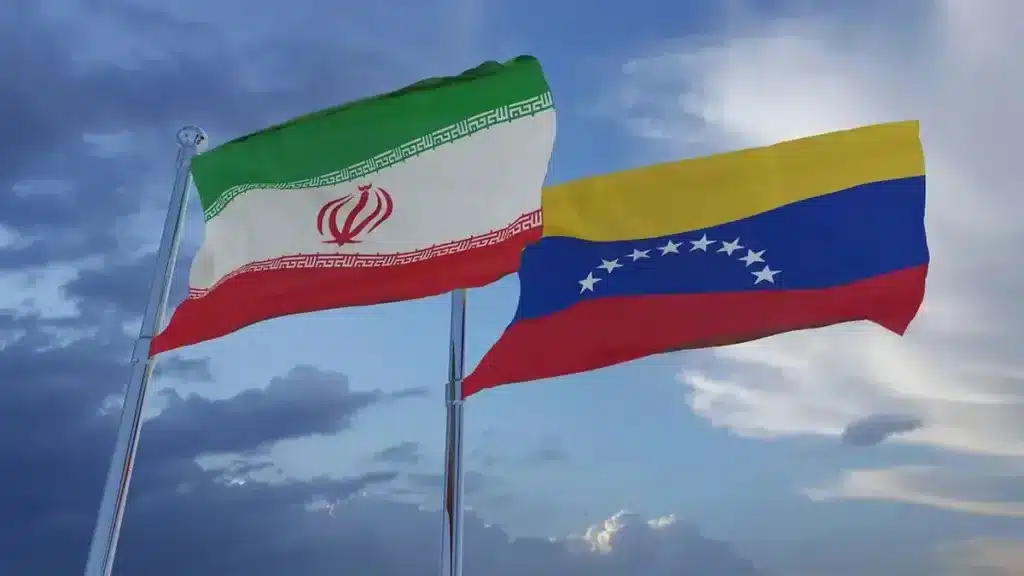
Flags of Iran and Venezuela. File photo.
Flags of Iran and Venezuela. File photo.
By Seyed Mohammad Marandi – January 17, 2026
In a move that stunned the world, the United States military launched attacks across the Venezuelan capital, bombing multiple sites, including a major academic and scientific center and a medical warehouse, as if to stress the similarities between US and Zionist troops. The operation culminated in the kidnapping of President Nicolás Maduro and his wife, and the murder of roughly 100 people.
This shameless act followed months of escalation. It began with threats over fabricated allegations of drug shipments, followed by a military buildup in the Caribbean. Then came a series of deadly missile strikes on boats, strikes that legal experts worldwide decried as unlawful, murdering over a hundred people, not all of them even Venezuelan. Most victims were likely ordinary fishermen or others simply struggling to feed their families.
Then, predictably, the narrative shifted to the real objective: oil. One hour after President Maduro was abducted, the White House made its announcement. The world looked on with disgust and shock to see a shackled head of state, albeit in high spirits, alongside his wife, who had been badly beaten by US troops.
The US president declared that Venezuela’s oil, the planet’s largest proven reserves, was now an indefinite American asset. From here on, its many billions in sovereign wealth were to be funneled through and stolen by Washington.
In Caracas, the response was a nation’s fury. The vice president and now acting president of Venezuela denounced an illegal, illegitimate kidnapping, a blatant violation of the UN Charter and all norms of human decency. Global condemnation was swift and widespread, emanating from Latin America, Africa, and Asia. It came from every corner except the capitals of Washington’s closest allies: the Israeli regime, the European Union, and other pro-Western regimes.
A new line was being drawn in real time for the whole world to see. A world leader abducted by a foreign army. A nation’s wealth declared the permanent property of another. The so-called rules-based international order torn to shreds. But the story is far from over. Resistance in Venezuela is alive.
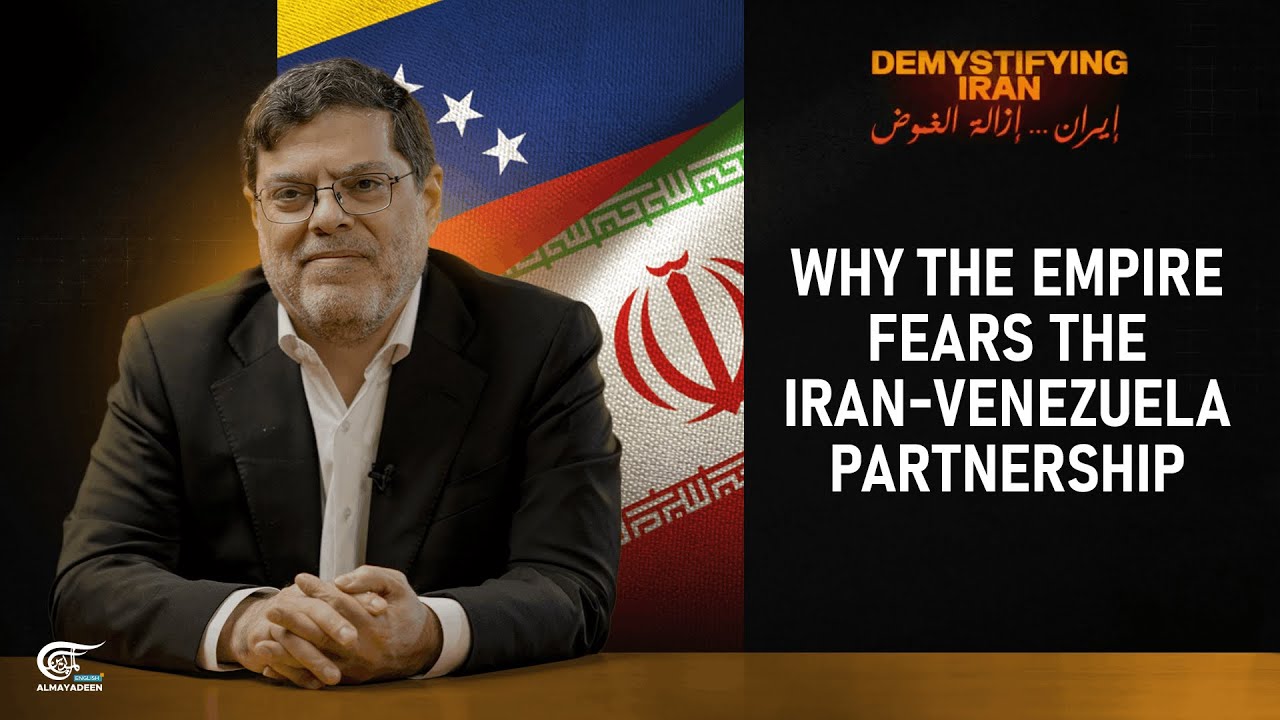
This brings us to the Iran-Venezuela partnership, an alliance branded from the outset by the empire as a global threat. It is no coincidence that Zionists and neoconservatives target Iran and Venezuela simultaneously. Their partnership represents a formidable challenge to this era of predatory imperialism. Its significance lies not only in economic and political cooperation, but in the awareness, solidarity, and understanding forged among the global majority, a force whose power cannot be measured in material terms. The demonization promoted by the empire and its media machine loses much of its potency as most people across Latin America and West Asia recognize their shared truths, ideals, and aspirations. This recognition is poison to the empire.
Despite Western asset theft, sanctions, violent regime-change operations, color revolution projects, and even war, the empire’s crafted narrative remains singular and dark: a strategic menace, an axis of anti-American authoritarianism, a marriage between two so-called pariah states. Within this frame, allegations build into a manufactured climate of fear. The partnership is branded as a pact for authoritarian cooperation. But in truth, it has become the world’s most advanced laboratory for evading illegal sanctions, sanctions deployed by the US and its allies to strangle nations, collapse economies, destroy jobs, increase poverty, break families, kill the sick for lack of medicine, unravel the fabric of societies, and bring nations to their knees.
The empire portrays a somehow sinister shadow economy conducting its business in the dark, on the high seas. This characterization is then made to morph inevitably into the ultimate security threat: military advisers, Iranian drones on Venezuelan soil, culminating in some alleged Hezbollah link. Here the narrative makes its decisive leap, transforming the threat from mere economic into something framed as existential, an illusion of danger to the United States itself. Finally, it is presented as a grand conspiracy: two isolated regimes plotting to invade the US with immigrants and refugees, kill its population with drugs, and other accusations that, while insane, remain tragically believable to a large segment of the heavily propagandized American public.
This is the narrative. It has been used to justify many years of barbaric sanctions against women and children. And now it has justified the abduction of a sovereign nation’s president and the massacre of roughly 200 people. This so-called criminal partnership is, of course, something else entirely. It is a determined collaboration between two nations forging an alternative path, a practical blueprint for preserving their independence in the face of aggression and collective punishment by the United States.
The relentless focus on an alleged global terrorist threat is a strategic distraction. This framing is designed to obscure the tangible daily realities that truly bind these brotherly nations: the engineers reviving refineries, the agricultural technology feeding cities, the 20-year strategic plan signed in Tehran. This is the real struggle, not merely to survive, but to sustain a modern state against a comprehensive and barbaric economic siege.
Let us interrogate the architecture of the story itself: how a narrative is weaponized, brick by brick, until the wall it builds is so high it conceals the human reality on the other side, justifying any action taken behind it. In the struggle for a multipolar world, who defines terrorism? Who defines legitimacy and morality? And what price are nations forced to pay to write their own history?
For Iran, this relationship is more than a mere strategic or economic alliance. It is the execution of a national mission, a principle engraved into the very foundations of the state. The constitution of the Islamic Republic of Iran is explicit. It contains a revolutionary mandate committing the state to the defense of the mustaz’afin, the oppressed and the downtrodden wherever they may be. This principle provides a lens through which the struggles of the Palestinian, but also the Bosnian, the South African, the Cuban, and yes, the Venezuelan, are seen as one and the same: a unified struggle against imperial domination and oppression.
This is not theoretical. It is a record of action. When most of the world’s governments were still conducting business with apartheid South Africa, the newly formed Islamic Republic of Iran immediately severed all ties. It became a vocal champion of the ANC and other resistance organizations, offering critical support to the anti-apartheid struggle while the West backed white supremacist rule. In the 1990s, as Europe stood by and watched a genocide unfold in Bosnia, Iran acted. It defied a UN arms embargo to provide the Bosnian army with crucial weapons, supplies, and military advisers, a lifeline that was key to ensuring the nation’s survival.
So when Iran looks at Venezuela today, an independent nation under brutal economic warfare, its assets stolen, its leader now abducted, it does not see a mere strategic partner. Iran sees a shared struggle against oppression. This constitutional and ideological imperative makes its principled stance more than a byproduct of the alliance. It is the soul of the alliance. And it is from this bedrock principle that, despite threats, cooperation has grown: a partnership forged in the urgent practical need to breathe life into an economy under siege. This reveals the real story, not of a dark axis, but of a blueprint for economic sovereignty forged in defiance of a brutal hegemon.
The partnership between Iran and Venezuela is neither ancient nor inevitable. It is a modern creation, forged by a shared vision of a multipolar world and hardened in the relentless pressure cooker of economic siege. For most of history, Tehran and Caracas were distant acquaintances. That changed at the turn of the century with a powerful fusion of ideologies: Bolivarian socialism and Islamic revolutionary thought, united by a single towering conviction, resistance to unipolar dominance.
The strategic bridge between Caracas and Tehran began construction in the early 2000s under Venezuela’s Hugo Chávez and Iran’s Mohammad Khatami. Their diplomatic courtship started in earnest in 2001 and was cemented through reciprocal state visits and major cooperation agreements in energy and construction. The partnership evolved further under President Mahmoud Ahmadinejad, solidifying from 2005 onward into a declared axis of unity against US imperialism.
The scale of cooperation for two heavily sanctioned nations was quite remarkable. They signed more than 270 bilateral deals. In 2007, they announced a $2 billion joint fund to invest in other countries attempting to liberate themselves. The commitment was underscored in 2006 when Chávez pledged that Venezuela would stay by Iran at any time and under any condition. By March 2005, the expanding partnership and Venezuela’s backing of Iran’s nuclear program was causing alarm within the US administration.
On the ground, Iranian firms built ammunition and cement factories, opened a car plant, and launched direct air links between their capitals. The value of Iranian industrial projects in Venezuela reached $4 billion, and bilateral trade had grown significantly by 2008. The bond held firm under Nicolás Maduro. However, the relationship soon faced its most severe challenge: comprehensive, crushing sanctions from the United States. This external pressure transformed their axis into a vital practical lifeline. Vision alone does not keep the lights on. Consequently, the alliance evolved from a union of rhetoric into a pragmatic pact for survival and development.
By 2020, Venezuela’s refining industry had collapsed. In response, Iran dispatched five tankers carrying 60 million gallons of gasoline on a defiant 15,000-kilometer voyage, with both nations warning the US against interference. This was a bold rescue mission for energy sovereignty, later formalized into a €110-million contract to repair Venezuela’s El Palito refinery. The cooperation, however, expanded far beyond oil. An Iranian supermarket chain opened in Caracas, and the two nations even launched joint nanotechnology research. This was a comprehensive project for building sovereign capacity, encompassing everything from food security and industry to advanced technology.
Critically, the cooperation extended into the cultural and scientific realms of both nations. Ministers of science, culture, and education traveled back and forth. This was no longer merely about trade; it was the forging of a long-term intellectual alliance. But this tangible, multidimensional success did not go unnoticed. In Washington, alarm solidified into formal counter-strategy. As early as 2012, the US Congress held hearings and drafted legislation specifically to counter Iran’s growing presence and hostile activity in the Western Hemisphere.
A peaceful partnership dedicated to improving lives had been officially designated an adversary in American law. And with that gaze fixed upon it, the dark narrative intensified. Mossad spread false reports of a planned Iranian naval base at a Venezuelan port. In Washington, and bizarrely across the obedient US media, the partnership was no longer framed as a regional challenge, but as an existential security threat on America’s doorstep.
Nevertheless, in 2022, the two countries defiantly signed a 20-year strategic cooperation plan in Tehran, inked by Venezuelan President Nicolás Maduro and the late Iranian President Ebrahim Raisi. Despite the escalating threats, each phase of the relationship built upon the last. It was this shared vision that made practical cooperation possible. It was this unyielding commitment to sovereignty and freedom from domination that ultimately led to the murders in the Caribbean, the bloodshed in Venezuela, and the kidnapping of its president.
But this is not a fleeting alignment. It is a structural alliance, a resilient network that has survived the passing of its founder, the late Venezuelan leader Hugo Chávez. It has persevered and thrived despite political transitions, over two decades of US pressure, and direct congressional action to counter it. These two nations concluded early on that when you are excluded from the system, you do not plead for re-entry. You build an alternative, piece by piece.
But when a new blueprint for independence is being written, what does the old power do? It seeks to erase the architects, and more importantly, the architecture. The attack on Venezuela was a message delivered to every nation seeking independence: “You are not safe. Your sovereignty is conditional. Your resources are forfeit.” The applause from the Zionist regime in response to murder and aggression confirmed the quality of the Venezuelan–Iranian relationship and the identity and nature of the antagonist.
Washington’s War on Iran: The Importance of Defending Information Space
The persistent rumors, often sourced to Israeli regime intelligence, of an Iranian military outpost or a Hezbollah hub in the Caribbean were more than ammunition for a hostile narrative. They revealed the power behind the curtain. To the supremacism of Zionism and its neoconservative allies, who are in fact one and the same, this is the ultimate threat. The very existence of independent nations pursuing their own dignity and honor and demanding equal rights is an existential threat to their domination. For them, such a threat justifies any response.
But the planners of this operation made a critical miscalculation. They believed that by severing the head, the body would collapse. They did not understand the roots. This alliance was the vanguard of a multipolar world and was founded upon a deep-rooted ideological belief in the shared dignity and honor of both peoples. It sought to challenge the architecture of a unipolar order even before the rise of antagonism between the West and Russia or China. It asserted the right of nations to chart their own independent course. This brotherhood helped ignite a fire that cannot be quenched by a dying empire, no matter how violently it lashes out.
The solidarity and comradeship between people of different continents, races, and religions have been a beacon of hope for the post-American era. This alliance was never merely bilateral. It is a cornerstone of a broader constellation within BRICS and the Global South of nations determined to write their own rules, to live on their own terms, and to reject the exhausted logic of colonialism in a new guise.
Anti-colonial sentiment is not a relic in Caracas or Tehran. It is the very fuel of their people’s resolve to resist piracy, looting, and, most importantly, the colonization of the mind. Time will prove that the abduction of President Nicolás Maduro has not cowed the Venezuelan people into submission. Instead, it has made their resistance a global inspiration, illuminating for the entire world the strength of a nation determined to defy an empire.
Across the world, people now witness men and women marching in defiance, refusing to be colonized by Washington. Meanwhile, their allies in Iran, likewise struggling against Zionist terror and aggression, will continue to stand by Venezuela through thick and thin. So, the collective march toward liberation from empire will continue.
This is a transcription of a presentation given by Seyed Mohammad Marandi on the program “Demystifying Iran” broadcast by Al Mayadeen. A Spanish language transcript of Marandi’s presentation is available at Misión Verdad.


