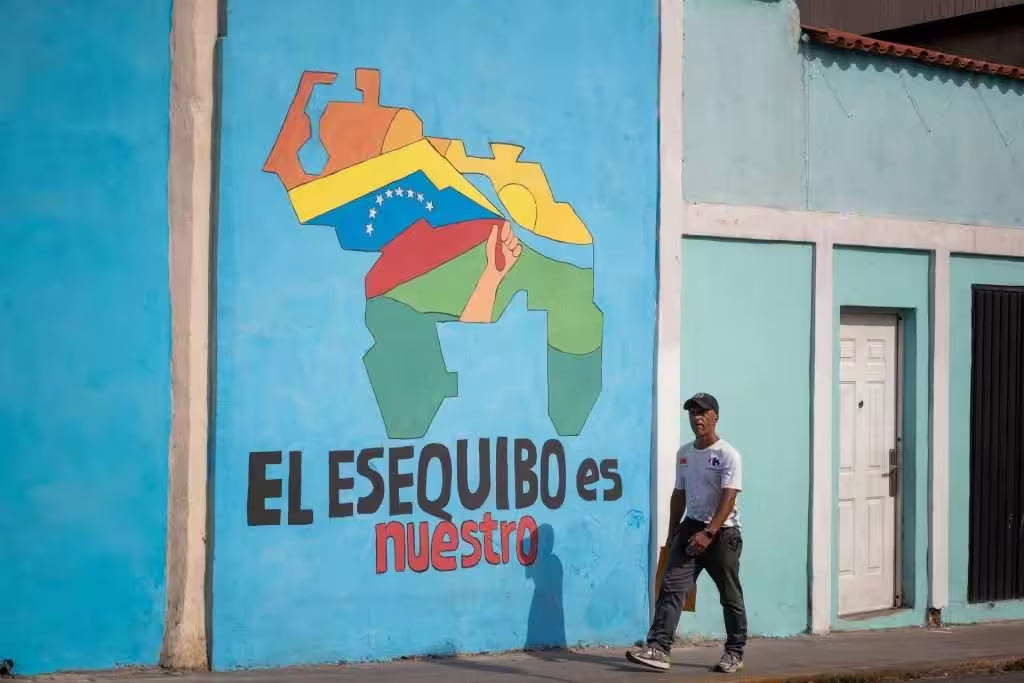
A passerby walks past a mural with a map of Venezuela that says 'The Essequibo is ours," in Caracas. Photo: El Periodico/file photo.
A passerby walks past a mural with a map of Venezuela that says 'The Essequibo is ours," in Caracas. Photo: El Periodico/file photo.
The Bolivarian Republic of Venezuela strongly reaffirmed that the 1966 Geneva Agreement is the only valid and existing legal instrument to resolve the territorial dispute over the Essequibo, and condemned unilateral actions by Guyana.
On Tuesday, February 17, Venezuela commemorated the 60th anniversary of the signing of the agreement, underscoring its unwavering commitment to a just and mutually satisfactory solution to the territorial dispute.
The acting president of Venezuela, Delcy Rodíguez highlighted that this agreement, signed under the auspices of the United Nations, effectively nullified the fraudulent 1899 Paris Arbitral Award that Venezuela considers an imperialist scheme orchestrated by the United Kingdom, unjustly depriving Venezuela of a vast portion of its territory.
Mandates of the Geneva Agreement
The Geneva Agreement mandates Venezuela and Guyana to engage in direct negotiations to achieve a practical and mutually acceptable settlement, thereby reaffirming Venezuela’s historical rights over 159,542 square kilometers of territory that have been an integral part of the country since the establishment of the Captaincy General of Venezuela in 1777.
The Agreement, signed in Geneva, Switzerland on February 17, 1966, stands as a pivotal international treaty registered before the UN, designed to address the territorial controversy between Venezuela and the then-British Guiana. This accord reasserted the Venezuelan claim to recover the land expropriated through the fraudulent 1899 Paris Arbitral Award, a process that attorney Severo Mallet-Prevost, representing Venezuela during the discussions of the Arbitral Award, exposed as a procedural fraud.
By subscribing to the Geneva Agreement, Venezuela and Guyana agreed to declare the Arbitral Award null and void, committing themselves to finding a practical and satisfactory solution through direct negotiation, acknowledging the territory as an integral part of Venezuela.
Venezuela’s Interior Minister Condemns US-Guyana Plot to Escalate Essequibo Dispute
Venezuela’s claims threatened by ExxonMobil
Venezuela has consistently condemned Guyana’s attempts to internationalize the conflict through an illegal lawsuit at the International Court of Justice (ICJ), an institution which Venezuela maintains lacks jurisdiction to settle this territorial dispute.
Furthermore, the Venezuelan government has strongly criticized Guyana’s granting of illicit concessions to the US oil giant ExxonMobil in the Stabroek block, located in undelimited waters. This action constitutes a flagrant violation of international law and poses a threat to regional stability, directly contravening the peace agreement signed in Argyle in 2023.
Venezuelan Foreign Minister Yván Gil had emphasized that the path of mutual understanding between two sovereign nations remains the only viable way to overcome this unfortunate legacy of imperialism. In accordance with the popular mandate expressed in the December 3, 2023, referendum in Venezuela, where 95% of voters rejected the ICJ’s jurisdiction, Venezuela unequivocally reaffirmed that it will never renounce its sovereign rights over the territory.
Over the last six decades, Venezuela has consistently demonstrated its commitment to peace and good faith, even following the 1970 Port of Spain Protocol, which aimed to improve relations with the newly independent Cooperative Republic of Guyana by setting aside the territorial dispute for 12 years. However, the Guyanese government has chosen to disregard the spirit of the Geneva Agreement, particularly since 2015, after ExxonMobil discovered oil deposits in the undelimited waters.
ExxonMobil has financed campaigns to present Venezuela as an aggressor in the dispute, and even funds Guyana’s case against Venezuela at the ICJ.
(Telesur English) with additional editing by Orinoco Tribune