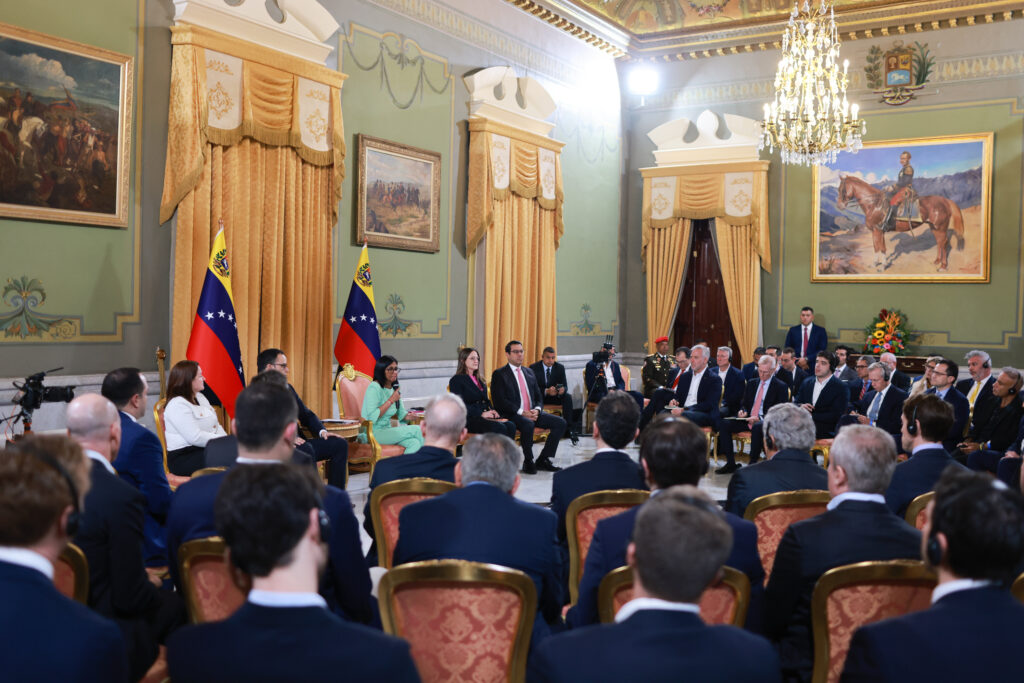
Acting President Delcy Rodríguez speaks with a delegation of national and international investors on March 24, 2026. Photo: Venezuela's Presidential Press.

Orinoco Tribune – News and opinion pieces about Venezuela and beyond
From Venezuela and made by Venezuelan Chavistas
Acting President Delcy Rodríguez speaks with a delegation of national and international investors on March 24, 2026. Photo: Venezuela's Presidential Press.
In order to facilitate the development of Venezuela’s economy and to provide security for investors, Venezuela has again demanded that the United States lift the illegal sanctions and blockade that it has maintained against the country since 2014. The request was made this Tuesday, March 24, by Acting President Delcy Rodríguez.
“Politics also speaks, and we have asked President Trump, for the benefit of investors, not only for Venezuela, which needs it, that there be no sanctions against Venezuela or its economy, but also for investors,” she stated during a meeting with national and international investors. “A license does not provide the necessary certainty for a long-term investment.”
From Miraflores Palace, the seat of the national government in Caracas, she cited as an example the case of the US transnational Chevron, which at one point was granted a license by the US regime. The license was then taken away by the US regime, and then it was granted again.
In that context, she emphasized that both the United States and Venezuelan governments must create “real conditions for investments in the country to develop in the short, medium, and long term. That’s why I speak about building real long-term bilateral relations; solid, with solid political and economic foundations.”
She added that there must be “a clear cooperation agenda, and that is where I call for the legal environment of both countries to provide security to the investor.”
“That is why we have insisted that the sanctions against Venezuela must cease, both as a matter of law but also so that investors feel confident that their investments here have a legislative and legal framework that provides them with that security,” she said.
After launching a military attack on Venezuela in the early hours of Saturday, January 3, and abducting the Constitutional and legitimate president, Nicolás Maduro, the Trump regime has issued licenses lifting a series of restrictions that they themselves unilaterally imposed for 12 years against the Venezuelan hydrocarbon sector in their eagerness to destroy the Venezuelan economy and overthrow the national government.
It is worth noting that most of these “licenses” cover authorizations for US industries; however, they also include restrictions on countries that the US considers its enemies: China, Russia, Iran, North Korea, or Cuba.
On February 18, the US regime extended for another year the sanctions imposed on March 8, 2015, by then-President Barack Obama, in Executive Order 13692, which laughably declared Venezuela as an “unusual and extraordinary threat.”
Since 2015, both Obama and the presidents who succeeded him, namely Donald Trump in his first term (2017-2021) and in his second (2025-), as well as Joe Biden (2021-2025), have imposed more than a thousand sanctions on Venezuela.
This is the fifth time in the last two months that the acting president has asked the Trump administration to lift the sanctions against Venezuela. One of those requests was on March 14, when she rejected Colombian President Gustavo Petro’s proposal for zero tariffs on all bilateral trade, citing the inequality caused by US sanctions against the nation.
“President Trump, this is the sentiment of our people, but it is also the way for Latin America, which you have referred to, to move forward together with balanced and equitable growth, where Venezuela also contributes to regional growth,” Rodríguez stated on March 14. “From here, Venezuela, in national unity, calls for the lifting of sanctions, the end of the blockade, and the establishment of cooperative, friendly, and collaborative relationships based on equality and respect.”
On February 26, 2026, 48 hours after Donald Trump referred to Venezuela as a “new partner and friend,” Acting President Delcy Rodríguez addressed a message to the US president requesting that he end the blockade and sanctions against the nation. That was the first appeal.
The following day, February 27, the acting president of Venezuela again demanded an end to the economic blockade imposed by the US against the country, calling for a reminder that it has significantly affected the local economy due to the restrictions placed on industries in the hydrocarbon sector.
On March 2, Rodríguez again asked the US president to lift the blockade and the unilateral coercive measures that his country maintains against Venezuela.
Guaranteed investments
This Tuesday, March 24, after expressing her satisfaction with the presence of a delegation of international and national investors, the acting president highlighted that this sector has guarantees so that its investments can develop extensively.
She affirmed to investors that “those who think, believe, based on the numbers and the analyses, that this is a good time and that Venezuela is a good place to invest, should know that they have guarantees, legal security, political security, stability, and peace of mind so that their investments can develop extensively, not only in the hydrocarbon sector, where there are many opportunities, but also in the mining sector.”
She noted that Venezuela, in addition to having the largest oil reserves on the planet, also has “one of the largest gold reserves in the world,” as well as reserves of bauxite and diamonds—”gigantic reserves that undoubtedly become a space for investment and development. ”
She recalled that these large resources should have an impact on the development of the national economy and on Venezuelan industry.
“That’s why I am so pleased that you can have meetings with Venezuelan businesspeople, because it allows you to know that there are business chambers here for each sector and that you can talk with your counterparts in the country and form alliances that will boost the national industry and the Venezuelan productive sectors,” she added.
She emphasized that the meetings between international investors and productive sectors, entrepreneurs, and businesspeople in Venezuela allow the parties to follow a joint path “so that we can move forward and so that you can see firsthand the progress we have made in the economic sphere and environment.”
The event was attended by the Vice President of Economy and Finance Calixto Ortegam the Minister of Ecological Mining Development Héctor Silva, the Minister of Hydrocarbons Paula Henao, and the Minister of Economy, Finance, and Foreign Trade Anabel Pereira.
The Mining Law will be approved within hours
The acting president informed investors that the Organic Law of Mines, currently being debated in the National Assembly, is expected to be approved this week. She stated that the law “makes significant progress in international standards and protocols for investment and mining and in business models for the mining sector.”
In that regard, she noted, “There is tax relief being introduced” in the legislation, which will be approved between Wednesday and Thursday of this week. She indicated that this “is very good news for sectors that want to invest in this area.”
The National Parliament approved, in its first discussion, on Monday, March 9, the Organic Law of Mines Bill, whose objective is to promote national and international investment in the country’s mining sector.
Rodríguez emphasized that Venezuela is making progress in important legislative reforms that can provide greater legal certainty to investors in the country.
In that context, she recalled that the first law that was reformed was the Organic Hydrocarbons Law, “which took very important steps, based on experience that we had, in the last two years, established within the framework of the economic blockade and sanctions, a legislative framework that allowed for creative forms of association with both national and international investment sectors, one of which became very famous, which is the CPP, Productive Participation Contract in Hydrocarbons.”
Regarding the CPPs, she said on Tuesday that the contract allowed the investment of nearly one billion dollars in 2025 to “allow us to recover 200,000 barrels of oil,” that is, to increase production.
“This type of business partnership is incorporated into the new Hydrocarbons Law,” she explained. “The reform also includes a new tax regime, with special incentives for investment in green fields, which were not previously considered but rather treated the same as type A fields, the brown fields. Now they have a practically new system, a tax regime for investments that allows for a faster recovery of the investment made in the country in these green fields.”
On Thursday, January 29, before an audience of oil sector workers and deputies to the National Assembly, the acting president, Delcy Rodríguez, promulgated the partial reform of the Hydrocarbons Law, which was unanimously approved hours earlier by the National Assembly.
On March 24, Rodríguez emphasized that Venezuela, in addition to having the largest crude oil reserves on the planet, wants to be an oil-producing powerhouse.
Finally, she added that the national government maintains a working agenda with companies that are arriving in the country.
(Diario VEA) by Yuleidys Hernández Toledo
Translation: Orinoco Tribune
OT/JB/SL