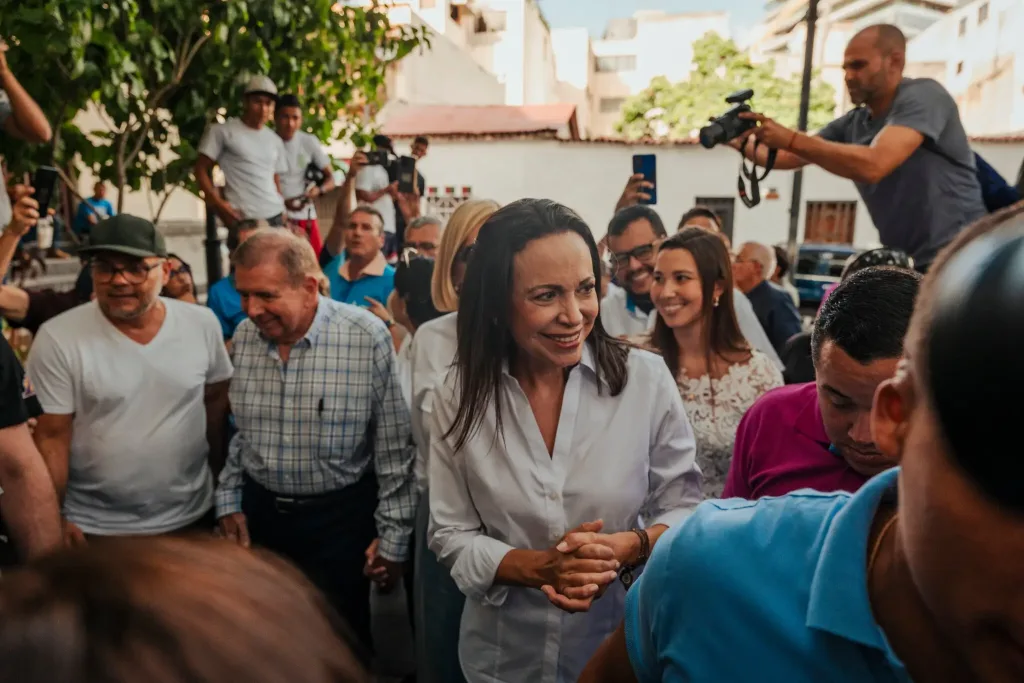
María Corina Machado and Edmundo González Urrutia. Photo: Ivan E. Reyes.
María Corina Machado and Edmundo González Urrutia. Photo: Ivan E. Reyes.
Editorial note: Orinoco Tribune does not generally publish mainstream media pieces. However, an exception is being made in this case, as the current report repeats accusations levied against this far-right politician.
By Simon Romero – Nov 26, 2025
Opposition leader Maria Corina Machado faces criticism that she is exaggerating threats posed by Venezuela’s leader to justify U.S. force to overthrow him.
As the Trump administration weighs using force to overthrow President Nicolás Maduro of Venezuela, former diplomats and even some prominent critics of President Maduro worry that his political opponents in Venezuela are promoting exaggerated claims and falsehoods to justify a U.S. intervention.
Maria Corina Machado, who was awarded the Nobel Peace Prize in October and is considered the opposition’s de facto leader, has recently amplified debunked claims that President Maduro fixed elections in the United States, aligning herself closely with President Trump and his allies.
“I have no doubt that Nicolás Maduro, Jorge Rodríguez and many others are the masterminds of a system that has rigged elections in many countries, including the U.S.,” Machado told Bloomberg News, referring to Venezuela’s president and the head of its National Assembly.
Trump followed over the weekend by amplifying unproven assertions that Venezuela interfered in the 2020 election.
Machado and other opposition leaders have also argued that President Maduro simultaneously heads two different drug-trafficking organizations threatening U.S. national security. The Trump administration has similarly sought to link President Maduro to both groups.
The Trump administration has designated those groups, Tren de Aragua and the Cartel de los Soles, as terrorist organizations. Trump officials have also claimed that the United States was in a state of armed conflict with “narco-terrorist” drug cartels to legitimize strikes on 21 boats, which have killed at least 83 people since September.
But the administration’s own intelligence agencies, experts on Latin America’s drug trade and other Venezuelan opposition figures have rejected the idea that President Maduro wields control of the two groups or is weaponizing them against the United States. While experts agree that figures in Venezuela’s military have been involved in drug smuggling, some doubt these organizations are even transnational drug cartels.

A broad range of experts in laws governing the use of lethal force say the U.S. attacks at sea are illegal and have described them as murders. They argue that the administration has not established that an armed conflict exists between the United States and Venezuela.
As Trump considers further moves against President Maduro, some longtime experts on Latin America have expressed skepticism over the reasoning for a potential mission aimed at regime change, saying they echo missteps in Iraq that produced years of protracted war. The Iraqi quagmire fueled concerns that foreign politicians might promote exaggerated narratives to persuade the United States to overthrow leaders of other countries.
“It’s time to summon the ghost of Ahmad Chalabi,” said John D. Feeley, a former U.S. ambassador to Panama, referring to the Iraqi politician who had a pivotal role in making the case for the United States to invade Iraq by providing false information that Saddam Hussein’s regime had weapons of mass destruction and operational ties to Al Qaeda.
Feeley, who worked for Secretary of State Colin Powell in the run-up to the Iraq war, said it felt as if he were watching similar events unfold. He questioned whether Trump officials were relying on dubious information about President Maduro’s operational control of drug trafficking and the ease of trying to topple him.
“It’s unbelievable how these guys are too stupid to read their own history and know that they’re headed for the same thing,” Feeley said.
In response, a White House official said President Maduro’s government was a narco-terrorist cartel and that Maduro was not a legitimate president.
Machado has emerged as the most prominent figure in Venezuela making the argument that President Maduro is a cartel kingpin.

“We all know that the head of the Tren de Aragua is Maduro,” Machado said in a podcast interview with the president’s eldest son, Donald Trump Jr. “The regime created, promoted, and funds the Tren de Aragua.”
Through a spokesman, Machado declined repeated requests to comment for this article. In an interview with The Times last year, she described President Maduro’s ouster as a matter of “hemispheric security” and, therefore, international importance.
Among Venezuelans who oppose President Maduro, there are at least a few skeptical of some aspects of her argument.
Henrique Capriles, an opposition figure, former governor and presidential candidate who has been marginalized in recent years, said in an interview that while Tren de Aragua is a dangerous gang, the idea that it was controlled by President Maduro amounts to “science fiction.”
Capriles, who ran and lost against President Maduro in 2013, was later banned from running for office, a prohibition lifted in 2025. His critics have accused him of colluding with the government after he decided to participate in a flawed National Assembly election.
For years, leaders in Venezuela’s often fractious opposition have made claims that President Maduro was orchestrating a vast drug-trafficking organization. There is little doubt, experts say, that illicit smuggling is enmeshed in Venezuela’s government. Several senior officials who have broken with the regime have accused top leaders of profiting from the drug trade.
“In our case the cartel is the state,” David Smolansky, a Venezuelan politician who represents Machado in Washington, said in an interview.
In 2020, during the first Trump administration, the Justice Department indicted President Maduro and other Venezuelan officials on drug-trafficking charges, accusing them of trying to “flood the United States with cocaine.” It specifically mentioned Cartel de los Soles, describing it as a drug-trafficking group directed by President Maduro.

The claims have not been tested in U.S. courts, but Trump officials breathed new life into the indictment this year, doubling the reward for President Maduro’s capture to $50 million.
But experts who have analyzed the Venezuelan drug trade for decades say the Cartel de los Soles is not a literal organization but shorthand for drug trafficking in the armed forces. That phenomenon is not unique to Venezuela, afflicting democratic and authoritarian countries alike in the Americas.
Drugs do pass through Venezuela, but of the cocaine reaching the United States from South America, less than 10 percent flows through Venezuela, the D.E.A. found. And Mexico, not Venezuela, produces fentanyl, the primary driver of overdose deaths in the United States.
Regarding Tren de Aragua, drug trade experts point out that it originated in a prison in Venezuela’s Aragua state and American intelligence agencies circulated findings in February that the gang was not controlled by the Venezuelan government. Its leader is thought to be Hector Rusthenford Guerrero Flores, who escaped from the prison.

Latin American countries, including Argentina, Ecuador, Peru and Paraguay have recently joined the United States in designating the Cartel de los Soles as a terrorist organization, which some Venezuelan opposition leaders cite as bolstering their case against President Maduro.
“These designations mean the Maduro regime is now like the Taliban, the only government in full exercise of power recognized as a terrorist organization,” Smolansky said.
Asked about proof that President Maduro leads two drug cartels, he replied: “This might be new to citizens in the United States or elsewhere in the region, but Venezuelans have been enduring this for over 20 years.”
Reuters: María Corina Machado Behind US’s False ‘Tren de Aragua’ Narrative Used to Attack Venezuela
Many critics of these claims share the Venezuelan opposition’s disdain for President Maduro, whose authoritarian rule plunged Venezuela into one of the world’s worst economic crashes in modern times.
When the collapse fueled an exodus from the country, Tren de Aragua also expanded into various countries in the Americas, often preying on fellow Venezuelan migrants and engaging in extortion, human smuggling and small-scale drug trafficking.
Still, no evidence has been found that Tren de Aragua is engaged in cross-border drug trafficking, according to Insight Crime, a research group focused on organized crime.
Machado, however, has kept pushing her assertions about President Maduro and drugs.

“Everybody knows that Venezuela is today the main channel of cocaine, and that this is a business that has been run by Maduro,” Machado told CNN. “The regime has turned Cartel de los Soles into one of the most powerful criminal structures all along this continent and other continents as well.”
The origins of using the term Cartel de los Soles to describe illicit military activities stretch back to an era well before Maduro became president in 2013. The term gained traction after a 1993 scandal when the C.I.A. worked with the Venezuelan military to send a ton of cocaine to the United States in a bid to infiltrate Colombian cartels.
Machado’s recent focus on debunked claims that Venezuelans had rigged U.S. elections — an argument Trump’s supporters have used to falsely assert that he won the 2020 election — has fueled claims that she is embracing misinformation to gain favor with the Trump administration.
“She’s saying our problem is actually your problem because it’s a national security issue for you,” said David Smilde, a Venezuela expert at Tulane University. “This can fit into existing agendas in D.C. and provide an extra emphasis to citizens who are not specialists in Venezuela.”
Simon Romero is a Times correspondent covering Mexico, Central America and the Caribbean. He is based in Mexico City.