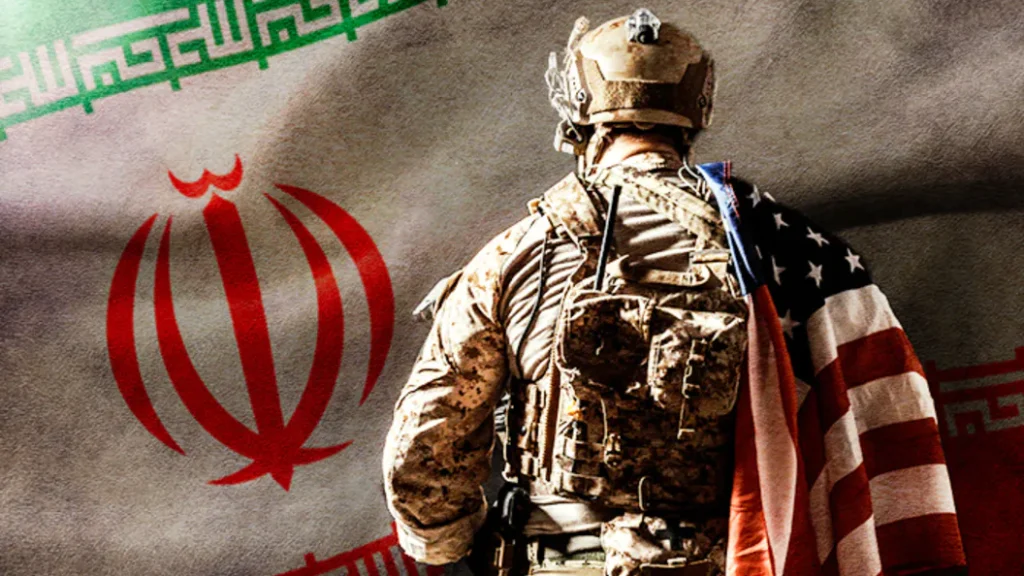
An armed soldier with a US flag on his back faces the flag of the Islamic Republic of Iran. lllustration: NEO.
An armed soldier with a US flag on his back faces the flag of the Islamic Republic of Iran. lllustration: NEO.
By Brian Berletic – Jan 15, 2026
The US has demonstrably continued its war on Iran through the execution of long-laid plans aimed at destabilizing the nation through US-backed protests and armed terrorists targeting major cities over the course of several days.
This follows a nearly 2-week-long war the US and its Israeli proxies launched against Iran in mid-2025—only having been placed on pause ahead of the next round of destabilization and military aggression, which appears to be unfolding now.
Amid the US-organized unrest in January 2026, the US has openly backed the opposition, calling for armed militants to continue their operations and to even seize government institutions.
The Associated Press would quote the US president as saying, “keep protesting and take over your institutions if you can,” and that,“help is on the way,” in reference to previous threats of US military strikes on Iran in support of the opposition.
Beyond rhetorical support, evidence of direct US involvement began to surface amid Western media reports.
The BBC in a recent article admitted—buried deep in the report—that “security forces have also been killed,” implying heavily armed elements amid the so-called “protests.” The same article admitted that informants contacting the BBC from within Iran were using “Starlink” satellite connections—referring to US-based SpaceX’s satellite communication network.
This comes as no surprise. As early as 2022, CNN reported that “the White House has engaged in talks with Elon Musk about the possibility of setting up SpaceX’s satellite internet service Starlink inside Iran,” as one of several ways to “support the Iranian protest movement.”
More recently, Forbes has admitted, “tens of thousands of Starlink units are operating inside Iran,” a metric of how aggressively the Biden administration-era initiative was executed and then continued under the subsequent Trump administration.
Beyond continuity of agenda between the supposedly “opposing” presidential administrations, plans to back violent unrest inside Iran have been laid out by US policymakers as early as 2009 in the Brookings Institution paper, “Which Path to Persia?” and seamlessly carried out by each successive administration regardless of political affiliation or campaign rhetoric.
The paper contains entire chapters titled, “The Velvet Revolution: Supporting a Popular Uprising” and “Inspiring an Insurgency: Supporting Iranian Minority and Opposition Groups,” as well as a chapter literally titled, “Leave it to Bibi: Allowing or Encouraging an Israeli Military Strike,” in which it stated, “the United States would encourage—and perhaps even assist—the Israelis in conducting the strikes themselves, in the expectation that both international criticism and Iranian retaliation would be deflected away from the United States and onto Israel,” a scenario that would unfold verbatim mid-last year.
Regarding US-engineered unrest, the 2009 paper proposes using US State Department-listed Foreign Terrorist Organizations (FTOs) including the Mujahedin-e-Khalq (MEK) the paper admits is highly unpopular inside Iran, had killed American citizens and military personnel in the 1970s, and has most certainly carried out terrorism against others since, but that it should be removed from the US FTO list in order for the US to provide greater and more open support.
In 2012, MEK was delisted under the Obama administration after years of lobbying from neoconservatives who would later line President Donald Trump’s first administration.
In regard to other groups now involved in unrest inside Iran, the 2009 paper stated: “The United States could opt to work primarily with various unhappy Iranian ethnic groups (Kurds, Baluch, Arabs, and so on) who have fought the regime at various periods since the revolution. A coalition of ethnic opposition movements, particularly if combined with dissident Persians, would pose a serious threat to regime stability. In addition, the unrest the groups themselves create could weaken the regime at home.”
This is now precisely what is taking place inside Iran today.
Despite preparations for both internal subversion and direct US military strikes on Iran spanning not only the Biden-Trump administrations, but going as far back as the Bush Jr. and Obama administrations, Iran has weathered these attempts for years and appears to have been at least partially prepared for the most recent round of US-engineered unrest.
The above-cited Forbes article reported Iran successfully shut down not only internet services US-backed militants were using to coordinate their actions and communicate with their foreign sponsors but also managed to extensively jam Starlink terminals in critical regions.
The same article speculated that Iran’s success may be owed to the transfer of Russian electronic warfare capabilities perfected in the US proxy war taking place in Ukraine, where Starlink has also been extensively used.
These developments highlight the priority of securing and defending national information space—space that in the 21st century constitutes as critical a national security domain as a nation’s airspace, land borders, and shores. Failure to do so has proven catastrophic.
US weaponization of information space in the 21st century
Throughout the 21st century, the US has deliberately and maliciously weaponized its domination over global information space, specifically through US-based social media platforms like X (formally Twitter), Meta/Facebook, YouTube, Google, Instagram, and many others.
As early as 2011 the New York Times admitted the so-called “Arab Spring” was in fact a long-planned and prepared-for regional destabilization campaign organized by the US government and its partners across big tech.
Its article, “U.S. Groups Helped Nurture Arab Uprisings,” would admit, “a number of the groups and individuals directly involved in the revolts and reforms sweeping the region received training and financing from groups like the International Republican Institute, the National Democratic Institute and Freedom House, a nonprofit human rights organization based in Washington, according to interviews in recent weeks and American diplomatic cables obtained by WikiLeaks.”
The article also admitted that a number of the opposition groups involved attended, “a 2008 technology meeting in New York, where they were taught to use social networking and mobile technologies to promote democracy. Among those sponsoring the meeting were Facebook, Google, MTV, Columbia Law School, and the State Department.”
In fact, this “technology meeting” was held annually for several years and built on the experience the US government obtained from similar political interference aimed at nations like Serbia, Georgia, Belarus, and Ukraine during 2000-2004.
The Guardian in 2004 would admit that ongoing protests in Kiev at the time were, “an American creation, a sophisticated and brilliantly conceived exercise in western branding and mass marketing that, in four countries in four years, has been used to try to salvage rigged elections and topple unsavoury regimes.”
It also admitted that “the campaign was first used in Europe in Belgrade in 2000 to beat Slobodan Milosevic at the ballot box. Richard Miles, the US ambassador in Belgrade, played a key role. And by last year, as US ambassador in Tbilisi, he repeated the trick in Georgia, coaching Mikhail Saakashvili in how to bring down Eduard Shevardnadze. Ten months after the success in Belgrade, the US ambassador in Minsk, Michael Kozak, a veteran of similar operations in central America, notably in Nicaragua, organised a near identical campaign to try to defeat the Belarus hardman, Alexander Lukashenko,” which the article admitted failed.
Thus, from 2000-2004 the US attempted serial overthrows of targeted governments across Eastern Europe, in 2011 the US refined these techniques to burn to the ground much of the Arab World, then successfully overthrew and plunged the nation of Ukraine into destruction-by-proxy war from 2014 onward, while last year overthrew the government of Nepal on China’s borders, and is now openly attempting to use these same tactics coupled with the threat of overt military aggression to topple the Iranian government.
While analysts have documented the growing disparity between the US and both Russia and China’s military industrial power, the US has retained almost uncontested dominance over global information space. Looking at the swath of destabilization, death, and destruction the US has cut from North Africa to Asia and everywhere in between throughout the 21st century, it has more than compensated for its lack of military industrial production. US information dominance has proven as much, if not more of a threat to the world than America’s still formidable military menace.
Revealed: The CIA-Backed Think Tanks Fueling the Iran Protests
The US threat to global information space requires global defense
The nations of Russia and China have—over the course of many years and through extensive work—secured their respective information spaces. This has—in turn—allowed both nations to secure and stabilize their political space, providing the social harmony required to not only survive ongoing attempts by the US to encircle and contain both global powers but, in many instances, to thrive.
This has been achieved through the creation of domestic alternatives to the US-based social media platforms that otherwise dominate global information space. Both nations have online networks that can be disconnected from Western-influenced information space when and if necessary.
Beyond this, both nations have created domestic pipelines ensuring crucial human resources such as programmers and technicians required to maintain the physical infrastructure of their information space are trained in-country and with the nation’s best interests in mind, as well as the media personnel, government officials, and other civil servants who use each nation’s information space.
This is not unlike the physical infrastructure built within any sovereign nation. Roads, rail, airports, and seaports are all acknowledged to be integral to national security, and thus their construction, maintenance, use, and protection are determined accordingly.
Unfortunately, many policymakers across the planet have yet to understand that information space in the 21st century is as important—if not more so —than this physical infrastructure or traditional national security domains.
Allowing the US to not only provide US-based social media platforms to nations rather than nations developing their own, but allowing the US to also control the flow of information and thus ideas and consensus on these platforms is as bad, or worse, than allowing foreign interests to control a nation’s physical borders, infrastructure, and even a nation’s own citizenry.
The cost of surrendering a key—if not the key— domain of national security to the United States is political infiltration, capture, and even complete collapse, as admitted US operations spanning the 21st century from Europe to the Arab World to Asia and back again have sufficiently demonstrated.
While the multipolar world joins to discuss cooperation across the traditional spheres of national security, urgent attention to securing of the globe’s information space from US influence and control is required.
Russia and China—which export weapons to help partner nations defend their traditional domains of national security—could export turnkey domestic alternatives to US social media platforms, physical infrastructure and gateways as well as electronic warfare equipment to defend against the sort of interference the US just executed across Iranian information space, as well as opportunities to link domestic social media platforms to multipolar alternatives to US-based X, YouTube, Facebook, and other platforms.
Iran, a nation with significant conventional military power, has been undermined and weakened because of its delay in securing its information space and thus political space sufficiently from foreign interference. And while it has acted decisively in recent weeks (and appears to have prepared at least months in advance), only time will tell if it is just in time or still too late.
The future of the multipolar world may depend not on how large the disparity is between it and the US hegemony in terms of traditional military power, but on how quickly the rest of the world realizes the importance of controlling information space the US has understood and exploited across the entirety of the 21st century.

Brian Berletic is a Bangkok-based geopolitical researcher and writer who hosts The New Atlas; former US marine officer. For over ten years he wrote under the pseudonym 'Tony Cartalucci.'