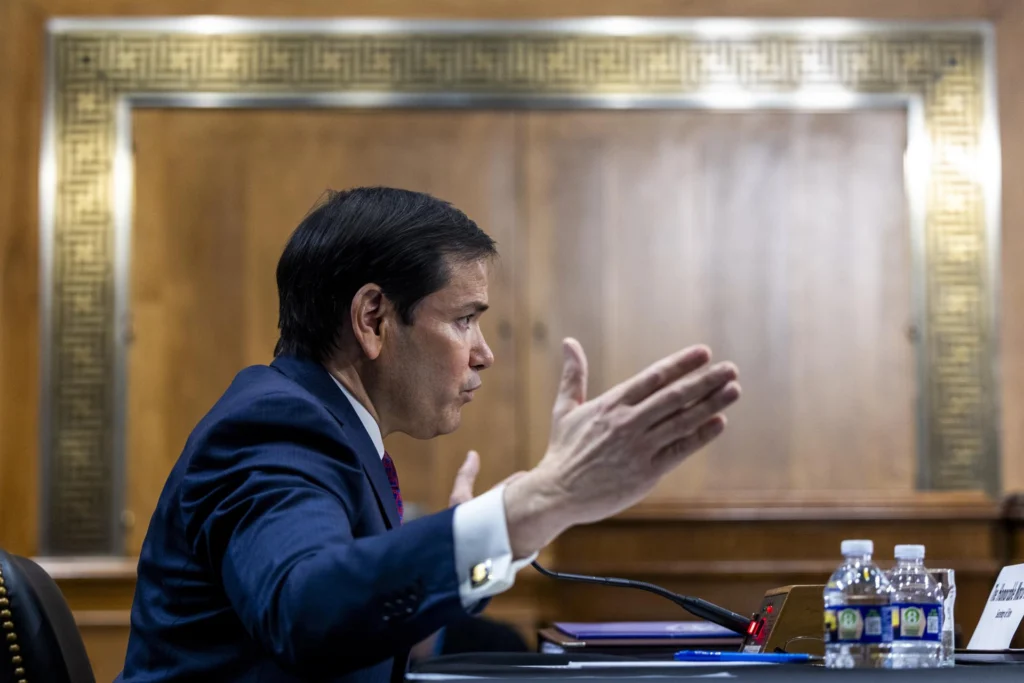
US National Security Advisor and Secretary of State Marco Rubio attempted to justify US crimes in Venezuela before the US Senate Foreign Relations Committee. Photo: EFE
US National Security Advisor and Secretary of State Marco Rubio attempted to justify US crimes in Venezuela before the US Senate Foreign Relations Committee. Photo: EFE
On Wednesday, the US Secretary of State denied that the US was waging war against Venezuela. In the same appearance, he warned that he would oversee Venezuela’s “transition” and threatened to use force if “other methods fail.”
Marco Rubio appeared before the US Senate Foreign Relations Committee on Wednesday. “There is no war against Venezuela, and we did not occupy a country,” stated Rubio. “There are no US troops on the ground.”
Republican Senator Rand Paul, who describes himself as “the most anti-war person in the Senate,” highlighted the contradiction: “If a foreign country bombed our air defense missiles, captured and removed our president and blockaded our country, would that be considered an act of war?”
“Of course it would be an act of war,” Paul continued. “I would vote to declare war if someone invaded our country and took our president.”
Rubio dodged the question. He argued that the January 3 attack on a sovereign nation was “law enforcement,” lasted only four-and-a-half hours, and was carried out to capture someone whom the United States “does not recognize as head of state,” with a US $50 million reward on his head.
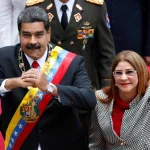
That day, Venezuelan President Nicolás Maduro and First Lady Cilia Flores were abducted by US troops following a military assault that left at least 100 people dead and more than 100 wounded, according to Minister Diosdado Cabello. Both President Maduro and Flores were transported to New York, USA, against their will, where they pleaded not guilty to charges of narcoterrorism.
Paul concluded his remarks by stating: “One-way arguments that don’t rebound, that you can’t apply to yourselves, that cannot be universally applicable, are bad arguments.”
Rubio’s contradiction did not end there. In his prepared remarks to the committee, he warned that the administration would use force “to ensure maximum cooperation if other methods fail.”
Two incompatible projects
While Rubio spoke of overseeing a supposed “transition from a criminal state to a responsible partner,” the president of the Venezuelan National Assembly, Jorge Rodríguez, outlined the country’s legislative priorities from the Federal Palace. One of these priorities remains strengthening People’s Power as a fundamental axis of the state.
These are two projects that cannot coexist. One, the US proposal—imperialist—envisions external control. The other—Bolivarian—deepens citizen participation in national decisions. The difference lies in principles: who determines the country’s destiny?
Acting President Delcy Rodríguez drew that line when she responded to statements by the US Treasury Secretary, which she described as “irrelevant and offensive”
“The people of Venezuela do not accept orders from any external force,” stated Delcy Rodríguez unequivocally. ” The people of Venezuela have a government, and this government obeys the people,” she declared before energy sector officials, legislators, and national and international business leaders.
Funds unlocked for social investment
Venezuela responds with action. Rodríguez announced the release of state funds that will be reinvested in social protection. “We are releasing funds to invest in essential equipment for hospitals, the electricity sector, and the gas industry,” she stated.
The government created two sovereign wealth funds: one earmarked for social needs and the other for public services and infrastructure. These resources had been frozen for years due to unilateral sanctions. Now, they will be channeled toward hospitals, the electricity grid, and the national gas industry.
Venezuela reaffirmed its willingness to engage in dialogue based on mutual respect and non-interference. Rodríguez insisted that any agreement must recognize the self-determination of the Venezuelan people and respect their democratic institutions.
Sovereign wealth funds allow the government to address national priorities without subordinating its domestic policy to external conditions. Caracas unlocks resources, invests in health and public services, strengthens people’s power, and reaffirms the fact that decisions about the country’s future are made by its own people.
Delcy Rodríguez Rejects US ‘Orders’ as Venezuela Advances Hydrocarbons Law Reform
(Telesur)
Translated by Orinoco Tribune
SL