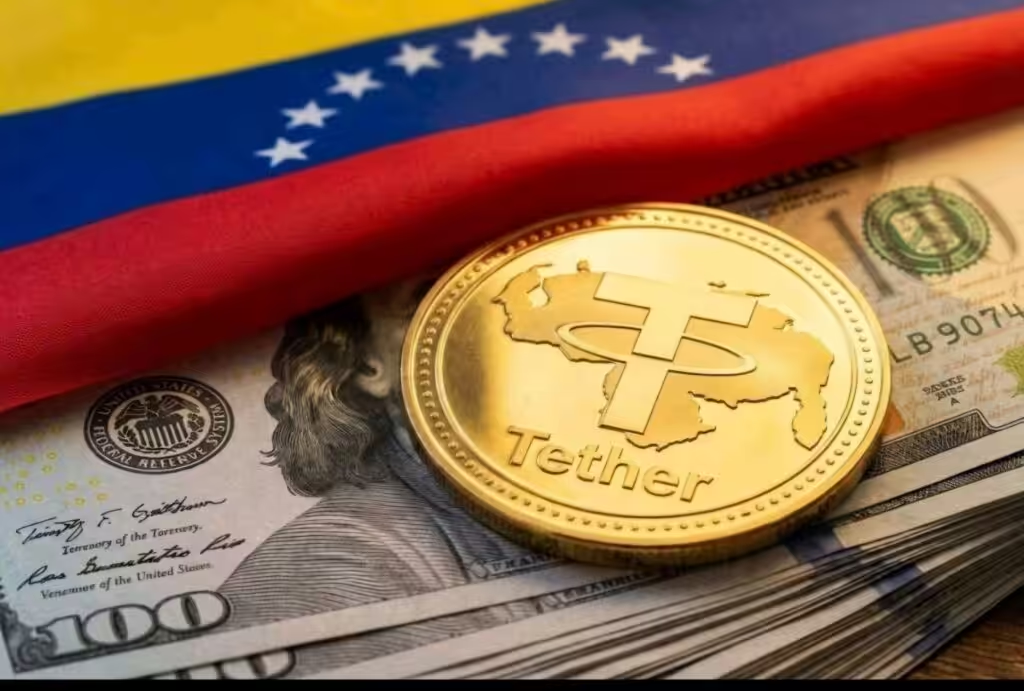
A collage with the Venezuelan flag, US dollar note, and Tether, Binance's mode of P2P mechanism. Photo: Binance.
A collage with the Venezuelan flag, US dollar note, and Tether, Binance's mode of P2P mechanism. Photo: Binance.
By Misión Verdad – Jan 28, 2026
Over the past few weeks, the Venezuelan exchange rate system, both official and unofficial, has been subject to significant volatility. The exchange rate between the bolívar and the US dollar (USD) has fluctuated considerably, distorting price systems and fueling inflation in Venezuela.
In summary, the official rate reported by the Central Bank of Venezuela (BCV), which represents the weighted average of bank exchange rates, showed a steady upward trend in an effort to narrow the gap with the parallel (black market) dollar.
On December 1, 2025, the exchange rate opened at 247.30 bolívars (Bs) per USD. By December 31, 2025, the rate broke the 300 barrier and then reached 301.37 Bs/USD on January 2, 2026.
During the first few weeks of the year, the pace of adjustment intensified. On January 13, it stood at 330.37 Bs/USD. As of January 27, the official exchange rate exceeded 358 bolívars, representing an increase of over 20% in just the first month of the year.
As for unofficial rates, the Binance P2P (peer-to-peer) market served as the primary gauge of foreign exchange in the unofficial sphere, exhibiting volatility and prices significantly higher than the official rate. By early December 2025, the average was already over 360 Bs/USD. By mid-December, the average on digital platforms was around 436.40 Bs/USD.
In January 2026, the gap peaked, reaching extreme distortion by mid-month. On January 13, while the BCV rate was 330, sale prices on Binance peaked at up to 608 Bs/USD. In some cases, prices reached 700, 800, and even 900 Bs/USD.
However, after reaching historic highs, the market experienced an adjustment towards the end of that period. By January 24, the Binance P2P marker was trading at approximately 470.52 Bs/USD. In mid-January, the highest exchange rate gaps between the BCV reference dollar and the P2P market were observed, fluctuating on an intraday basis between 80%, 110%, and even 200%. After the adjustment, the gap narrowed to 20%.
The component factors
While the BCV rate has maintained a steady upward trend, the P2P market referred to by Binance for the USD showed extreme volatility. It should be noted that the value of the latter affects the price of cash currencies in informal or “street” transactions.
The composition of prices on unofficial markers was clearly influenced by political variables. During the month of November, the Trump administration deployed direct coercive actions and physical blockades of Venezuela’s maritime oil activity, a situation that led to the theft of oil tankers, which in turn resulted in the interruption of currency sales mechanisms by the BCV through the exchange intervention mechanism.
Throughout December and until mid-January, BCV conducted no foreign exchange interventions, which increased the “currency drought,” uncertainty, and, consequently, speculation.
When the US invasion of Venezuela and the kidnapping of President Nicolás Maduro took place on January 3, the variables of uncertainty, exchange rate fluctuations, and the absence of foreign currency supply increased, creating the ideal environment for speculators. Traditional price setting in the P2P system favored disproportionate upward trends that were, in many cases, unmanageable.
This reflects the distortions emanating from the P2P ecosystem: a small conglomerate of suppliers and buyers, which does not represent the majority of daily currency transactions carried out in the country, where transaction amounts are not comparable to those of the regular currency supply in foreign exchange interventions.
The distortions fueled by speculation spread beyond that system and had collateral effects on the real economy. Many businesses adjusted their prices, which led to increased inflation.
However, Venezuelan politics has now been overshadowed by an “oil détente” between the governments of the US and Venezuela, suggesting a process of easing illegal coercive sanctions. In this regard, the Venezuelan government announced the release of foreign currency that came from the sale of Venezuelan oil to the United States, a mechanism executed via the BCV and then through national banks, which are the suppliers of foreign currency for the benefit of prioritized economic activities such as health, food, and production.
This element led to an adjustment in the unofficial exchange rate system, which had an impact on various markers and led to a downward differential of up to 20% between the BCV dollar and Binance’s P2P.
Once again, the persistence of significant structural vulnerability in the Venezuelan economy is evident. This vulnerability stems from the link between oil activity, which is susceptible to blockades and turbulence, and variable monetary conditions.
Short-term and medium-term questions
The stability of the exchange rate system depends on many factors, such as currency flows, the release of foreign currency by non-priority sectors, and price formation in the official and unofficial spheres that mitigates exchange rate gaps.
One of the major difficulties in setting prices in the unofficial sphere is the serious problem of persistent speculative practices involving the USD, both in its physical form and in digital versions. Agents on various unofficial platforms have turned foreign currency into a commodity in itself, benefiting from speculation and cartelizing prices, always on the rise, taking advantage of the limitations of the official exchange mechanism.
Another complex element is the psychosocial and economic pattern in the market and the informal retail sale of foreign currency. This is the tendency to seek the highest rate on any platform in order to transfer those reference values to the real market, either for the purchase and sale of banknotes or for referencing prices for certain goods and services in the economy.
Any scenario of stabilization and reduction of exchange rate gaps—and their psychosocial and economic consequences—will necessarily be possible within the framework of expanding the supply of foreign currency in the country.
However, the future is not necessarily uncertain. In fact, there is a strong possibility that the emergence of a general license issued by Washington for oil activities in Venezuela would allow for the regularization of energy flows, which will increase access to foreign currency.
Acting President Delcy Rodríguez proposed to the National Assembly a partial reform of the Organic Law of Hydrocarbons, which is shaping up to be an important mechanism for channeling new investments into Venezuela, which would be in foreign currency.
Rodríguez has also indicated that some $1.4 billion is expected to be invested in oil activities in the country this year, a figure that could vary considerably with the emergence of new oil exploration agreements, which may increase the flow of foreign currency into the exchange system at the expense of direct investment in capital goods and other goods and services.
There are other measures that are pending in terms of national monetary policy. One of them is the authorization of interbank transactions and payments between national entities in dollars, which could reduce the incidence of the use of stablecoin platforms such as Binance.
The operation of currency exchange offices remains another pending element, a postponement that is due to the physical availability of foreign currency in banknotes, which exist in the economy but are kept as savings or as means of payment, in amounts that are insufficient for a sustained process of currency buying and selling.
The exchange rate context in 2026 could resemble that of 2024, when the gap between the official and unofficial reference dollars reached minimum levels, of 5%-9% difference, a range that fostered a system of imports, supply of goods, prices of goods and services, and manageable containment of devaluation of the bolívar.
Translation: Orinoco Tribune
OT/SC/SH

Misión Verdad is a Venezuelan investigative journalism website with a socialist perspective in defense of the Bolivarian Revolution