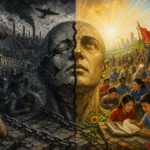
AI depiction of the US working class and the surveillance imposed onto them by the police state. Photo: Weaponized Information.
AI depiction of the US working class and the surveillance imposed onto them by the police state. Photo: Weaponized Information.
By Prince Kapone – Jan 30, 2026
The U.S. economy is generating profits without integrating people into stable life. Domestic labor is being recalibrated through precarity, surveillance, and managed migration. Fortress America turns the hemisphere into a disciplined rear-base of corridors, minerals, and compliant labor. The American Pole and technofascism are one system—an empire tightening the enclosure at home and abroad.
When the Empire Starts Rebuilding the Cage
Every system has a moment when it stops pretending. For decades, the U.S. ruling class sold “freedom” as a universal export and “prosperity” as the natural reward for loyalty. But now the mask is slipping, and we can see the gears: a society where wealth accelerates upward like a rocket while life on the ground feels heavier, meaner, more surveilled, and more fenced in. This is not an accident. It is not simply the mood swings of a bad administration. It is the political economy of a declining imperial core reorganizing itself for a harsher era—an era where the empire can no longer buy consent the way it used to, and where it must increasingly manufacture obedience instead.
The core claim of this essay is simple, but it cuts against the liberal fog machine. What we are witnessing is not “authoritarian drift.” It is not an unfortunate detour from an otherwise healthy democracy. It is a structural transition in the relationship between labor, surplus, and social stability inside the imperial core. In plain terms: the empire’s old bargain is breaking down. The system is capturing more wealth at the top while absorbing fewer workers into stable life at the bottom. And when a capitalist order can no longer integrate people through expanding material conditions, it moves toward containment—through policing, border regimes, surveillance, and ideological discipline. That is the logic of technofascism as we use the term: monopoly-finance capital in decay fusing with the security state and the digital apparatus to govern an increasingly surplus, fragmented, and potentially rebellious population.
You can see the outline of this transition in the cold numbers. Labor’s share of national income has been pushed down to levels that would make an old robber baron blush, while corporate profits rise into record territory like a tide that never reaches the shore. Billionaire wealth swells beyond comprehension as the bottom half of households are told to be grateful for crumbs and motivational speeches. This is not merely inequality as a moral problem. It is inequality as a structural feature: the upward transfer of surplus paired with a tightening state apparatus designed to manage the human fallout of that transfer. When capital wins more and labor receives less, the gap must be filled with something. If it cannot be filled with rising wages and stable futures, it is filled with fear, discipline, and force.
This is why the growth of the border regime and the growth of the surveillance regime are not side stories. They are not “culture.” They are not merely “security.” They are governance adapting to material conditions. A society built on imperial plunder once had enough surplus to keep large parts of the settler population pacified—through cheap credit, cheap commodities, and the soft bribes of consumer life. But imperial decline changes the arithmetic. The empire’s global extraction machine faces more resistance abroad and more contradiction at home. Multipolarity is not just a diplomatic slogan; it is a material problem for an empire whose power depended on being the universal gatekeeper of trade, finance, technology, and legitimacy. As that gatekeeping weakens, the ruling class seeks to lock down what it can still control: the domestic population and the hemisphere it has long treated as its backyard.
So we need to name the process with the clarity it deserves: domestic labor recalibration. By this we mean the strategic restructuring of the workforce’s size, composition, and discipline under conditions where the system can no longer absorb labor the way it once did, where automation eats jobs while calling itself innovation, and where global labor arbitrage is increasingly constrained by geopolitical fracture. Recalibration is not a conspiracy theory; it is a ruling-class adjustment. It appears as policy: weakening unions, crushing strategic strikes, expanding precarious work, tightening eligibility for social survival, and weaponizing immigration status as a lever over wages. It appears as technology: algorithmic management, biometric tracking, productivity surveillance, and the conversion of workplaces into monitored zones where the boss has a stopwatch and the state has a database.
And it also appears—crucially—in mass deportations and the militarization of migration. Liberal commentary often treats deportations as pure reactionary theater, and reactionary they are. But reactionary policies can still have rational functions for capital. When millions are expelled or deterred, labor is not simply removed from the U.S. labor market; it is forcibly redistributed into more precarious economies across Central and South America, expanding the reserve army of labor where U.S. corporations and allied comprador elites want to deepen nearshoring and restructured supply chains. Deportation becomes a hemispheric labor policy. It pressures wages downward in the very countries being positioned as low-cost workshops of the American Pole. It undermines popular nationalist development efforts that modestly raise wages and strengthen bargaining power. And it strengthens U.S. leverage over states whose economies become more dependent on compliant labor regimes, remittance flows, and security cooperation.
This is where the internal and external sides of the story fuse into one system. The American Pole is the outward architecture of the same crisis-management project. Fortress America is not a metaphor; it is a strategy of imperial consolidation in the context of western decline. As Washington loses the ability to command the whole planet, it tightens its grip on the hemisphere—over ports, corridors, minerals, energy flows, data networks, and compliant governments. Domestic labor recalibration is the internal discipline required to sustain that outward project; hyper-imperialist recalibration is the external reorganization of the hemisphere into a controlled rear-base for confrontation with rivals, above all China. The empire is shrinking, but it is not becoming gentle. It is becoming more concentrated, more coercive, and more willing to turn every tool—law, money, technology, borders, police—into a weapon.
If this sounds grim, good. Reality is grim. But clarity is not despair. Clarity is the beginning of strategy. The task of Weaponized Information is not to mourn the death of imperial myths but to expose the material anatomy of the new regime being built in their place. When the empire starts rebuilding the cage, we should not ask whether the bars are polite. We should ask who built it, who profits from it, how it functions, and where it can be broken. That is what the rest of this essay will do: trace the economic base driving this transition, map the mechanisms of labor recalibration, and show how technofascism is the political form emerging to govern the crisis—at home, and across the hemisphere the empire is trying to lock into its American Pole.
Growth Without Workers, Profits Without Peace
If you listen to the evening news or read the financial press, you might think the U.S. economy is a stubborn success story. Growth numbers flash green, stock indexes climb like ivy on a crumbling wall, and politicians congratulate themselves for “resilience.” But resilience for whom? Underneath the surface of headline growth lies a different reality: an economy that expands in value but contracts in its ability to absorb human beings into stable, dignified life. This is the economic base of domestic labor recalibration — a system still generating profit, but doing so in ways increasingly detached from broad employment, rising wages, and social reproduction.
Start with where the gains are going. Corporate profits have surged to historic highs, while labor’s share of national income has been pushed down toward record lows. Productivity continues its long march upward, powered by automation, logistics optimization, and digital control systems. But median compensation limps along far behind. Workers are producing more value per hour than ever, yet receiving a shrinking slice of what they create. In earlier phases of U.S. capitalism, rising productivity was partially translated into higher wages, broader homeownership, and expanding social programs — the material basis for social stability in the imperial core. Today, that translation mechanism is breaking down. The surplus flows upward into profits, dividends, and buybacks, not outward into mass prosperity.
Even inflation — which mainstream voices often blame on workers, migrants, or mysterious “supply shocks” — has carried a different signature in recent years. A significant share of price increases has been driven by expanded corporate profit margins rather than runaway wage growth. In plain language: firms used crisis conditions to raise prices beyond cost increases, protecting and expanding profitability while households absorbed the hit. This is not a glitch; it is a class relation. Capital protects its returns first and lets labor adjust through higher rents, higher food bills, and higher debt burdens. The result is an economy that grows on paper while everyday life becomes more precarious for the majority.
Industrial policy, widely celebrated as a renaissance of state-led development, reveals the same contradiction. Massive public subsidies have flowed into semiconductor plants, battery factories, and “strategic” manufacturing under programs like the CHIPS and Science Act. But the jobs picture is more complicated than the ribbon-cutting ceremonies suggest. These new facilities are among the most automated in history. They require highly specialized technical labor in relatively small numbers, not the mass industrial workforce of the twentieth century. Even as billions are invested, analysts warn of labor shortages in narrow skill categories while overall employment gains remain modest. Capital investment surges; broad labor integration does not keep pace. The factory returns, but as a fortress of machines with a skeleton crew.
This is not a failure of policy; it is a reflection of structural limits. U.S. capitalism is trying to rebuild industrial capacity for reasons of geopolitical competition and supply-chain security, not because it has rediscovered love for the working class. The goal is resilient production, not mass employment. From the standpoint of monopoly capital, a highly automated plant is ideal: fewer workers to organize, fewer wages to pay, more predictable output. From the standpoint of society, however, this deepens the core contradiction. Investment rises without a proportional expansion of stable jobs. Growth detaches further from livelihoods.
At the same time, union power remains historically weak relative to the scale of corporate concentration. Union density has fallen to levels not seen since before the New Deal, even as surveys show tens of millions of workers would join a union if they could. This gap between desire and reality is not accidental; it is produced through aggressive anti-union campaigns, legal obstacles, and state interventions that prioritize “supply chain stability” over workers’ bargaining power. When rail workers threatened to strike, federal authority moved swiftly to block them in the name of economic security. The message was clear: when labor action conflicts with the smooth functioning of capital, the state will step in on behalf of the latter.
Mainstream think tanks register these developments, but through a different lens. Where workers see exploitation, policy analysts speak of “skills mismatches” and “labor market frictions.” Where communities experience wage stagnation, reports call for “upskilling” and “workforce development” to meet the needs of strategic industries. Even the more liberal institutions frame the problem primarily as one of competitiveness: how to ensure the U.S. has the right labor inputs to win great-power competition. The distribution of power between capital and labor is treated as background noise. The upward redistribution of surplus is normalized as an economic fact, not a political choice.
This is the heart of the crisis of surplus absorption. Capital continues to generate and capture enormous wealth, but has shrinking outlets for productive, labor-intensive reinvestment that also stabilize society. Instead, surplus is funneled into financial speculation, stock buybacks, luxury real estate, and the defense sector. Wall Street inflates asset values; the Pentagon absorbs trillions in public spending; tech platforms monetize attention and data. These are effective for profits, but weak at integrating people into secure, socially useful roles. The economy becomes top-heavy, like a tree with lush branches and rotting roots.
Under these conditions, domestic labor recalibration becomes a structural necessity from the standpoint of the ruling class. If the system cannot absorb everyone into stable employment with rising living standards, it must manage a growing population that is partially surplus to its needs. Some will be pulled into narrow high-skill sectors; others will circulate through precarious gig work, temp contracts, and informal hustles; many will hover at the edge of unemployment, debt, and state supervision. The old promise — work hard and you will rise — is replaced by a new reality: work constantly just to avoid falling. This is not simply inequality. It is a reorganization of the social role of labor itself in a stagnating imperial core.
And when the economic base takes this form — profits without proportional employment, growth without broad security, productivity without shared gains — the superstructure cannot remain liberal in the old sense. A society that no longer integrates through rising material conditions must increasingly govern through discipline. The numbers are not just statistics; they are signals. They tell us that the system is shifting from expansion to containment, from incorporation to management. The next step in the story, then, is to look directly at the mechanisms of that recalibration — how labor is being reshaped, divided, and controlled to fit the needs of a system that has more capital than it knows what to do with, and more people than it wants to fully include.
Recalibrating the Workforce: Who Is Kept, Who Is Cast Out, Who Is Controlled
If Part II exposed the economic ground shifting beneath our feet, Part III names the process taking shape on that unstable terrain. Domestic labor recalibration is not a slogan; it is a structural response by capital to a world in which it can no longer promise mass prosperity at home while extracting superprofits abroad without resistance. The imperial core is no longer expanding fast enough to absorb everyone into stable employment, yet it still requires labor — just not in the same numbers, forms, or conditions as before. The result is a deliberate reorganization of who gets integrated, who gets marginalized, and how everyone else is disciplined.
First, consider the tightening vise around labor’s share of the social product. Even during periods of growth, real wage gains have trailed behind profit expansion. Corporate margins have proven far more flexible than workers’ paychecks, rising aggressively during crisis periods and remaining elevated afterward. Meanwhile, union density has sunk to levels that would have shocked even the robber barons of the early twentieth century. Tens of millions of workers express a desire to unionize, yet face legal roadblocks, union-busting campaigns, and drawn-out procedures that exhaust momentum. When workers in strategic sectors push too far — threatening to interrupt the smooth circulation of goods — the state reveals its class character. Strikes are blocked, contracts imposed, and “economic stability” invoked as a higher good than democratic control over working conditions. In this way, suppression of labor’s share is not just a market outcome; it is a political project, backed by law, courts, and executive power.
Second comes selective inclusion and exclusion — the careful management of who is allowed into the labor market, under what terms, and with what degree of security. Immigration policy offers a sharp illustration. On one side, millions of migrant workers have entered the labor force in recent years, filling gaps in agriculture, logistics, care work, and tech. On the other side, deportation regimes expand, border zones militarize, and legal statuses become more precarious. The message is contradictory only on the surface. The system wants labor power, but in forms that are flexible, deportable, and politically fragmented. A worker whose right to remain depends on employer sponsorship or constant legal renewal is easier to discipline than one with full political rights and long-term security. At the same time, the growth of gig platforms and temp agencies multiplies forms of contingent labor inside the country, ensuring that even citizens experience employment as a revolving door rather than a stable footing.
This dual movement — import labor, criminalize labor; recruit workers, keep them insecure — is not confusion. It is calibration. Think tanks discuss “labor supply stabilization” and “strategic visas” for critical sectors, while others call for tighter borders and mass removals. These positions appear opposed, but function together in practice. The labor market is not being opened or closed in a simple sense; it is being tuned. Some categories of workers are pulled in to meet industrial or technological needs, others are pushed out or kept in a state of fear, and the overall effect is downward pressure on wages and upward pressure on compliance. Labor becomes a managed flow, not a social right.
Third, technology enters not only as a tool of production, but as an instrument of discipline. The modern workplace increasingly resembles a command center. Warehouses operate under algorithmic management that tracks movement, speed, and even biometric signals. Delivery drivers are scored, nudged, and penalized by software. Office workers face keystroke monitoring and productivity dashboards. Artificial intelligence systems are introduced to automate tasks, but also to measure workers against ever-shifting performance benchmarks. The point is not simply to replace labor with machines, though that happens too. It is to render remaining labor transparent, comparable, and controllable in real time.
Policy discourse softens this reality with the language of innovation and efficiency. Analysts speak of “digital transformation” and “AI-driven productivity,” acknowledging displacement but promising new opportunities somewhere down the line. Yet even the most optimistic assessments concede that entire categories of routine work are being hollowed out. The new jobs that appear often demand higher skills, greater geographic mobility, and constant retraining — conditions that many workers, especially older or poorer ones, cannot easily meet. Thus, automation functions as both a labor-saving technology and a sorting mechanism, separating a smaller core of highly integrated workers from a larger periphery of precarious or displaced people.
All these mechanisms converge on a single outcome: the workforce is being resized, re-tiered, and re-disciplined. A narrow stratum of highly educated technical workers is cultivated and rewarded, especially in sectors tied to national security and high technology. A broader layer cycles through unstable service, logistics, and care jobs with limited bargaining power. Another segment drifts between informal work, unemployment, debt, and state supervision. The old Fordist dream of stable, long-term employment as a social norm fades into a memory. In its place emerges a stratified labor regime designed for a slower-growing, more conflict-ridden imperial core.
From the standpoint of capital, this recalibration is rational. It reduces labor costs, increases flexibility, and aligns the workforce with the needs of automated production and geopolitical competition. From the standpoint of society, however, it generates chronic insecurity, weakened solidarity, and a growing population that is only partially integrated into the formal economy. These people do not disappear; they become subjects of management rather than participants in shared prosperity. And when more and more of the population must be managed rather than integrated, the line between economic policy and social control begins to blur.
Domestic labor recalibration, then, is not a side effect of technological change or globalization. It is a deliberate reorganization of the social role of labor under conditions of imperial strain. It answers a simple question from the ruling class perspective: if we cannot profitably employ everyone on stable terms, how do we restructure work, movement, and discipline so that accumulation continues and unrest remains containable? The answer, increasingly visible, is a labor market engineered for hierarchy, insecurity, and surveillance — a foundation on which a more openly coercive political order can be built.
When Consent Wears Thin: The Turn from Liberal Management to Open Coercion
Every economic order carries a political form that helps stabilize it. For decades, the United States managed its class contradictions through a mix of consumer credit, modest upward mobility, and the promise that tomorrow would be better than today. That promise is now threadbare. When the system can no longer integrate broad layers of the population through rising living standards, it must rely more heavily on containment. What we are witnessing is not simply polarization or “democratic backsliding,” but a structural shift in governance — from managing consent to managing instability.
The warning signs are written across the legal landscape. In the wake of mass protests and social unrest, state legislatures moved swiftly to narrow the channels of political participation. Waves of new voting restrictions reshaped access to the ballot through tighter ID rules, reduced early voting, purges of voter rolls, and increased partisan control over election administration. These measures are often justified in the language of “election integrity,” but their material effect is clear: participation becomes more difficult for the young, the poor, the precariously employed — precisely those most affected by the economic recalibration described earlier. Democracy remains in form, but its social base is quietly thinned.
At the same time, the right to protest has been progressively fenced in. States expanded “anti-riot” statutes, enhanced penalties for blocking roads or critical infrastructure, and broadened the legal definition of disorderly conduct. What was once framed as the democratic right to assemble is increasingly treated as a public order problem. Demonstrations that challenge corporate power, policing, or austerity are met not only with tear gas and batons, but with preemptive legal tools designed to chill participation. In this climate, dissent becomes something to be managed, monitored, and, when necessary, criminalized.
Security frameworks once aimed primarily at foreign threats have been reoriented inward. The language of “domestic extremism” now circulates widely across federal and state agencies. Fusion centers coordinate intelligence between local police, federal authorities, and private actors. Protest movements, labor actions, and community organizations find themselves analyzed through risk matrices more familiar from counterterrorism doctrine than from civic life. The underlying assumption is telling: social unrest is not a signal that material conditions require change, but a security variable to be contained.
This shift is reinforced by bipartisan political behavior. Despite fierce rhetorical battles, there is remarkable continuity when it comes to funding for police, border enforcement, and intelligence agencies. Budgets for surveillance technology, data analytics, and tactical equipment expand even as social programs face austerity pressures. Corporate donors, momentarily startled by open assaults on electoral norms, quickly return to supporting candidates who promise deregulation, tax advantages, and “law and order.” Stability for markets outweighs fidelity to democratic procedure.
Think tank discourse, stripped of its technical polish, reveals the logic at work. Analysts warn that internal disorder could undermine the country’s ability to compete globally. Social cohesion is framed as a strategic asset; unrest as a vulnerability exploitable by rivals. The conclusion drawn is not that inequality should be reduced or labor empowered, but that institutions must be strengthened to ensure continuity and predictability. In practice, “institutional strength” often means expanded policing powers, broader surveillance, and firmer executive authority.
The border becomes a laboratory for this new mode of governance. Vast resources flow into walls, sensors, drones, biometric databases, and rapid-deportation systems. These tools do not remain confined to the geographic edge of the nation. Technologies and practices developed for migration control migrate inward, finding use in urban policing, workplace verification systems, and data-sharing networks between agencies. The distinction between external security and internal order erodes, replaced by a continuous field of monitoring.
Crucially, this evolution does not announce itself as a break with liberalism. It presents itself as a defense of it. Politicians insist that stronger policing protects freedom, that tighter voting rules defend democracy, that expanded surveillance ensures safety. The language of rights is preserved even as the material capacity to exercise those rights narrows for broad sections of the population. Liberal governance, in this phase, becomes a shell within which a more coercive core develops.
Seen from above, the transformation appears rational. If the economy can no longer guarantee stable livelihoods for all, and if social discontent grows as a result, the state must ensure that discontent does not spill over into systemic disruption. From below, however, the experience is one of shrinking space — for organizing, for dissent, for meaningful participation in shaping collective life. Politics becomes less a forum for resolving social conflicts and more a mechanism for administering them.
The transition from liberal management to coercive governance is thus not an accidental slide. It is the political superstructure adapting to an economic base that produces surplus populations, precarious work, and sharper inequality. As the promise of inclusion weakens, the apparatus of control strengthens. This does not yet resemble open dictatorship; elections continue, courts function, media debates rage. But the balance shifts steadily toward surveillance, restriction, and force as normal instruments of rule. In that sense, the path toward a mass surveillance police–military state is paved not by sudden rupture, but by the cumulative normalization of exceptional measures in the name of stability.
Smoke, Mirrors, and Manufactured Enemies: How Ideology Softens the Blow
A system that takes more from working people while giving them less cannot survive on police budgets alone. It also needs stories — loud, emotional, distracting stories that turn anger sideways instead of upward. As domestic labor recalibration deepens and living standards stagnate, ideological management becomes a central task of the state. The goal is simple: prevent class consciousness from forming by saturating public life with cultural battles that feel urgent but leave the economic order untouched.
Across the country, political energy is redirected into carefully staged moral panics. School curricula, gender identity, immigration fears, crime waves, “wokeness,” and patriotic symbolism dominate headlines and legislative sessions. Meanwhile, wages trail productivity, rents swallow paychecks, medical debt grows, and workplace surveillance tightens. The spectacle of cultural conflict functions like a smoke machine on a stage: it fills the air so thoroughly that the machinery moving behind the curtain becomes harder to see.
One of the clearest examples is the wave of restrictions on how race, inequality, and history can be discussed in classrooms. Dozens of states have introduced or passed laws narrowing what teachers can say about systemic racism or historical injustice. These moves are framed as protecting children or preserving national unity, but their deeper function is to block analytical tools that help people understand exploitation and power. A population discouraged from examining the structural roots of inequality is easier to govern when inequality sharpens.
The same pattern appears in the backlash against diversity, equity, and inclusion programs. Corporations and universities that once promoted DEI as a harmless gesture of inclusion now retreat under political pressure. The ruling class is not suddenly allergic to diversity; it is recalibrating ideological strategy. During a phase of contraction, symbolic concessions become expendable. What matters more is consolidating a disciplined social base that can be rallied around nationalism, order, and resentment rather than redistribution or workplace power.
Culture war politics also fragment potential solidarity across lines of race, gender, and immigration status. Instead of seeing common cause against rising rents or precarious employment, workers are encouraged to see one another as threats — competitors for jobs, benefits, or recognition. Migrants are blamed for wage stagnation; urban communities are blamed for crime; youth are blamed for moral decline. Each narrative directs frustration away from the concentration of wealth and power and toward other segments of the working and oppressed classes.
Media ecosystems amplify this fragmentation. Outrage cycles move at high speed, with social platforms and cable news channels monetizing emotional reaction. The attention economy thrives on polarization because polarization keeps people engaged while obscuring shared material interests. A worker who spends hours arguing online about cultural flashpoints has less time and energy to organize at the workplace, attend a union meeting, or analyze why their real wages have barely moved in years.
At the institutional level, this ideological fragmentation is paired with a quiet hardening of political structures. Corporate funding patterns show continuity across partisan lines when it comes to core priorities: defense spending, border enforcement, policing, and corporate tax policy. Candidates who support these pillars remain well financed even if they undermine democratic norms. The message is subtle but clear: stability for capital matters more than procedural democracy when the two come into tension.
Think tanks rarely address this ideological battlefield directly, yet their frameworks implicitly rely on it. Reports speak of “social cohesion,” “national resilience,” and “public trust” as strategic assets. But cohesion is imagined not as shared prosperity or worker empowerment, but as alignment behind national goals defined from above. Division is lamented only insofar as it threatens economic performance or geopolitical standing, not because it reflects deepening class inequality.
In this environment, elections still occur, debates still rage, and freedom of speech is loudly celebrated. But the range of economically transformative options narrows. Policies that would significantly redistribute wealth, strengthen labor power, or demilitarize budgets struggle to gain institutional traction. The political arena becomes a theater where cultural identities clash while the underlying structure of accumulation remains largely undisturbed.
Ideology, in this sense, acts as a pressure valve. It releases social tension in symbolic forms that do not challenge the economic base. Anger finds expression in battles over statues, slogans, and school boards rather than in coordinated demands for shorter workweeks, higher wages, public housing, or workplace democracy. The system permits loud arguments about who belongs, but resists serious challenges to who owns.
For a ruling class navigating decline, this is efficient governance. As long as working people are divided and emotionally invested in symbolic conflicts, the harder realities of labor recalibration — stagnant wages, precarious employment, intensifying surveillance, shrinking public goods — can advance with less unified resistance. The cultural battlefield, then, is not a distraction from political economy; it is one of the key terrains on which the political superstructure is stabilized during a period of tightening material conditions.
When Silicon Wears a Badge: The Political Form of Technofascism
By the time we reach this stage of the transition, the pieces stop looking accidental. Industrial policy wrapped in national security. Immigration managed like a labor input. Automation celebrated while jobs disappear. Surveillance normalized in the name of safety. Corporate power fused with state planning. None of this is a glitch. It is a new political form growing out of a stressed economic base. Not a break from capitalism — capitalism tightening its belt, hardening its face, and wiring itself to machines. This is what we are calling technofascism.
Let’s be clear and throw the academic cushions out the window. We are not talking about goose-stepping uniforms or old European scripts copied and pasted. We are talking about a mass surveillance police-military state built through digital infrastructure, corporate platforms, data extraction, and algorithmic management. The boardroom, the server farm, and the security agency are no longer separate buildings. They are rooms in the same house.
Look at how ruling-class policy thinking lines up. Industrial strategy is no longer about general prosperity; it is about “strategic sectors,” “resilience,” and “competition with adversaries.” That means public money, private profit, and labor discipline all pointed toward defense, chips, AI, energy, logistics. Think tanks across the spectrum — from RAND to CSIS to Brookings — agree on this core: the economy must be reorganized to serve long-term geopolitical rivalry. When the economy becomes a war-prep platform, society follows.
At the same time, immigration policy is treated less as a human question and more as workforce engineering. Some flows are welcomed, others criminalized, depending on sectoral demand and political optics. Migrants become a pressure valve for labor shortages and a scapegoat when wages stagnate. Deportations, visa programs, border militarization, and guest-worker schemes operate together as tools for calibrating labor supply, not expanding rights. Human mobility is managed like inventory.
Automation and artificial intelligence enter the picture not as neutral progress but as instruments of control. In warehouses, trucks, offices, and delivery platforms, algorithms track productivity down to the minute. Facial recognition, keystroke logging, route optimization, and biometric systems turn the workplace into a data mine. The promise sold to the public is efficiency; the reality for workers is tighter supervision, speed-up, and a thinner margin for error or resistance.
Meanwhile, the same technologies flow outward into policing and border enforcement. Predictive policing tools map “risk” onto neighborhoods already marked by poverty and racialized surveillance. Drones, sensors, and databases extend the reach of the state across deserts and city blocks alike. Border regions become testing grounds where tech firms pilot systems that later migrate inward. The line between foreign and domestic security blurs until it almost disappears.
This convergence is not happening in secret. Policy papers openly link internal stability to great-power competition. They argue that a divided, unrest-prone society is a vulnerability. The solution offered is not deep redistribution or worker empowerment; it is resilience through control — stronger security institutions, better data integration, closer partnerships between government and tech companies. Stability is defined as the smooth functioning of markets and supply chains, not the well-being of the people who keep them running.
In this arrangement, democracy does not vanish overnight. It thins. Formal rights remain on paper, but material power concentrates further upward while surveillance capacity expands downward. Elections continue, but the economic options on the table narrow. Media debates rage, but the core alignment of monopoly capital, security agencies, and technology platforms stays remarkably consistent. The system learns to manage dissent, not eliminate it — to monitor, channel, and contain rather than persuade.
Technofascism, then, is not an ideology first. It is a management strategy for a period when the old social contract cannot be maintained. When broad prosperity is off the table, consent must be manufactured through nationalism, fear, and digital mediation, while compliance is ensured through data-driven oversight and an ever-present security apparatus. The velvet glove of consumer choice wraps around the iron hand of algorithmic discipline.
For the working class, this means the terrain of struggle shifts. The boss is no longer just a supervisor; it is a software system. The cop is no longer just on the corner; he is in the database. The border is no longer just a line on a map; it is a network of sensors and contracts stretching deep into everyday life. Resistance has to adapt accordingly — linking workplace organizing to fights over data rights, surveillance, automation, and public control over technology.
Strip away the branding, and the pattern is blunt. Monopoly capital needs new tools to manage a tighter labor market, thinner margins of legitimacy, and a more volatile world. The state needs new tools to maintain order without the cushion of rising living standards. Digital technology provides those tools. Technofascism is what happens when they are fused into a governing model.
This is not the end of struggle. It is the sharpening of its edges. Because the same networks that track and discipline can also connect and inform. The same workers squeezed by algorithms can organize across warehouses, platforms, and borders. The same communities targeted by predictive policing can build alliances that expose and resist it. The political form of technofascism is rising — but so too is the possibility of a new, more technologically literate, more strategically coordinated resistance rooted in the lived reality of this new system.
Yet this domestic fusion of capital, state, and tech is inseparable from—and sustained by—the external reorganization underway in the hemisphere.
The Pole and the Cage: How Hemispheric Fortress Fuels Domestic Technofascism
Technofascism, then, is not just a domestic mutation of liberal democracy under stress. It is the internal political form of a system that is also reorganizing itself externally. The same ruling class that wires the workplace, fuses tech with policing, and normalizes algorithmic oversight at home is simultaneously redesigning the geopolitical environment in which that system must survive. Industrial policy, border militarization, and AI-driven labor control are not self-contained responses to domestic crisis; they are the inner gears of a larger imperial recalibration. To understand why the surveillance state is expanding, why labor is being tiered and disciplined, and why insecurity is becoming a permanent condition, we have to look outward—toward the hemispheric fortress being built to stabilize these changes.
Because the United States is not simply hardening internally; it is contracting strategically. As global dominance becomes harder to sustain in a multipolar world, the empire shifts from universal manager to regional enforcer. That shift reshapes everything. The Western Hemisphere is recast as a controlled rear-base, a secured zone of labor, resources, logistics corridors, and compliant governments meant to underwrite long-term rivalry with other great powers. And once that external consolidation begins, it feeds directly back into domestic governance: labor must be disciplined to match fortress supply chains, migration must be managed as workforce engineering, and surveillance must scale to contain the social fallout. What looks like a national turn toward technofascism is inseparable from this hemispheric turn toward Fortress America.
To understand what is happening inside the United States, we have to stop treating “the homeland” and “foreign policy” like two separate rooms in the same house. They are the same room—just viewed from different doors. Domestic labor recalibration is the inner architecture of a system that is tightening. The American Pole is the outer scaffolding holding that tightening structure in place. And Fortress America is the shared method: when an empire in decline can’t govern by abundance, it governs by constraint—locking down movement, locking down resources, locking down dissent, and locking down the terms on which working people can survive.
This is the feedback loop liberal analysis keeps missing. The United States does not securitize migration because it suddenly developed a passion for border paperwork. It securitizes human movement because labor is one of the last great levers the ruling class can still pull in a period of imperial contraction. And it doesn’t pull that lever only inside the U.S. labor market. It pulls it across the hemisphere. The deportation flight, the detention contract, the visa bottleneck, the militarized checkpoint—these aren’t disconnected scenes. They are components of a regional labor regime, built to keep wages low, keep bargaining power fragmented, and keep the reserve army of labor circulating in the direction most profitable to capital.
When masses of workers are expelled or deterred, labor power is not simply “removed” from the U.S. economy. It is pushed into more precarious economies across Central and South America—exactly where the empire is trying to deepen nearshoring, restructure supply chains, and build a disciplined rear-base for confrontation with rivals. That is why mass deportation is never just reactionary theater. It is workforce engineering with a badge on it. It exports surplus labor southward, cheapens nearshore production for U.S.-aligned monopolies, and reinforces dependency in states pressured to absorb the fallout. Then, in the other direction, the system selectively imports labor back in—often under statuses that are conditional, revocable, employer-tethered, and therefore perfectly designed for compliance in agriculture, logistics, care work, and the lowest-rung sectors that keep the imperial core functioning.
This is what “Fortress America” really means. It isn’t only walls and speeches. It is the conversion of an entire hemisphere into managed space: ports, corridors, minerals, energy routes, data pathways, and compliant governments arranged like pieces on a board. “Homeland security” becomes hemispheric war-planning, and the rhetoric of “invasion,” “narco-terror,” and “border emergency” becomes the moral alibi that launders old imperial doctrine into new administrative language. Yesterday it was “communism.” Today it is “narco-terrorism.” Same function: turn political disobedience into criminality, and criminality into permission for siege.
The doctrine itself signals this shift. The 2026 National Defense Strategy frames border security as national security, calls for coordinated deportation and border sealing, and elevates control of “key terrain”—including the Panama Canal, the Gulf of America, and Greenland—as core strategic priorities. It criticizes the post–Cold War era for outsourcing industry and opening borders, explicitly linking those choices to internal vulnerability and external rivalry. This is not the language of a confident global manager. It is the language of consolidation—of an empire redefining its minimum viable zone of control.
Now watch how this external consolidation boomerangs inward. The technologies used to police the hemisphere do not stay at the border. They migrate into workplaces, cities, and everyday life. Drones, biometrics, predictive analytics, data integration, fusion-center logic—first normalized in border zones and counterinsurgency theaters, then redeployed domestically under the banners of “efficiency” and “public safety.” What begins as counterinsurgency logistics at the edge becomes algorithmic management in warehouses and predictive policing in neighborhoods, turning hemispheric war-prep tools into domestic labor-discipline infrastructure.
This is also why labor discipline and geopolitical strategy increasingly speak the same language. “Resilience,” “supply chain security,” “strategic sectors,” “critical infrastructure”—these terms are not neutral. They are the vocabulary of a war-prep economy. When production is reorganized for long confrontation, workers are treated less like citizens and more like inputs. The state and capital want high-output logistics with low-disruption labor. They want automated plants with skeleton crews. They want gig workers that can be tracked, scored, and replaced. They want unions weak enough that “economic stability” can be invoked to crush strikes the moment circulation is threatened. In short: they want a workforce calibrated for a fortress economy—disciplined, tiered, surveilled, and permanently unsure of its footing.
So the American Pole is not “foreign policy” running beside domestic technofascism like a parallel track. It is the track. Hemispheric consolidation creates the external conditions for domestic labor recalibration: cheaper labor reservoirs abroad, friend-shored corridors controlled by compliant regimes, resource flows protected by coercion, and rivals denied durable footholds. And domestic technofascism creates the internal conditions for hemispheric consolidation: a population managed for instability, dissent pre-empted by surveillance, and work reorganized for strategic rivalry rather than human need.
This is why the fortress metaphor matters. The structure is being rebuilt from both ends. The bars are economic—profit without broad employment, productivity without shared gains, debt as a leash. The bars are political—restricted protest, criminalized disruption, tightened voting access where it threatens power. The bars are technological—algorithmic management at work, predictive policing in neighborhoods, biometric identity regimes at the border. And the bars are hemispheric—sanctions, corridor control, chokepoint strategy, “security cooperation” that functions as counterinsurgency logistics. Different materials. One enclosure.
And yet every enclosure built in a hurry shows its seams. A fortress that must police movement across a hemisphere is confessing weakness, not strength. A labor regime that relies on insecurity and surveillance is admitting it can no longer integrate people through rising life. A doctrine that collapses “homeland” into “hemisphere” is saying the global grip is slipping—and the base is being hardened. That is the contradiction. The empire digs in, but digging in creates pressure. Pressure creates learning. Learning creates organization. The same networks used to monitor can be used to connect. The same corridors built for capital can become choke points for labor. The same attempt to discipline the hemisphere can generate new solidarities across it.
This is what clarity is for. Not despair. Strategy. Once the Pole and the enclosure are seen as one system, the fights stop looking isolated. The strike and the deportation raid become connected. The warehouse algorithm and the border biometric become connected. The sanctions regime and the rent hike become connected. The American Pole is not simply a map of empire abroad. It is the exterior wall of a domestic order that is hardening. Fortress America is not a slogan. It is a construction site. And technofascism is the political form rising to run it.
Surplus People in a Surplus System: Why Recalibration Becomes Survival Strategy
By now the pattern should be visible without a magnifying glass. The system is not simply being governed differently; it is being stabilized differently. What we have been calling domestic labor recalibration is not a side effect of bad leadership or partisan dysfunction. It is a survival strategy for an imperial economy that can no longer grow its way out of contradiction. When surplus can’t be expanded smoothly, populations themselves begin to be treated as surplus.
In earlier phases of U.S. capitalism, expansion provided breathing room. New industries, new suburbs, new markets abroad, and new credit cycles helped absorb labor, raise expectations, and keep social peace. The empire could export its contradictions — through offshoring, financialization, and military dominance — while still maintaining the illusion of shared prosperity at home. That model is breaking down. Growth continues in numbers, but it narrows in distribution. The gains concentrate upward while insecurity spreads outward.
This is where domestic labor recalibration enters as a form of imperial self-preservation. If the system cannot profitably employ everyone at rising wages, it must reorganize how people are used, where they are located, and how they are controlled. Some workers are integrated into strategic sectors tied to national security and industrial policy. Others are pushed into precarious service, gig, and informal roles. Still others are warehoused through prisons, marginalized through criminalization, or cycled in and out of the labor market through immigration enforcement and deportation regimes.
From the standpoint of capital, this is rational. A leaner, more flexible workforce reduces costs and increases leverage. A pool of insecure labor disciplines those still employed. Automation shrinks payrolls while raising productivity. Deportations and border controls reshape labor markets across the hemisphere, replenishing cheap labor pools abroad and reinforcing dependence on U.S.-aligned supply chains. Each move appears separate, but together they form a coherent adjustment to tighter global margins and sharper geopolitical rivalry.
From the standpoint of working people, it feels like permanent instability. Jobs become gigs, careers become contracts, neighborhoods become zones of policing, and futures become harder to imagine. Housing, healthcare, and education grow more expensive even as work becomes less predictable. The promise that hard work leads to stability loses credibility, and with it the ideological glue that once held the system together.
This is why the coercive superstructure grows alongside the economic recalibration. A population that cannot be fully integrated through rising living standards must be managed through surveillance, policing, and ideological containment. The mass surveillance police-military state is not an overreaction; it is the administrative arm of a system learning to govern insecurity rather than eliminate it. Where growth once did the work of pacification, now data and force take a larger share.
Technofascism becomes the political form that ties these threads together. It offers a story of national revival and security while quietly normalizing deeper inequality and tighter control. It fuses monopoly capital with state planning, digital technology with law enforcement, and patriotic rhetoric with austerity in practice. It promises order in a time of anxiety, even if that order rests on narrower opportunities and wider surveillance.
Seen in this light, domestic labor recalibration is not a temporary phase. It is the internal mirror of imperial recalibration abroad. Just as the United States tightens its grip on the hemisphere through the American Pole strategy, it tightens its management of labor and dissent at home. External contraction and internal discipline move together. The same system that cannot tolerate autonomous development in Latin America struggles to tolerate autonomous power among workers inside its own borders.
But history does not end with recalibration. Every attempt to stabilize exploitation creates new contradictions. A workforce pushed into precarity also becomes harder to predict and easier to radicalize. Communities subjected to constant surveillance develop new forms of solidarity and resistance. Migrants, workers, and youth tied together by digital networks can organize in ways previous generations could not. The tools of control are real, but so are the capacities for collective action.
If domestic labor recalibration is the system’s strategy for surviving decline, then the task for working people is to turn that survival strategy into a point of rupture. To connect fights over wages to fights over surveillance. To link struggles against deportation to struggles against union busting. To see the prison, the warehouse, the border, and the data center as connected sites of the same political economy. Only by recognizing the totality of the recalibration can a counter-project emerge with enough clarity and strength to challenge it.
The ruling class is reorganizing society to preserve its power in a harsher world. The question that remains is whether the people forced to live under that reorganization will accept the new terms — or whether they will use the very pressures of recalibration to forge a different future beyond the shrinking horizons of empire.
From Recalibration to Rupture: Where the System Shows Its Seams
Every system that tightens its grip reveals, at the same time, where its hands are weakest. Domestic labor recalibration is meant to stabilize a shrinking imperial order, but in doing so it exposes the very fault lines that make that order fragile. The more society is reorganized around insecurity, the harder it becomes to sustain legitimacy. The more life is governed through surveillance and coercion, the clearer it becomes that consent is thinning out. Recalibration, meant to preserve the system, also lays the groundwork for its rupture.
Start with work. A labor force fragmented into gigs, contracts, temp assignments, and algorithmically managed shifts is easier to exploit, but harder to bind ideologically. When jobs no longer promise stability, the old social contract — work hard, play by the rules, move up — loses its persuasive power. Workers who once saw themselves as future homeowners or small business owners increasingly experience themselves as disposable inputs in someone else’s platform. That shift in lived reality is not just economic; it is political. It breeds distrust in institutions that seem designed to protect capital, not people.
Then look at debt. Student debt, medical debt, credit card debt, housing debt — these function as quiet chains, binding millions to precarious employment. But chains also create shared conditions. A generation that enters adulthood already burdened by debt is a generation less invested in defending a system that offers little relief. When repayment becomes a permanent horizon, the legitimacy of the arrangement itself comes into question. The system depends on debt to stabilize consumption, yet that same debt undermines faith in the system’s fairness.
Add to this the expansion of surveillance. The workplace is monitored, the border digitized, the city mapped through cameras and predictive algorithms. The state presents this as security, efficiency, modernization. But people experience it as scrutiny without support, oversight without care. When every action is tracked while basic needs remain uncertain, the promise of freedom rings hollow. The tools designed to preempt unrest also signal to the population that they are being governed as potential threats rather than as participants in a shared project.
This is the contradiction at the heart of the mass surveillance police-military state. It seeks to manage instability without resolving its causes. It polices symptoms while preserving the structure that generates them. But repression without reform does not produce long-term stability; it produces simmering discontent. Each new layer of control confirms what people increasingly suspect: that the system can find money for drones, databases, and detention centers, but not for healthcare, housing, or dignified work.
Meanwhile, the international dimension seeps back into domestic life. Workers are told to tighten their belts for the sake of competition with China, to accept austerity in the name of national strength, to see migrants as threats rather than fellow laborers. The language of geopolitics is used to justify downward pressure on wages and upward pressure on discipline. But when great-power rivalry becomes an excuse for everyday hardship, patriotism loses some of its adhesive power. People begin to ask: strength for whom, and at whose expense?
All of this creates a volatile mix. A population that is more educated than ever, more connected than ever, and more economically insecure than ever is not a docile one. Digital networks that enable surveillance also enable communication and organizing. Supply chains that integrate continents also create choke points where workers can exert leverage. Communities pushed to the margins often develop the deepest traditions of mutual aid and resistance. The same conditions that make recalibration necessary for the ruling class make collective action more thinkable for everyone else.
Rupture does not arrive on schedule. It builds through small refusals, local fights, and unexpected alliances. Warehouse workers linking with delivery drivers, students linking with adjunct faculty, migrants linking with citizen workers, tenants linking with unhoused neighbors — these are the social forms that grow in the cracks of recalibrated capitalism. Each struggle over a contract, a rent hike, a deportation order, or a police budget is also a struggle over the kind of society that emerges from imperial decline.
Cubans Denounce the Presence of the US Chargé D’Affaires After Interventionist Action
The system hopes to manage decline through tighter control and narrower distribution. But history shows that periods of contraction can also be periods of imagination. When the old promises fade, space opens for new ones. When the state reveals its coercive core, illusions about neutrality and fairness fall away. The very clarity produced by crisis can accelerate political learning on a mass scale.
Domestic labor recalibration is designed to make a harsher world livable for capital. Its unintended consequence may be to make that world intolerable for those who live by their labor. And when enough people reach that conclusion, recalibration stops being a strategy of stabilization and becomes the prelude to transformation. The seams are already visible. The question is not whether contradictions will sharpen, but whether the forces gathering along those seams can turn pressure into organized power.