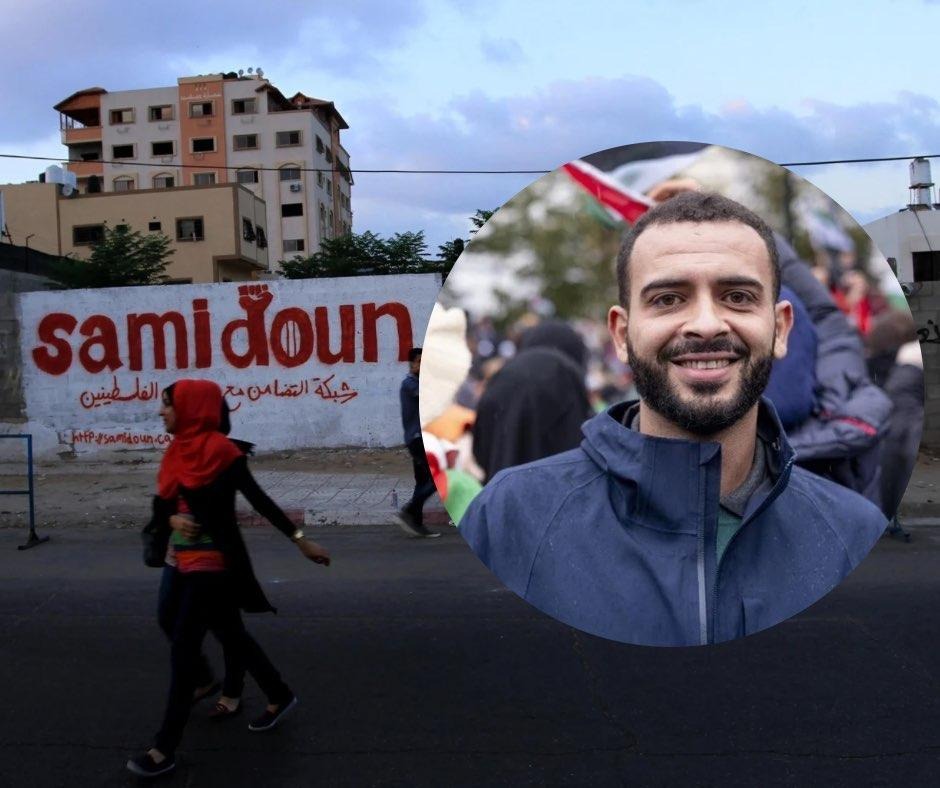
Photo composition: in the foreground Mohammed Khatib and in the background the wall painted with graffiti that says Samidoun. Photo: Samidoun Network.
Photo composition: in the foreground Mohammed Khatib and in the background the wall painted with graffiti that says Samidoun. Photo: Samidoun Network.
By Samidoun – Feb 9 , 2026
“Samidoun… the Voice of the Prisoners and Their Arm in the Diaspora” is the title of an article written by comrade Mohammed Khatib three years ago in Al-Akhbar newspaper.
Mohammed is the son of the displaced village of al-Mallahah, occupied in 1948, and the son of Ain al-Hilweh refugee camp. Today, he is imprisoned in a Greek jail on the island of Crete. In this article, he sheds light on the importance of the role played by the Samidoun Palestinian Prisoner Solidarity Network, and its role in supporting Palestinian prisoners and their causes.
We republish this article today because of its direct relevance to Mohammed’s own case of detention, and because it represents a living testimony to the experience of imprisonment and the ongoing struggle for freedom, and in order to reinvigorate the role of our people in the camps and across the diaspora.
Samidoun: The Voice of the Prisoners and Their Arm in the Diaspora
Mohammed Khatib
Friday, 17 February 2023
Two years ago, specifically in February 2021, the so-called Zionist entity’s minister of war, Benny Gantz, placed the Samidoun Network on the so-called “terrorist list.” So who is this network, and why has it received such attention?
The Samidoun Palestinian Prisoner Solidarity Network, known simply as “Samidoun,” was founded in 2011 in Canada. Over time, it has become one of the most important international–Palestinian organizations confronting the Zionist movement outside occupied Palestine. Its first officially founding activity was in solidarity with Sheikh Khader Adnan, who at the time was waging an open hunger strike.
Today, Samidoun includes in its ranks hundreds of international supporters from approximately 20 countries, as well as dozens of Palestinian and Arab youth who have found themselves new refugees in several European capitals, extending to North and South America, as a result of wars, displacement, and siege in their countries—especially over the past ten years.
Organizing Identity
Samidoun presents a revolutionary model in organizational, militant, and popular work in the diaspora. This experience is distinguished by the nature and identity of the network and by the diversity of its Palestinian, Arab, and international cadres. Over years of work, a deeply rooted conviction has crystallized: that the struggle for the freedom of Palestinian, Arab, and international prisoners, and for the liberation of Palestine from the river to the sea, means a radical transformation in the region and the world—one that goes beyond Palestine’s geographic boundaries and serves the interests of all peoples and liberation movements, especially those confronting fascism, racism, and capitalism in the heart of the major imperial centers, such as the United States and Canada, as well as the old/new colonial powers in Europe.
Based on this conviction, it is natural that Samidoun supports solidarity campaigns with political prisoners in the prisons of the United States, Greece, Turkey, the Philippines, and elsewhere. It is also natural that it adopts a supportive position toward political prisoners in Arab prisons, including the ongoing campaign in support of political detainees in the prisons of the Palestinian Authority, and in confronting the security coordination apparatuses with the Zionist entity in the occupied West Bank, in addition to confronting all forms of repression and corruption.
To promote the prisoners’ cause, Samidoun launched an educational campaign in five foreign languages, presenting the history of prisoners detained in Zionist prisons prior to the 1993 Oslo Accords. It is also currently preparing to launch an international campaign demanding the release of the bodies of martyrs withheld by the occupation, and opposing the so-called “numbered graves,” in which the occupation has held hundreds of martyrs since the launch of the Palestinian revolution to this day. The logic of this campaign is rooted in duty toward the families of the “martyr-prisoners,” and in the pursuit of unity of the people, the cause, and the rights, and in building bridges of struggle and return between exile and homeland.
Zionist Attacks… Organizing Continues
Zionist campaigns against Samidoun never cease, through constant incitement and attempts to criminalize it under various pretexts, including linking it to the Popular Front for the Liberation of Palestine, by association with what are called “organizations designated on terrorist lists.”
Over the past ten years, Samidoun’s cadres have been subjected to all forms of repression and restriction, including direct threats, deportation and expulsion, and even threats with weapons, beatings, and arrest. In a country like Germany, for example, the network faces an ongoing and systematic Zionist and fascist campaign of repression, in addition to multiple forms of state terror.
Yet all attempts at repression and intimidation have failed to affect the development and trajectory of the work. On the contrary, Samidoun’s membership continues to expand, with increasing numbers of Palestinian and Arab youth joining it in more than one country, and these youth now lead activities across different arenas. This stems from a belief that continuous confrontation with the Zionist enemy and its allies is, in fact, one of the most important sources of strength and the accumulation of impact and action.
For example, Samidoun works to organize the global week of solidarity with the prisoner and national leader Ahmad Sa’adat, Secretary-General of the Popular Front, who was abducted by the Palestinian Authority’s security forces on 15 January 2002 and imprisoned with his comrades in Jericho Prison for four years, before occupation forces re-abducted him on 15 March 2006. The Collectif Palestine Vaincra, one of the most important organizations affiliated with Samidoun, also organizes solidarity campaigns with the Lebanese Arab prisoner Georges Ibrahim Abdallah, imprisoned in French prisons since 1984. Part of the struggle to free Abdallah has involved transmitting his thought and positions to wide popular spaces after his case had been marginalized for decades.
Based on this militant and political vision, Samidoun supports the struggles of political prisoners around the world by forging direct relationships between the Palestinian prisoners’ national movement and revolutionary movements worldwide, within a vision whose essence lies in the strategic importance of the prisoners’ movement and the position it represents as one of the most important bases of daily confrontation and resistance—and as the trusted national leadership of the Palestinian people. Accordingly, Samidoun views the prisoners’ movement as the first line of defense for our people, and as a national reference with an effective and influential role in Palestinian political decision-making and in shaping the strategy of return and liberation.
Ben-Gvir Claims 100 Doctors Volunteered To Execute Palestinian Prisoners Despite Ethics Ban
Resistance and the Masses
Samidoun aligns itself with the armed Palestinian and Lebanese resistance, and considers the liberation of prisoners a fundamental task achieved through resistance action. At the same time, it recognizes the particular importance of the popular, media, political, and cultural role in amplifying the prisoners’ voices and defending their rights internationally. It also sees this responsibility as one that must remain firmly on the agenda of the Palestinian people in the diaspora, and on the programs of supporters of Palestine, liberation forces, and international boycott movements.
As part of what Samidoun does to realize this vision, it publishes on its website, in ten languages, near-daily reports on the occupation’s crimes against women prisoners and prisoners, and calls on its supporters and all those it reaches to write letters to the prisoners and address messages to them.
Samidoun bases the formulation of its positions and work strategy on the militant vision articulated by the prisoners themselves, conveyed daily from inside Zionist prisons. It also follows articles, studies, books, and various directives issued by the leadership of the prisoners’ movement, translating and disseminating them among its members and supporters.
Samidoun also expresses—without deviation—its principled position toward the Zionist entity: that it is a racist settler-colonial entity that must be removed by force from all of occupied Palestine, from the river to the sea. It likewise affirms that the right of return for Palestinian refugees is the core of the Palestinian people’s cause, just as the prisoners’ issue is the cause of freedom in its comprehensive sense. Accordingly, the goal is the liberation of the land and the human being.
* Coordinator of the Samidoun Network in Europe
(Samidoun)